At a glance:
- The wellbeing paradox: Despite 75% of employees being aware of workplace support services, only 17% actually use them, revealing a disconnect between their availability and meaningful engagement.
- Invisible struggles: 77% of the workforce reports symptoms of poor mental health, yet 78% do not identify as having a formal condition, often dismissing their distress as “just life” and delaying care.
- Barriers beyond awareness: Uptake is hindered by deep-seated trust and privacy concerns, with nearly 10% of employees fear their manager finding out they sought help.
- The shift to proactive care: Traditional, reactive eap models are missing the mark. The report advocates for ‘human-centric’ support that is personal, 24/7, and clearly confidential to drive ROI.
It’s a common predicament for HR leaders: Despite increasing investment in traditional workplace wellbeing, employee uptake remains lower than expected.
Perhaps you’re asking yourself whether people are fully aware of the support available. You might be wondering if they value it. Or feel reassured, assuming that your workforce is simply doing well.
Across Australia, New Zealand, and the UK, organisations have made significant investments in employee wellbeing. Expanded employee assistance programs. Mental health days. Resilience training. Safety initiatives.
On paper, support has never been more visible. And yet, the data tells a more complex story.
The gap between support and struggle
When we look beneath the surface, the scale of the challenge becomes clearer.
Sonder’s 2026 State of Employee Health and Wellbeing Report reveals a stark paradox:
- 77% of employees experienced symptoms of poor mental health in the past 12 months.
- Yet 78% do not identify as having a mental health condition.
- 75% are aware of workplace health, safety or wellbeing services.
- But only 17% have used them.
- 33% delayed seeking medical support, with 42% saying their symptoms “weren’t serious enough.”
So, while a significant majority of the workforce reports navigating stress, anxiety, burnout, or emotional strain in some form — and they know support exists — most aren’t using it.
This suggests that availability and awareness alone are not enough to drive engagement. Even the most well-intentioned wellbeing programs can fall short if they don’t reflect the lived realities, perceptions, and concerns of the people they’re designed to support.
Why awareness doesn’t equal action
Behind every statistic is a person considering whether or not to reach out.
When employees were asked why they did not access support services, the reasons were revealing.
According to Sonder’s research, among those who didn’t access support:
- 63% said they didn’t feel they needed it
- 15% didn’t feel comfortable asking
- 13% didn’t trust it would help
- Nearly 10% worried their manager would find out
- 6% feared embarrassment or colleagues knowing
For many employees, the barriers are around perception, trust, and comfort. Some minimise their own experience. Others worry about being perceived differently at work, and concerns about confidentiality remain powerful. Even a small doubt about privacy can be enough to stop someone from seeking support.
Generational nuance adds further complexity:
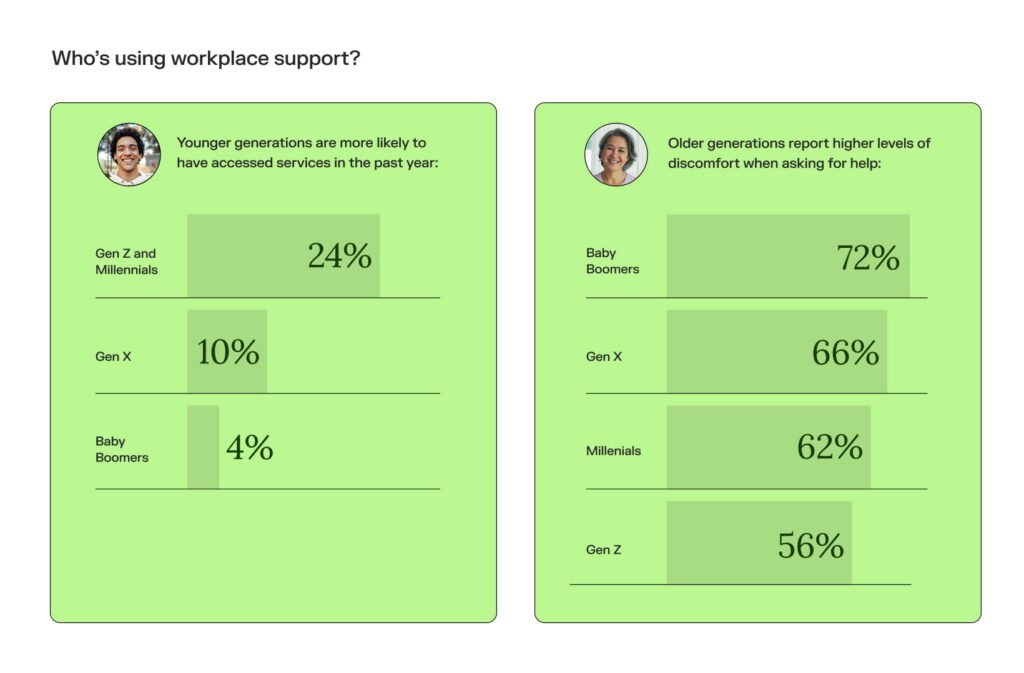
On a positive note, younger employees are more likely to access workplace support services and may feel more comfortable discussing their workplace mental health.
Meanwhile older employees report higher levels of discomfort when asking for help, often shaped by longstanding cultural norms about resilience and self-reliance.
When employee wellbeing investment misses the mark
Understandably, it can be confronting for leaders to see low engagement numbers after significant investment and a genuine intention to offer support.
However, the challenge lies in the fact that many traditional wellbeing initiatives still operate at a surface level. Short-term workshops. Limited-session programs. Annual awareness campaigns. And support framed primarily around crisis response.
Regardless of intention, there is a sense that workplace support offerings feel procedural rather than personal.
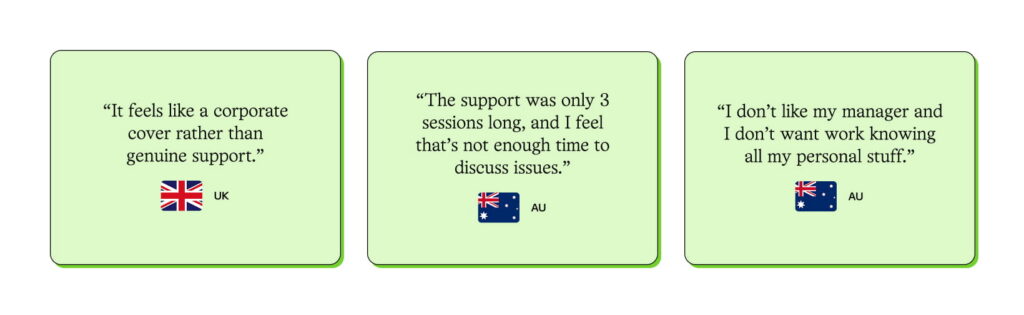
Qualitative feedback within the report revealed such frustrations with respondents describing services that were:
- Difficult to access
- Too limited in scope
- Unclear about confidentiality
- Unlikely to meaningfully address the complexity of their situation
This doesn’t mean that wellbeing programs are ineffective. There is plenty of strong evidence that well-designed, thoughtfully implemented workplace support can improve resilience, productivity, and retention.
The challenge lies in ensuring that support is structured in a way that reflects the realities of everyday life. Like any effective strategy, it should continuously adapt to meet the evolving needs of your workforce.
What employees actually want from workplace support
At its core, the report points to something deeply human. Employees want to feel understood and safe when they reach out for support.
Across survey responses, several themes emerged consistently. Employees value support that is:
| Personal | They seek to speak with someone who empathises with their circumstances and takes their concerns seriously. Generic advice rarely builds confidence. |
| Accessible | Support needs to be easy to access, without complicated processes or limited availability. Flexible delivery across time, location, and format reduces friction and increases the likelihood of engagement. |
| Confidential | Confidentiality cannot be assumed. It needs to be clearly communicated and reinforced. Employees need assurance that their privacy will be protected, without managerial visibility. |
| Comprehensive | Short-term or one-off interventions can feel insufficient when someone is navigating sustained stress. Ongoing, multi-touch support that adapts to evolving challenges fosters deeper trust and better outcomes. |
When these elements are in place, people are more willing to reach out. Support feels accessible and relevant, not something saved for moments of crisis. Crucially, employees are more likely to seek help early, before challenges build and become harder to manage.
This is where modern wellbeing models are heading. As explored in Sonder’s ongoing discussion on the evolving role of EAPs, there is a clear shift toward integrated, preventative care that supports employees in real time, not only when they reach breaking point.
We don't have a traditional EAP in place. Our engagement levels with Sonder have far surpassed anything we had previously. Over 55% of our employees have used Sonder, whereas previously we had less than 5% of our employees using our previous EAP provider.

Head of Diversity, Inclusion u0026 Wellbeing, Hays
Moving from reactive to proactive support
Traditional EAP models have long provided valuable reactive support, particularly for employees navigating acute or crisis situations.
Proactive wellbeing strategies take this further, focusing on reducing stigma, making support easier to access, and normalising care as part of everyday work. They recognise that mental health exists on a continuum, and that early intervention, guidance, and preventative care can reduce the risk of more serious outcomes later.
The report’s findings encourage organisations to reflect on how their wellbeing strategies are structured.
Practical steps may include:
- Clearly reinforcing confidentiality safeguards, boosting employee confidence in the wellbeing offering
- Designing flexible, multi-channel access pathways to suit different communication preferences
- Communicating support in language that resonates across generations
- Embedding wellbeing conversations into leadership practices, normalising seeking support
And in addition, considering:
- Providing integrated care that addresses safety, medical, and mental health needs together
While simply offering a wellbeing program has become table stakes for businesses, organisations that take the next step in integrating a holistic health, safety and wellbeing solution are reaping the rewards. Benefitting from a healthier, happier workforce, they see reduced absenteeism, improved engagement, stronger team cohesion, plus overall organisational performance.
Discover how Best & Less reduced turnover and boosted employee engagement with Sonder.
The cost of business inaction
Workplaces are one of the most consistent communities adults have. For many people, colleagues form a significant part of their daily social interaction and sense of belonging.
When distress goes unaddressed, the impact extends beyond the individual.
It can show up as:
- Increased presenteeism
- Growing absenteeism
- Employee turnover
- Strained team dynamics
Over time, these factors become powerful influences on organisational culture and performance — often forming a subtle undercurrent that can be increasingly difficult to address.
The paradox highlighted in this report reflects the complexity of human nature, workplace trust, and the perceptions shaped by context.
Organisations have already taken important steps by investing in wellbeing. The next step is ensuring that this investment translates into felt support.
For every $1 invested in workplace mental health, organisations see an average return of $2.30 through improved productivity, reduced absenteeism, and lower turnover.
Employee wellbeing: A roadmap forward
Sonder’s 2026 State of Employee Health and Wellbeing Report provides a roadmap for leaders who want to close the gap between awareness and action.
It encourages organisations to look beyond surface metrics and ask deeper questions:
- Do employees trust our support?
- Is it easy to access?
- Does it reflect the realities of their lives?
- Are we meeting people early, not only when challenges escalate?
The measure of a wellbeing program is not simply that it exists. It is whether employees feel supported enough to use it. And whether that support makes a meaningful difference in their lives and in your workplace.
Download a copy of the new wellbeing framework here.
Solutions for organisations seeking external support
Beyond adjusting existing strategies, there are ways to provide additional support that helps employees and managers alike.
Employees face challenges ranging from everyday stress and fatigue to urgent physical or mental health concerns. Managers often find themselves navigating these issues without clear guidance.
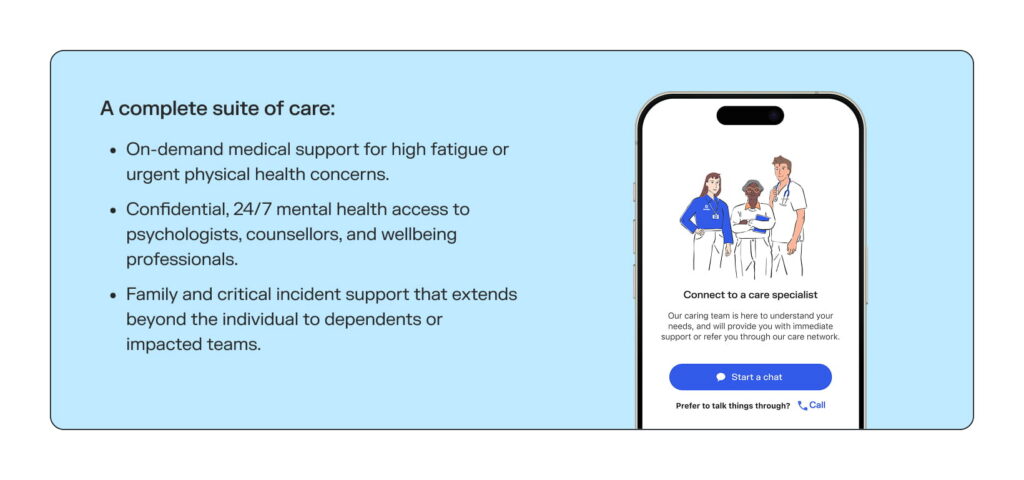
The report highlights the value of support that is accessible, confidential, and responsive. Sonder was created to support exactly this — providing employees with 24/7 access to qualified nurses and counsellors, on-demand mental health and wellbeing support, guidance for managers, and assistance for families or teams affected by critical incidents.
Sonder helps people and organisations build resilience and ensures employees can access support early, without adding extra pressure to managers.
To find out how Sonder can support your team, book a demo here.