
At a glance:
- Financial stress is a business issue, not a private one. It rose from 11% to 13% in Australia in a single year, and people experiencing it are 2.6 times more likely to report high or very high psychological distress.
- It hits performance directly. Money worries erode concentration, increase errors, and drive presenteeism, absenteeism and turnover, all of which reach the bottom line.
- It doesn’t have a single face. Women, single parents, renters, carers and younger workers are most at risk, yet stigma keeps many from speaking up.
- Leaders can change the outcome. Spotting the early signs, opening the conversation with care, and making support visible and easy to access all reduce the impact on your people and your organisation.
Has the latest interest rate rise hit our mortgage repayments yet?
When are this term’s school fees due?
Will we have enough left over to cover that surprise vet visit?
This is the internal monologue of someone navigating financial uncertainty, alongside their day job. An experience many of your team carry with them every day. And while it might seem like a private matter, financial stress isn’t contained to the family home. It can disrupt sleep, amplify anxiety and chip away at the cognitive capacity needed to do good work.
That’s why forward-thinking employers are recognising the need to treat financial wellbeing the same way they treat mental health: as both a human and a business imperative.
This article is for informational purposes only and does not constitute financial advice. If you’re experiencing financial hardship, please speak with a qualified financial counsellor or contact a service such as the National Debt Hotline on 1800 007 007.
The hidden cost of financial stress at work
Struggling to afford everyday expenses, pay bills on time, and navigate debt repayments are common signs of ‘financial stress’. And unfortunately, financial hardship is on the rise in Australia.
According to the Australian Institute of Health and Welfare (AIHW)’s Financial Stress and Mental Health report, overall financial stress in Australia rose from 11% to 13% between 2022 and 2023 alone — the sharpest single-year increase in over a decade, driven by rapid interest rate hikes and sustained cost-of-living pressure.
People experiencing financial stress are 2.6 times more likely to report high or very high psychological distress, and 2.5 times more likely to report poor mental health overall.
Australian Institute of Health and Welfare’s Financial Stress and Mental Health report.
This data reveals an important link: financial stress drives worsening mental health, while poor mental health reduces a person’s ability to manage their finances or seek help. An employee in financial distress isn’t just distracted; they’re caught in a cycle that, without intervention, tends to worsen over time.
For organisations, the hidden cost of financial stress at work increases the likelihood of presenteeism, absenteeism, and talent attrition — all of which have a direct impact on your bottom line.
In dollar terms, presenteeism has been estimated to cost the Australian economy $10.9 billion annually. Some studies suggest that presenteeism costs up to 1.7x an affected employee’s wage.
When someone is under sustained financial stress, the cognitive load can interfere with planning, decision-making and problem-solving. It is not simply a motivation issue. People may have less bandwidth to prioritise, concentrate, regulate emotion and complete complex tasks, which can increase the risk of errors or withdrawal at work.

Clinical psychologist, Sonder
Who’s most at risk? Recognising financial stress in your team
Financial stress doesn’t impact everyone equally. According to the AIHW, a person’s demographic group, employment status, family type and housing status can affect their likelihood of experiencing financial stress.
Here’s what the AIHW data tells us:
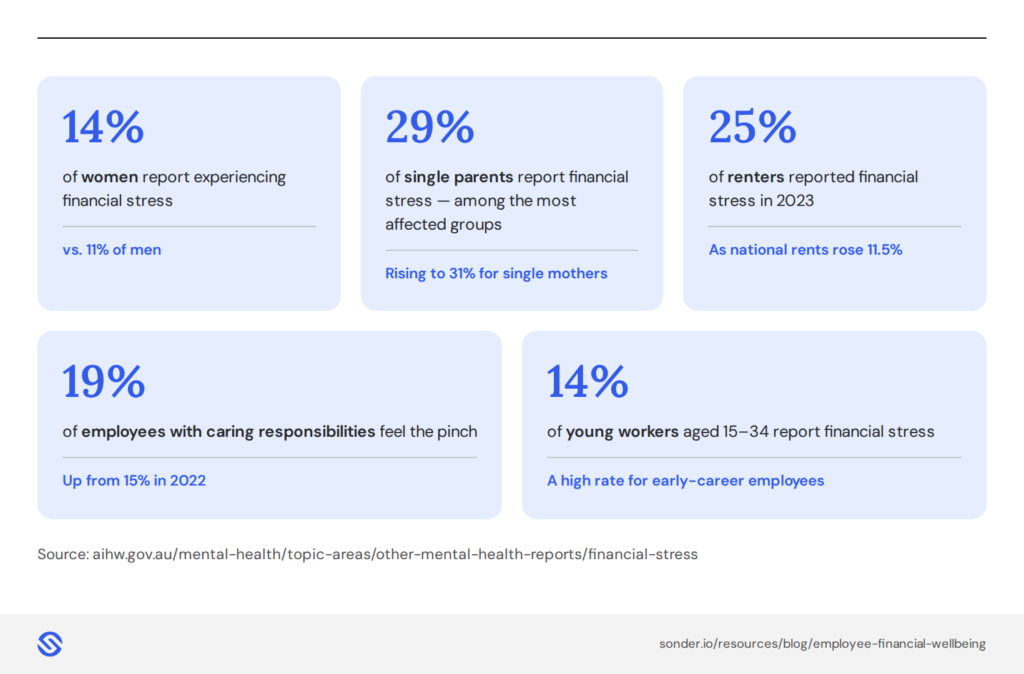
- Women: Consistently report higher levels of financial stress than men: 14% of women experienced financial stress compared to 11% of men.
- Single parents: Are among the most affected: 29% of single parents report experiencing financial stress, rising to 31% among single mothers.
- Renters: Are significantly more vulnerable: 25% of renters reported experiencing financial stress in 2023, coinciding with a steep rise in average rental prices (climbing 11.5% nationally in 2023).
- Employees with caring responsibilities: Are feeling the pinch: Rates of financial stress jumped from 15% in 2022 to 19% in 2023 for those caring for children, elderly parents or family members living with a disability.
- Young workers: Aren’t immune either: Australians aged 15 to 34 are reporting high levels of financial stress (14%).
For leaders, it’s important to recognise that financial stress doesn’t have a single face. It’s the renter who’s just received a significant increase in their renewal notice, the employee sandwiched between childcare costs and ageing parent care, and even the parent quietly calculating how far this week’s groceries will stretch.
With the cost of living continuing to rise and global uncertainty impacting everything from fuel to flight prices, the question for employers is no longer whether financial stress is affecting their people. It’s about what the organisation is proactively doing to prevent and address it.
What leaders can do: A practical guide to support employee’s financial wellbeing
Addressing your employees’ financial wellbeing starts with pinpointing who needs support and having the right tools and resources readily available to step in.
Spot the early signs of financial distress
For many, money is still a taboo topic. That means that financial stress isn’t always visible. Instead, it will likely show up through other issues in the workplace, such as:
- Low concentration: Employees who seem distracted or are taking longer to complete familiar work might be carrying a mental load that has nothing to do with the task at hand.
- Increased errors or mistakes: When someone’s mind is spinning with financial worries, their capacity for careful, complex thinking shrinks. Small mistakes might crop up more often, and work quality may start to slip.
- Withdrawal from team interactions: Someone who has become quieter in meetings, stepped back from social gatherings or seems disengaged might be managing something they don’t feel safe or ready to bring up.
- Increased sick leave: Financial stress has a well-documented impact on sleep, immunity, and physical health. A pattern of short, frequent absences can sometimes signal that an employee is running on empty.
Remember: Employees who are struggling won’t always come forward on their own. The stigma around financial difficulty mirrors what we once saw around mental health: the sense that struggling with money is a personal failure rather than a human experience, especially in a cost-of-living environment that is structurally hard.
Poor financial health can create a downward spiral. 49% of Australians have delayed seeking medical support due to rising out-of-pocket costs and gap payments.
Australian Healthcare Index 2025
Rather than waiting for a person to reach a crisis point, proactive check-ins and keeping an eye out for early warning signs of financial stress can help reduce its impact on the individual and the organisation at large.
Dos and don’ts for difficult conversations
Spotting the signs is the first step. The next, and often harder one, is knowing what to do with that instinct. A direct conversation about money can feel intrusive, and many leaders worry about overstepping. But staying silent carries its own cost.
If you’ve noticed a shift in someone on your team, here’s how to open the door gently, without pressure and without prying.
| ✅ Do | ❌ Don’t |
| Create space without pressure: Start by checking in on general wellbeing before going near the topic of finances. | Ask directly about personal finances, debt, or specific money situations: It can cause the person to shut down entirely. |
| Use normalising language that removes shame from the conversation: “A lot of people are navigating a tough cost-of-living period right now; I just wanted to make sure you know what support is available to you”. | Frame it as a performance management conversation: If someone feels like they’re in trouble at work, they’re far less likely to open up about what’s really going on. |
| Point to available resources: Your EAP, financial wellbeing programs, or platforms like Sonder. | Assume you know what the issue is: Financial stress can look like a dozen different things, and what you’re observing may only be part of the picture. |
| Follow up: One conversation is rarely enough, meaning a brief, low-pressure check-in a week or two later signals that your care is genuine. | Leave it at “let me know if you need anything”: It’s well-intentioned, but it puts the burden back on the person least likely to ask. |
Make support visible and easy to access
Knowing support exists and feeling able to ask for it are two very different things. Most organisations have wellbeing resources in place, but few feel truly accessible to employees.
The problem is activation, not just awareness.
Awareness of workplace wellbeing support sits at 75%, but only 17% have actually used it in the past 12 months.
Sonder’s State of Employee Health and Wellbeing Report 2026
The employees who need support most are often the least likely to go looking for it, particularly when the topic carries stigma, or when someone is already stretched thin and doesn’t have the bandwidth to navigate an unfamiliar system.
This is where leaders can make a genuine difference by changing how visibly and how often those resources are communicated. A few practical ways to do that:
- Put it on the team meeting agenda: Normalise the conversation by referencing available support regularly in team meetings.
- Build into onboarding packs for new starters: Employees who know about support from day one are more likely to use it before they reach a crisis point.
- Regularly share in Slack channels: A timely post during a period of economic pressure (a rate rise, when a cost-of-living news story hits headlines) can reach people at exactly the right moment.
- Talk about your own experience: Leaders who openly reference wellbeing resources, even casually, send a signal that using them is normal and encouraged.
The goal is to make sure that your people know the path to seeking support and feel empowered and encouraged to take action whenever they need it.
How Sonder supports employee financial wellbeing
There’s a common misconception that Sonder doesn’t extend to financial wellbeing. In fact, financial health is an essential pillar of Sonder’s holistic model of care. What happens in someone’s bank account affects what happens in their mind, their body, and their performance at work.
“A holistic approach that considers a person’s cognitive, emotional, social, physical, financial, and spiritual wellbeing at all times is clearly needed.” Dr Jamie Phillips
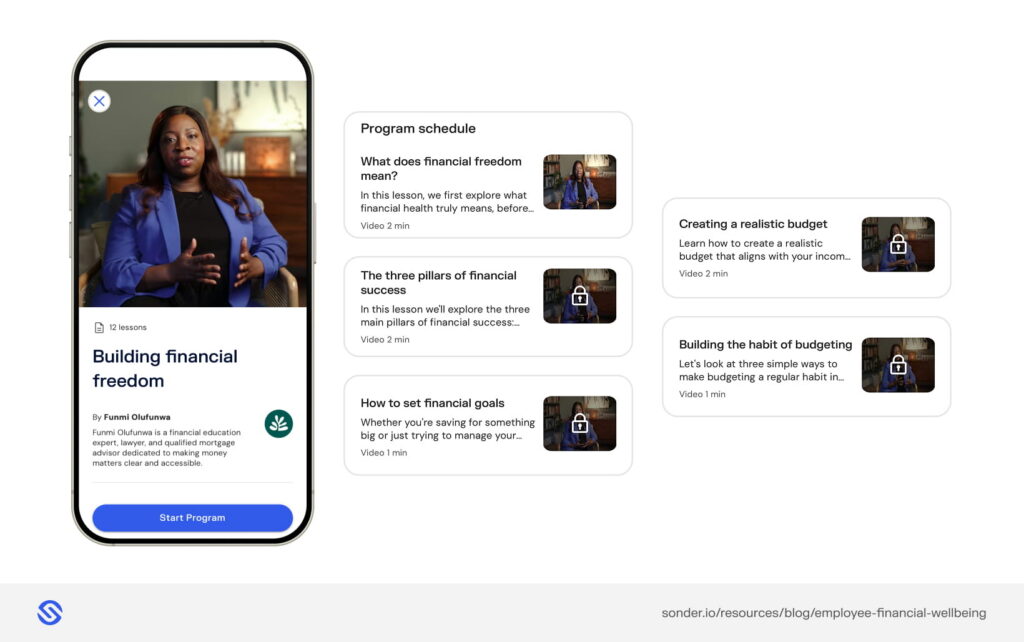
At the heart of Sonder’s financial wellbeing offering is the Building Financial Freedom series, led by qualified financial expert Funmi Olufunwa.
Designed to shift someone’s relationship with money, the video series covers the fundamentals: budgeting, demystifying common financial terms, smarter saving, balancing savings with investing, and building an emergency fund. It’s practical, accessible, and built for people at any point in their financial journey.
For employees who need more immediate support, Sonder provides access to a curated directory of specialist financial support services (including the National Debt Hotline, Mob Strong Debt Help, The Salvation Army’s Moneycare, Moneysmart, and more).
Plus, Sonder’s self-service resource library rounds out the offering, covering everything from cost-of-living pressures and financial hardship to superannuation basics, tax, redundancy, insurance, and scam awareness — resources relevant to employees at every life stage and financial situation.
The difference this kind of accessible, integrated support makes is measurable. While traditional EAP models see just 3-5% employee usage, Sonder averages 30 – 40%.
Over 55% of our employees have used Sonder, whereas previously we had less than 5% using our previous EAP provider.

Head of Wellbeing, Hays
When employees feel more secure in their financial lives, everything else has a stronger foundation: their mental health, their relationships, and even their ability to focus on the work that matters.
Ready to see how Sonder can support your team’s financial wellbeing? Explore Sonder’s resources or book a demo to find out more.
FAQs
Financial stress is the strain of struggling to afford everyday expenses, pay bills on time, or manage debt repayments. In Australia it rose from 11% to 13% between 2022 and 2023, the sharpest single-year increase in over a decade.
People experiencing financial stress are 2.6 times more likely to report high or very high psychological distress. At work this shows up as low concentration, more errors, withdrawal, and increased sick leave, driving presenteeism, absenteeism and turnover.
AIHW data shows women, single parents (29%, rising to 31% for single mothers), renters (25%), employees with caring responsibilities (19%), and workers aged 15 to 34 (14%) report the highest levels.
Spot the early signs, open the conversation without prying, and make support visible and easy to access by building it into meetings, onboarding and regular communications.
Yes. Financial health is a core pillar of Sonder’s model of care, including the Building Financial Freedom series, access to specialist financial services, and a self-service resource library.