Opens in a new tab
Take product tourMembersSearch
-
-
-
The Sonder App

At a glance

Here’s how the two models compare on the things buyers ask about most.

Traditional EAP compared with Sonder
DimensionTraditional EAPSonder
Scope of care Mental health support and counselling, often with legal and financial advice referrals. Mental health, medical advice and personal safety support in one platform.
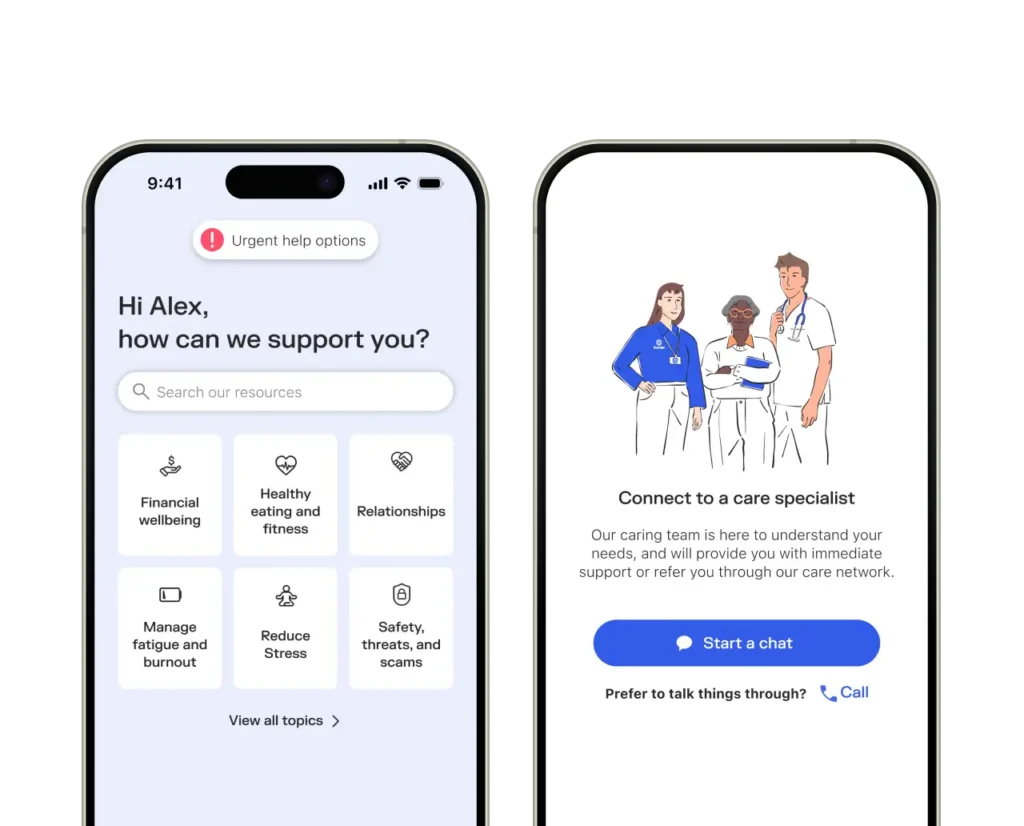
How people access it A phone line, with web or video options from some providers. Some providers will require an employee to reach out to their HR team for a referral. App-first with QR code onboarding — no work email or HR referral needed. Phone support is also available.
Response time A call is answered, then an appointment is booked — often days later. A Care Specialist responds in seconds, any time of day or night.
Hours Counselling lines are often available 24/7, but appointments mostly run in business hours. Support runs 24/7 — 58% of Sonder support cases between June 2025 and June 2026 happened outside business hours.
Engagement Around 5% average utilisation in Australia. Around 40% of members engage with Sonder.
Approach Most respond once an issue is raised. Early intervention, with ongoing support and follow-up.
Accreditation Varies by provider; industry association membership is voluntary. Accredited by the Australian Council on Healthcare Standards (ACHS), held to the same standards as hospitals — with care delivered by clinicians registered with national medical and psychology bodies across Australia, the UK and New Zealand.
Employer reporting Periodic usage reports. Real-time dashboards with de-identified wellbeing and risk trends.
Medical care Not usually part of an EAP offering. 24/7 advice from registered nurses, plus help navigating to the right care.
Personal safety Not usually part of an EAP. Personal safety tools include Check on Me and Track My Journey. Members can also seek urgent help in the app.
Safety alerts Not usually part of an EAP. Real-time alerts on local incidents, extreme weather and travel disruptions from Sonder’s intelligence team.
Follow-up Employee-initiated — the employee books each session, and follow-up bookings continue with the same counsellor. Follow-up is built in — triage shapes the care for each issue, and Sonder checks back in rather than waiting for the person to return.
Critical incidents Most providers offer critical incident counselling, often on site. A critical incident management team, on-site trauma support, and a 24/7 Support Centre that can send a responder to a member’s location.
Family access Many providers extend counselling to immediate family members. Family access to Sonder’s full support — mental health, medical and safety — is available on certain plans.
Workplace injuries Outside an EAP’s scope. 24/7 early-intervention support for workplace injuries.

When a traditional EAP is the right choice

  • You only need short-term counselling and critical incident response.
  • Your people mostly work set hours at a desk, and can get to appointments in business hours.
  • An EAP rounds out support you already provide, for example in-house wellbeing programs, occupational health or safety systems.
  • You want the lowest per-employee cost for counselling coverage.

When Sonder is the better fit

  • You want one front door for mental health, medical questions and personal safety — before, during and after your people need it.
  • Your people work shifts, travel, work alone, or don’t have a desk or a work email.
  • Help is needed at 11pm as often as 11am.
  • You need data to show how you’re managing psychosocial risk.
  • You measure value by how many people actually access support.

How the two models differ

Scope: Counselling only vs mental health, medical and safety

A traditional EAP centres on counselling. Sonder covers mental health, medical and safety needs in one place. This approach allows members with multifaceted issues to get a better outcome. A sleepless employee might need a counsellor — or a nurse, or somewhere safe to raise a concern about a colleague, or perhaps a combination of care. With one front door, people don’t have to self-diagnose their own problem before asking for help, and by looking at a case holistically, Sonder can get to the heart of the issue.

Access: A phone line vs an app with a Care Specialist on the other end

A traditional EAP starts with a phone call. Sonder starts with an app and gives the user the option of seeking help via instant chat or phone call. Either way, there is a real person on the other end. Anyone without a smartphone can reach the same support, any time of day.

Response: Booking an appointment vs a reply in seconds

A traditional EAP answers the call, then books an appointment — often days later. Sonder replies in seconds. From there, Sonder’s triage process matches the person to the right support, and urgent cases are escalated immediately. For someone reaching out at 2am, the difference between a reply now and an appointment next Tuesday can be the difference between getting help and giving up.

Engagement: Why most EAPs go unused

Around 5% of employees use a traditional EAP in Australia, while around 40% of members engage with Sonder. The gap isn’t about the quality of counselling. It’s awareness (people forget the EAP exists), stigma (calling a counselling line feels like a big step and people worry their workplace will know), and friction (finding the number, calling in work hours, waiting). An app people already know and trust, covering everyday health questions as well as hard moments, gets used.

Approach: Responding to a crisis vs early intervention

A traditional EAP responds once something has gone wrong. Sonder detects issues early, identifies emerging risks, and works to prevent them becoming crises. A health question answered today doesn’t become unplanned leave next month. For employers, that early-intervention model is also how psychosocial risk gets managed proactively rather than reported retrospectively.

Reporting: Periodic usage reports vs real-time trends

A traditional EAP sends periodic usage reports. Sonder shows real-time, de-identified trends. Employers see patterns — which teams are under pressure, what kinds of support people are seeking, how usage shifts after an incident — but never individuals. No names, no case details, and group data only appears above a minimum threshold.

Pricing: Pay-per-use vs one fixed fee

A traditional EAP is often priced per employee or per use; Sonder plans are built around your needs, most based on a predictable annual fee. With per-use pricing, higher engagement means a higher bill — so the program’s success works against its budget. Sonder’s model flips that: from focused mental health support to comprehensive medical, mental health and safety care, pricing is agreed up front. The more your people use it, the more value you get from the same spend.

How the Sonder platform works

By focusing on early intervention, Sonder helps employers reduce absenteeism, minimise long-term claims, and increase productivity by addressing issues before they reach a crisis point.
Watch the video

What changes when you switch

Many organisations will stay with an underperforming EAP provider because they worry about the change management of launching a new service. But there is a way to move on from an existing EAP without creating gaps in care and minimising friction.

  1. 1Before go-live

    No gaps in care, even mid-treatment

    A short overlap between providers lets anyone already in counselling finish their sessions with their current counsellor while everyone else moves across.

    Before go-live, we also collect your critical incident contacts and set up your reporting portal, so there’s never any doubt about who responds.

  2. 2Launch

    A switch is a chance to relaunch support

    Reintroducing support to your whole workforce often does more to lift uptake than the change of provider alone.

    Every customer gets the Sonder Marketing Toolkit, which includes launch resources, email templates, videos, QR codes and promotional assets that can be co-branded.

    It helps your people understand everything Sonder covers, from mental health to medical and safety support.

  3. 3After launch

    Launch is the start, not the end

    With Premium Onboarding, you get:

    • A dedicated Onboarding Manager
    • Product and communications workshops
    • Enablement sessions for members, leaders and People and Culture teams
    • Regular check-ins through launch and activation

    After launch, your Customer Insights Partner provides ongoing communications support and champion training to keep uptake building.

An educator sits with a group of young children in a bright classroom, everyone raising their hands
Gowrie NSWNot-for-profit early and middle childhood education provider
Case study

Gowrie NSW: from safety net to everyday support

Gowrie NSW, a not-for-profit early and middle childhood education provider, switched from a traditional EAP that staff only thought of in a crisis. They launched Sonder with site champions, a manager toolkit, and monthly wellbeing themes instead of a one-off announcement.

You don’t have to be in a crisis to seek support. We wanted something that meets people where they are, and helps them make a small change in direction before things escalate.

Sam CordobaHead of People and Culture, Gowrie NSW
Read the full Gowrie NSW story →
The result

After switching from a traditional EAP to Sonder

62% utilisation, against a traditional EAP benchmark of around 5%

Half of all support requests come in after hours

80% of requests start in the in-app chat

Frequently Asked Questions

How we compared

This comparison draws on Sonder service and member data for 2026, and publicly available information about the traditional EAP category, last checked on 19/10/26. Claims about traditional EAPs are based on independent and government research where available, with vendor material labelled as such. Spot something out of date? Let us know at marketing@sonder.io and we’ll correct it.

Ready to get started?

See the difference for yourself

Download the report