At a glance:
- The scale of the problem: Men make up 93% of work-related fatalities in Australia, are 22.3% more likely to make a serious workers’ compensation claim, and two-thirds who are struggling don’t feel confident asking for help.
- Why awareness months matter: Events like Men’s Health Month and Tradies National Health Month give teams and managers a natural, low-barrier opportunity to start conversations and reduce the stigma that stops men from seeking support.
- Beyond the box-tick: Surface-level initiatives can actively damage trust and psychological safety. Lasting impact requires systemic change, not one-off gestures like yoga sessions or morning teas.
- What real support looks like: Empowering managers to spot early warning signs, building psychological safety into everyday check-ins, and providing always-on access to care are the foundations of a genuinely supportive workplace.
June marks an important reminder for Australian workplaces. Men’s Mental Health Month (anchored by Men’s Health Week, running from June 15 – 21 2026), is a timely opportunity to prioritise the health and wellbeing of your male workforce. And for construction and trade- heavy teams, Tradies National Health Month in August offers another opportunity to do the same.
Free download: Plan for every awareness date with Sonder’s 2026 employee health and wellbeing calendar
The need has never been more pressing. According to SafeWork Australia, the vast majority of workers killed in work-related activities are men (93%). Plus, men are 22.3% more likely to make a serious workers’ compensation claim than women, and claim higher levels of compensation.
Professions dominated by men (such as construction workers and tradies) face even greater health and wellbeing risks. Data from the recent Tradies National Health Survey found that over 90% of tradies experienced work-related injuries or pain over the past 12 months, with the vast majority (90%) caused or worsened by work.
Beyond physical injuries, research reveals that two-thirds of men are struggling or in crisis don’t feel confident or empowered to ask for help.
Construction, an industry dominated by men, is one of the highest-risk industries in Australia. SafeWork Australia reveals an average of 29 workers lose their lives due to workplace incidents each year. Source: Australian Institute of Health and Safety.
But raising awareness isn’t enough. The real opportunity, and responsibility, for businesses lies in using these moments as a springboard for lasting impact. Not a one-off morning tea or a corporate LinkedIn post, but a meaningful cultural shift that makes checking in, speaking up and looking out for yourself just another part of the job.
Why businesses should take action during awareness months
Timely moments, such as Men’s Health Month, shine a much-needed spotlight on issues that many employees are quietly navigating in private.
Stigma still stops many men from speaking up or seeking help when they’re struggling. Often, the signs of poor health are hiding in everyday interactions (avoiding coffee runs, a sharp rise in sick days, and no longer contributing in team meetings). Health awareness campaigns give teams and managers permission to reach out, ask for help, or start a conversation that could save a life.
As a business, prioritising the health and wellbeing of your people is no longer a “nice to have”. It’s an essential part of tackling higher rates of absenteeism and presenteeism, reduced productivity, and retention challenges — all of which are on the rise.
Why businesses need to prioritise the health and wellbeing of their people:
- Legal and compliance obligations: Under Work Health and Safety (WHS) legislation, employers are legally obligated to manage physical and psychosocial hazards at work (including proactively addressing risks such as job demands, role clarity, and harmful behaviour). Non-compliance can lead to a range of penalties, including fines, legal action and reputational risks.
- Employee engagement and retention: Globally, the World Health Organisation (WHO) estimates that 12 billion working days are lost every year due to mental health challenges such as depression and anxiety. Closer to home, research from the University of Melbourne has found that absence rates are roughly 5% higher among workers who report being in poor mental health.
- Financial consequences: Along with a decline in productivity levels, failing to address employees’ health and wellbeing can lead to a rise in compensation claims. Psychological injury claims now make up 12% of all workers’ compensation claims, but account for 38% of costs, and the average claim has nearly doubled in the past five years.
Untreated psychological problems are estimated to cost Australian organisations $10.9 billion each year through absenteeism, presenteeism and workers’ compensation claims. Source: Safe Work Australia.
The risk of performative gestures
But raising awareness and starting conversations is only the first step. In fact, empty promises and surface-level initiatives can damage trust and even increase psychological harm.
If a company’s participation in awareness campaigns feels forced, performative or inauthentic, it can heighten stigma and decrease psychological safety. Wellbeing talks, printed handouts, and mindfulness exercises are only effective if they’re supported by ongoing, systemic shifts in how an organisation operates, too.
For example, running a one-off yoga session or meditation class while still expecting staff to work 60+ hour weeks and hit unattainable deadlines actually perpetuates an unsupportive culture in which unrealistic expectations and unmanageable workloads go unchecked.
As a leader, it’s your responsibility to ensure your organisation is moving beyond box-ticking initiatives and prioritising meaningful, systemic change that boosts the health and wellbeing of your entire workforce. Here’s what that could look like in action.
| Performative initiative | Genuine fix |
| Providing superficial wellbeing ‘perks’ (like free fruit and pizza Fridays) that don’t tackle the root cause of unrealistic workloads | Introducing flexible working hours, manageable performance metrics and clear boundaries on email response times |
| Managers preaching about work-life balance while failing to manage their own boundaries | Leaders walking the talk (disconnecting on weekends, taking annual leave etc.) |
| Tracking vanity metrics (e.g. meditation class attendance), rather than assessing whether employee stress has actually reduced | Monitoring meaningful indicators of improved employee health and wellbeing (such as a drop in turnover and absenteeism) |
Practical strategies to support men’s health and wellbeing in the workplace
In this masterclass, Graeme Cowan — author of Back from the Brink, Founding Board Director of R U OK? and host of The Caring CEO podcast — joins Sonder social worker Brandon Freeme to unpack the hidden ways mental health shows up in men, and share the practical strategies leaders can use to drive real, lasting change.
From one-off gestures to year-round support
Awareness months are a helpful catalyst for ongoing cultural change. If your organisation is ready to move beyond standalone events, here are three practical ways you can create year-round engagement and meaningfully foster healthy, engaged teams.
Empower managers to spot early warning signs
Managers have a crucial role to play in building more productive, engaged and resilient teams. In fact, they’re often the first people in an organisation to spot when something’s off, even before a team member might be ready to reach out.
Sonder’s research reveals that only 50% of managers agree their employer has provided sufficient support and training to effectively support their team’s wellbeing.
So, what early signs should leaders be looking for? Withdrawing from the team, a rise in absences, losing interest in work they used to care about, and changes in mood and behaviour. These can all be early indicators. A low-pressure check-in during a 1:1 meeting can be the nudge an employee needs to seek support before things escalate.
Learn more: You don’t need to be a counsellor to support a colleague. What matters most is listening without judgment and being fully present. Learn how to have a productive conversation and what to say when a colleague says they’re not OK in Sonder’s guide.
Create psychological safety in everyday moments
Speaking of check-ins, psychological safety in meetings doesn’t happen by accident. It’s built through consistent, everyday interactions that give employees the confidence to open up when things aren’t going well.
Encourage managers to make wellbeing a regular part of 1:1s with their direct reports (rather than waiting for formal reviews or crisis moments). Start by normalising the question: “How are you actually going?” Particularly for male-dominated industries, conversation starters like this can be the invitation men need to speak up.
Learn more: Download Sonder’s 1:1 template pack which balances performance and wellbeing.
Remove barriers to accessing support
Asking for help is just the first step. For many, practical barriers like cost, availability of care, stigma, and even not knowing where to start, can stop them from accessing the support they need.
One of the most effective ways to reduce these roadblocks is by making care available 24/7 through a health and wellbeing platform. Sonder provides immediate personal safety, medical, and mental health support through a practical mobile app — removing the need for awkward HR conversations or navigating GP waitlists.
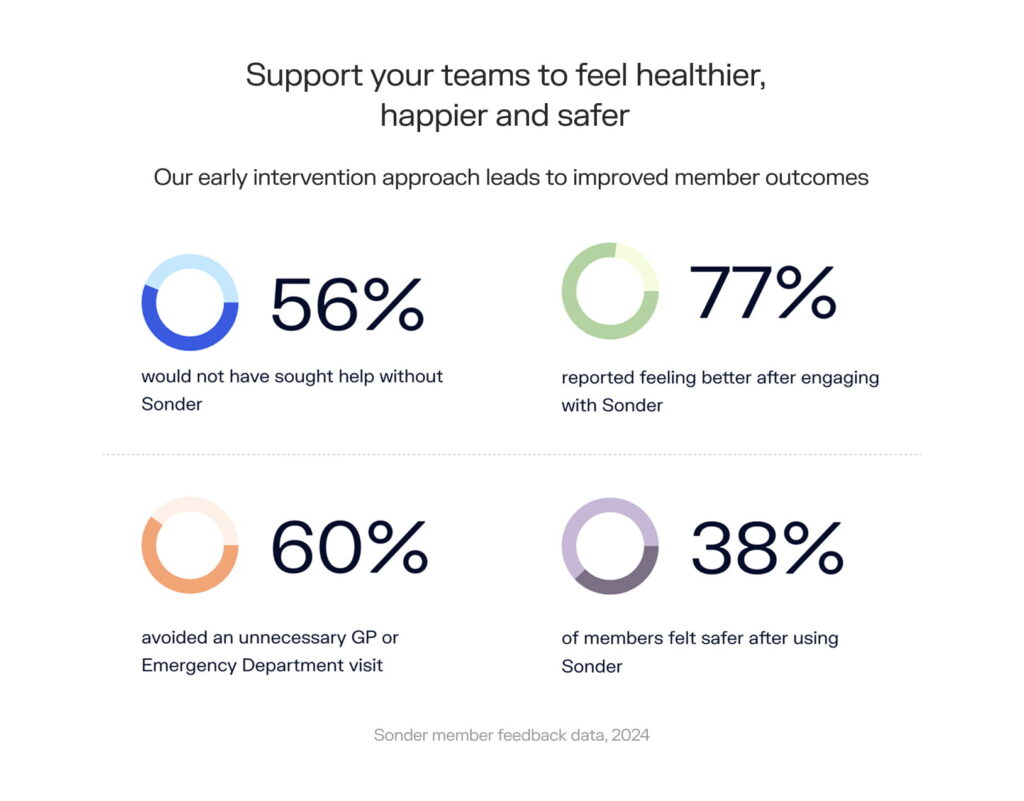
This approach meets employees where they’re at, covering the full spectrum of care from self-help wellbeing resources to the ability to call or chat with trained healthcare professionals 24/7 (with an average response time of just 10 seconds).
Proactive wellbeing culture in action: The Built story
Built is a major player in the construction sector, an industry where mental health stigma and a dispersed workforce can make it challenging to deliver wellbeing support.
After recognising that a traditional EAP model wouldn’t be sufficient, Built partnered with Sonder. They now provide teams and their families with 24/7 access to mental health support, medical advice, and safety alerts through Sonder’s single, confidential app.
The rollout of Sonder was proactive, led by Built’s Head of Health and Wellbeing, Haydn Masters. Running a national roadshow across project sites allowed him to connect directly with employees and managers, normalising the idea of seeking support.
People want to get help, but they don't want any bias or judgment. That was the lacking component.

Head of Health and Wellbeing at Built
The impact was significant. Within three months, one in three employees had activated a Sonder account. Today, 38% of the workforce are actively using Sonder and over half of all support interactions happen outside of business hours — proving the value of always-on care in an industry that never really clocks off.
Read more: Discover Built’s full success story here.
Ready to achieve similar engagement?
Move beyond awareness days and reactive EAPs that fail to engage your teams. If your organisation requires both practical support for workers and year-round reassurance for managers, Sonder is ready to help.
Discover how our holistic, 24/7 care model:
- Reduces stigma and drives high support utilisation.
- Turns your safety commitment into tangible wellbeing outcomes.
- Aligns perfectly with the realities of demanding, onsite work.