At a glance:
- Psychosocial safety is now a legally enforceable duty across all of Australia: With Victoria’s regulations coming online in December 2025, every state now requires employers to identify and control psychosocial hazards, and 2026 marks the start of a “full accountability era” where regulators expect evidence, not intent.
- The cost of getting it wrong is severe and personal: Psychological injury claims average around $300,000 and take five times longer to resolve than physical injury claims, businesses can’t insure against WHS breaches, and individual directors and executives can be personally fined.
- Managers are both the biggest risk and the strongest control point: structurally overloaded and expected to be coaches, compliance officers and mental health first responders all at once, managers shape psychosocial risk through everyday behaviours like role clarity, organisational justice and psychological safety.
- Evidence of oversight is now the bar, not policy documents: boards and executives need to document hazard identification, test whether controls actually work, and consult the workforce, while equipping managers with the practical skills that reduce risk at scale.
Psychosocial safety is no longer just an HR or People & Culture conversation. It’s now a boardroom issue, and in the wake of new legislation, growing claim costs and increased regulatory scrutiny, there are hard legal and financial consequences for organisations that get it wrong.
Under Australia’s WHS psychosocial regulations, every employer now has a legally enforceable duty to identify and control psychosocial hazards. Yet a significant gap exists between what leaders believe to be true about psychological safety and what employees actually experience. According to Sonder’s Safety Gap Report 2025, senior leaders rank every aspect of psychological safety at 80% or above — but for middle managers and below, rankings fall as low as 65%.
That gap represents both a risk and an opportunity. With the right support and frameworks in place, organisations can step up, at both a strategic board level and an operational manager level, to create psychologically safe workplaces.
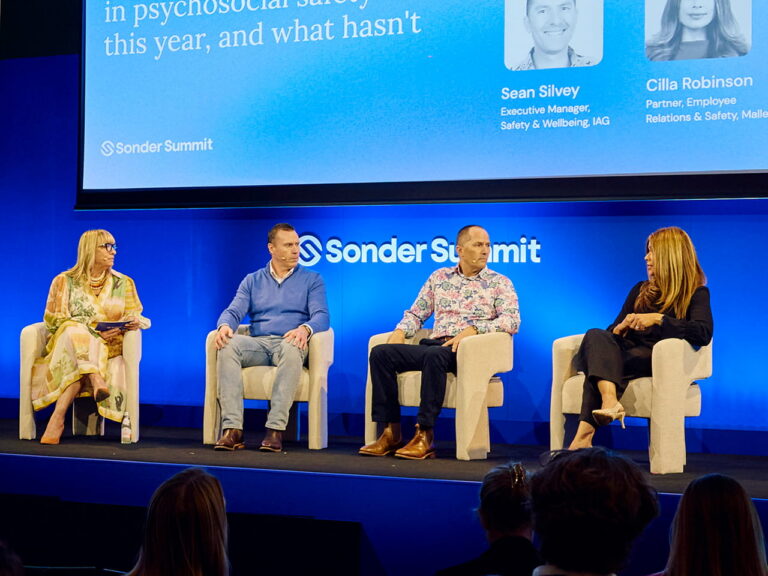
To explore what’s changed — and what’s now required — Sonder brought together two of Australia’s leading voices on psychosocial safety: Kristen Raison and Sam Young, co-founders of human performance consultancy Humn, who work with organisations to translate psychosocial risk into practical action.
Watch the full recordings below or read on for the highlights.
Meet the Psychosocial safety experts
Co-founder and CEO of Humn, Kristen brings nearly three decades of experience across finance, boardrooms and senior leadership, backed by formal training in HR and commerce. She’s a company director and has led teams through complexity firsthand, giving her both technical expertise and lived experience. She now helps organisations build safer, more compliant workplaces by reducing psychosocial risk and staying ahead of regulatory requirements.
Co-founder of Humn and registered clinical psychologist, Sam has spent decades helping leaders navigate the complexities of people, performance and change. Known for making the complex feel refreshingly human, she’s a thought leader in leadership, wellbeing and psychologically safe workplaces. Sam’s on a mission to help organisations stop guessing and start building cultures where people genuinely thrive — not just survive.
The regulatory shift every executive needs to understand
Most executives are familiar with the term psychological safety. Fewer understand psychosocial safety, and the difference matters:
- Psychological safety: How people feel and whether they’re comfortable speaking up, taking risks and admitting mistakes without fear.
- Psychosocial safety: The systems and organisational factors that produce those feelings, such as work design, management practices and workplace conditions that either protect or expose employees to harm (known as psychosocial hazards).
Importantly, psychosocial safety is a legally mandated obligation for organisations in Australia.
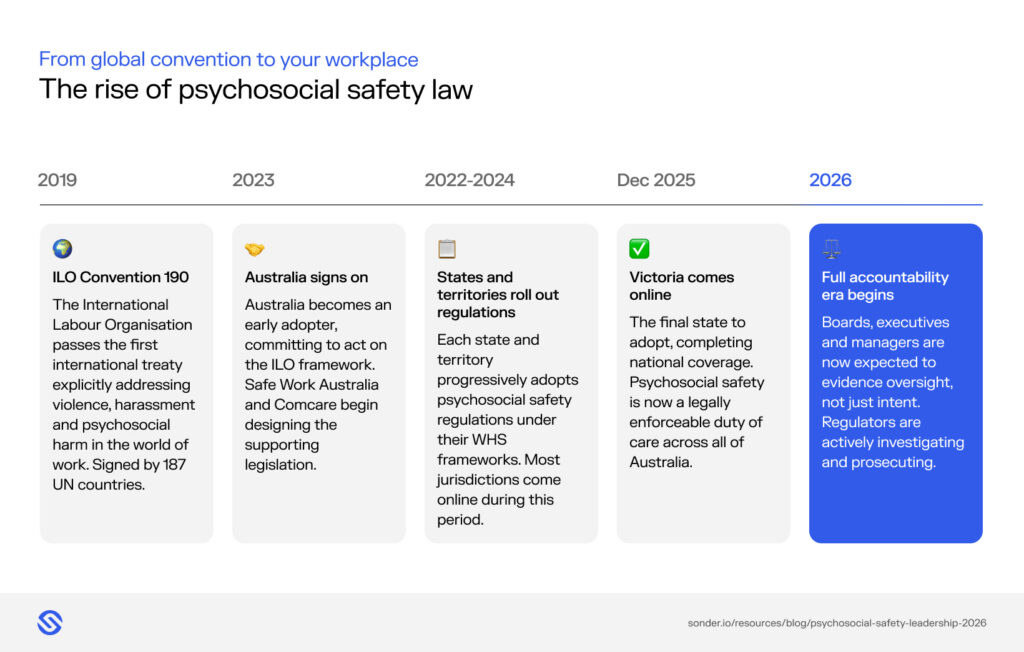
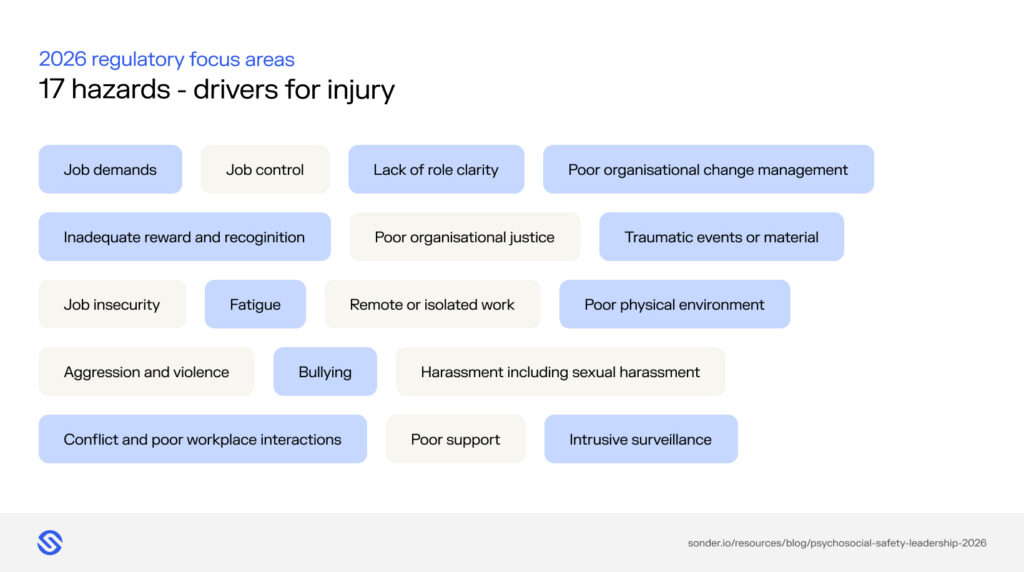
Under Work Health and Safety (WHS) legislation, businesses are now required to identify and manage 17 psychosocial hazards in Australia, from role ambiguity and high job demands to poor support and traumatic events. Effective psychosocial risk management means the standard has shifted from “did you have a policy?” to “did you take reasonably practicable steps to control the risk?”
What makes this moment different, Kristen argues, is the pace at which the regulatory environment has hardened.
Mental health claims have risen 97% over the past decade, according to SafeWork Australia, and just from 2021-22 to 2023-24, claims grew a further 19%. Plus, the “reasonably practicable” shift means businesses need to proactively anticipate harm, rather than waiting to respond to claims and incidents.
The numbers prove that this is no longer a people problem. It’s a business one.
“Inaction, delay, or reliance on wellbeing programs alone is no longer defensible with a regulator.”
Kristen Raison
The business case: Why this sits on the risk register, not the wellbeing agenda
The risks and costs of poor psychosocial safety are proving too significant to ignore. Not only are psychological injury claims on the rise, but they’re also some of the most complex and costly to resolve.
The average physical injury claim costs around $60,000. In contrast, the average psychological injury claim runs closer to $300,000, and takes five times longer to resolve.
On average, 88% of workers who experience physical injuries return to work within 13 weeks, whereas 40% of workers with psychological injuries have not returned to work within a year.
Workers Compensation Ministerial Statement
The volume of psychological injury claims in Australia has surged — and unlike physical injury claims, businesses cannot insure against WHS breaches. When a claim is upheld, it hits the bottom line directly. Individual leaders and directors can even be personally fined, and their employer cannot pay on their behalf.
With SafeWork Australia putting psychosocial risk under the microscope and actively prosecuting organisations nationwide, both Kristen and Sam make it clear: executives can no longer bury their heads in the sand.
The Vision Australia case: What a $1.4 million breach actually looks like
A Vision Australia employee was placed on a performance management process and ultimately terminated. They lodged an unfair dismissal claim and were awarded approximately $27,000.
But they didn’t stop there. The employee then filed a separate claim alleging that the performance management process itself had caused them psychological harm, and that Vision Australia had failed to follow their own HR policies and procedures throughout.
The court found in the employee’s favour. Vision Australia was ordered to pay an additional $1.4 million.
The key takeaway? It wasn’t a dramatic incident or a toxic workplace. It was a relatively routine HR process, handled incorrectly. The organisation had policies in place, they just didn’t follow them.
“The question is no longer can we afford to invest in psychosocial safety. It’s ‘can we afford not to?’”
Kristen Raison
Where managers fit in, and why they’re the biggest control point
Managers are at the frontline of psychosocial safety, sitting at the intersection of work design, leadership behaviour and systems function. Sam argues that in most organisations they are simultaneously the biggest psychosocial risk factor – and the most powerful control point.
The catch is that manager roles are structurally overloaded. Today, managers are expected to be operational leaders, performance coaches, mental health first responders and even compliance officers — often with less authority than any of those roles actually requires, and more accountability than most were ever hired for.
Layer on top of that the invisible pressures: global or hybrid teams, a near-constant pace of organisational change, emotional labour they were never trained for, and systems that frequently contradict each other. The complexity has exploded, and the support hasn’t kept pace.
“Most psychosocial harm at work is not caused by bad people. It’s caused by well-meaning managers operating inside unclear, pressured systems.”
Sam Young
Read more: Keep learning with Sonder’s guide to building more resilient teams, created specifically to support and empower managers. Download now.
Three manager behaviours that can create (or reduce) psychosocial risk
Effective psychosocial risk management doesn’t always require sweeping structural change. Often it’s shaped by the small, daily behaviours of your leaders. Sam identified three manager behaviours that consistently show up as either protective factors or risk drivers in workplace settings.
1. Role clarity
Poor role clarity and ambiguity can be more harmful than the volume of work. Unclear expectations are one of the strongest predictors of workplace stress; not workload alone, but not knowing what success looks like or which priorities actually matter.
Sam recommends a simple check-in practice for managers: use your one-on-ones to ask two questions. What are our top three priorities right now? Do you know what success looks like in your role? The answers will tell you more than any engagement survey.
Free download: Download Sonder’s ultimate 1:1 template pack for performance and wellbeing here.
2. Organisational justice
Decisions don’t need to be loved, but they need to be understood. When decisions feel opaque, inconsistent, or handed down without context, the result isn’t just frustration. It’s disengagement, eroded trust, and a team that stops believing their input matters.
Managers who share the reasoning behind decisions (the constraints, the trade-offs, the alternatives considered) build the kind of trust that buffers teams through difficult change. Learn more about how fairness and organisational justice influence morale, burnout and retention.
3. Psychological safety
Psychological safety is not the same as comfort, and it isn’t about being nice. It’s about whether people feel safe enough to raise problems, admit mistakes, and disagree without fear of punishment.
When a workplace is psychologically unsafe, people use silence to hide problems. And silence is not a green flag. It’s an early warning sign.
Good intentions don’t remove the duty of care. Systems that support managers reduce risk at scale, and that’s what we need to be investing in.”
Sam Young
Psychosocial risk management in action
Knowing the risks is one thing. Acting on them is another.
Here’s what meaningful action looks like at each level of an organisation:
- For executives and boards: Document your psychosocial hazard identification process, consult your workforce, test your controls, and integrate psychosocial risk management into your governance frameworks. Not as a compliance exercise, but as ongoing oversight. WHS psychosocial regulations now require evidence of action, not just policy. Regulators want to see more than good intentions; they’re looking for demonstrated, ongoing steps. You can find Sonder’s tools and templates to kickstart your process here.
- For managers: The micro-skills matter more than most realise, things like setting clear expectations, being transparent about decisions, normalising uncertainty, signposting support early, modelling boundaries, and making invisible work visible.
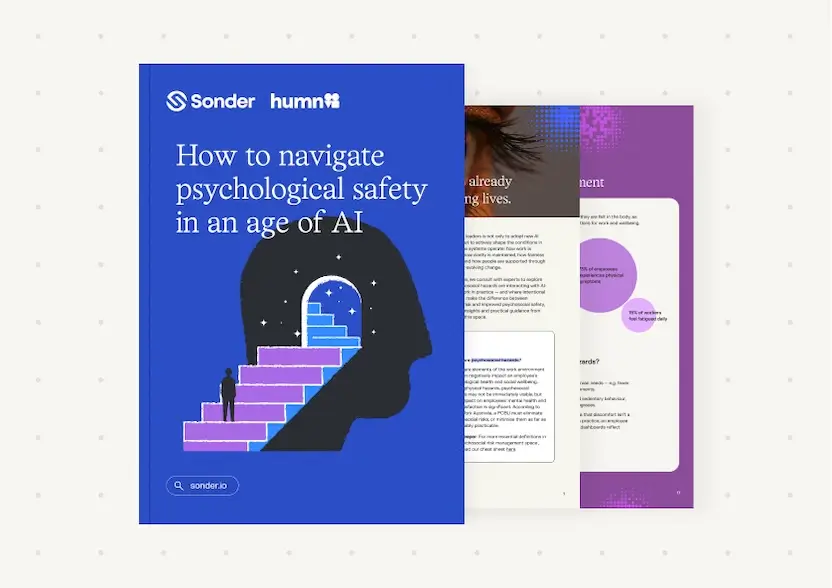
How to navigate psychological safety in an age of AI
As AI integration becomes ubiquitous, organisations face a new frontier of workplace risk. With advice from a psychosocial expert and work futurist, this new resource shares guidance on how to navigate the new risks and potential rewards when it comes to psychological safety.
The guide maps six key psychosocial hazard areas to the specific risks and opportunities created by AI, including:
- How AI is reshaping job demands and what leaders should watch for
- Why role clarity and support are harder to maintain in AI-enabled environments
- The hidden isolation risk of tool-first ways of working
- How to manage fairness and trust when AI shapes decisions
- Best practice case studies from MYOB and Culture Amp
- Expert guidance from Ingrid Jenkins, Kristen Raison, and Dominic Price
How Sonder helps lower your risk profile
Sonder is built to support both psychosocial safety and employee wellbeing. With access to mental health, medical and safety support, Sonder functions as critical infrastructure to lower your risk profile:
- It empowers your managers, alleviating the specific pressure on them and reducing the risk over-stretched leaders can pose.
- It provides a 24/7 safety net that catches people when primary and secondary controls aren’t enough.
Book a demo to see how Sonder supports psychosocial safety at every level of your organisation.
Psychosocial hazards FAQs
Safe Work Australia’s model Code of Practice identifies 14 core psychosocial hazards that employers must identify and manage: high or low job demands, low job control, poor support, lack of role clarity, poor organisational change management, inadequate reward and recognition, poor organisational justice, traumatic events or material, remote or isolated work, poor physical environment, violence and aggression, bullying, harassment (including sexual harassment), and conflict or poor workplace relationships and interactions.
Comcare’s code, which applies to Commonwealth-covered workplaces, adds three more: fatigue, job insecurity, and intrusive surveillance, bringing the total to 17. Organisations are required to take reasonably practicable steps to control each of these, not simply acknowledge they exist.
These terms are often used interchangeably, but they refer to different things. Psychological safety describes how an individual feels at work — specifically, whether they feel safe enough to speak up, take risks and admit mistakes without fear of punishment. Psychosocial safety refers to the organisational systems, structures and management practices that create (or undermine) those feelings. In practical terms: psychological safety is the outcome, psychosocial safety is the system that produces it. Under Australian WHS law, it’s the latter that organisations are legally obligated to manage.
Yes. Under WHS legislation, personal liability can extend beyond the organisation to individual officers, executives and managers. If a regulator finds that a person in a position of responsibility failed to exercise due diligence — for example, by ignoring known psychosocial risks or failing to act on complaints — they can be personally fined. Critically, their employer cannot pay the fine on their behalf. This is one of the most significant shifts in the regulatory landscape and a key reason psychosocial safety has moved from the HR agenda to the boardroom.