At a glance:
- Vicarious trauma is a recognised psychosocial hazard: It can affect anyone repeatedly exposed to other people’s distress — not just frontline workers.
- The body responds to indirect trauma the same way it does to direct threat: Through automatic nervous system reactions, not conscious choices.
- Effective support isn’t about absorbing everything: Boundaries, regulated interactions, and knowing when to refer someone on are skills, not failures of care.
- Looking after yourself is part of supporting others: Sustainable support starts with recognising your own limits.
Supporting others through distress is part of many roles — whether you’re leading a team exposed to distressing content, managing customer aggression, or simply showing up for the people around you.
But here’s what often goes unacknowledged, support comes at a cost. Exposure to someone else’s trauma — whether you witness it, hear about it, or help someone through it — can affect you too. So much so that Safe Work Australia recognises it as a psychosocial hazard.
When empathy drives over-involvement, even the most well-intentioned support becomes unsustainable. Recognising your limits isn’t a failure of care — it’s what makes care possible long-term.
This psychologist-led masterclass with Rachel Tomlinson from My Mirror offers practical guidance for anyone supporting others through difficult times. Watch in full below, or read on for the key takeaways.
Meet the expert: Rachel Tomlinson
Psychologist and Clinical Director at My Mirror, Rachel Tomlinson, brings extensive experience supporting individuals, leaders, and families through challenging periods. In this session, she shares practical, clinically grounded strategies to help support others in ways that are both compassionate and sustainable.
What trauma in the workplace can actually look like
A traumatic event is anything that triggers a person’s sense of threat to life or safety. This response can happen whether the threat is real or perceived.
“Your nervous system is not going to fully distinguish between experiencing danger, witnessing danger, or hearing detailed descriptions of danger.”
Rachel Tomlinson, Psychologist and Clinical Director at My Mirror
Trauma lives in the body first
Trauma is processed through the nervous system first, not the logical part of the brain. So before someone can even explain how they feel, their body is already reacting.
Our brains are built to notice danger in order to protect us. So when something distressing happens, the body moves into a state of alert and hypervigilance, prioritising survival over logic.
For example, when you touch something hot, and your hand pulls away instantly, the body reacts before the thinking brain catches up.
When people feel overwhelmed, it can show up in many different ways:
- Freeze: feeling stuck, unable to concentrate
- Dissociation: feeling disconnected or unreal
- Fawn: focusing on others’ needs while minimising your own
It’s important to realise that these aren’t conscious choices, they’re automatic survival responses. Understanding this can be incredibly helpful when responding to someone in this state.
“It can feel and show up in our bodies as nausea, shakiness, tightness in the chest, headaches, fatigue, and even feeling numb or disconnected — often before people can put words to what they’re experiencing.”
Rachel Tomlinson, Psychologist and Clinical Director at My Mirror
Signs of vicarious trauma to watch for in yourself and others
Have you ever found yourself thinking about a conversation long after it’s ended, or leaving a chat feeling more reactive or drained than usual? These can be subtle ways trauma shows up in everyday interactions.
When you’re experiencing trauma, it isn’t always obvious. Instead, it can surface through changes in how you think, feel, and respond to others.
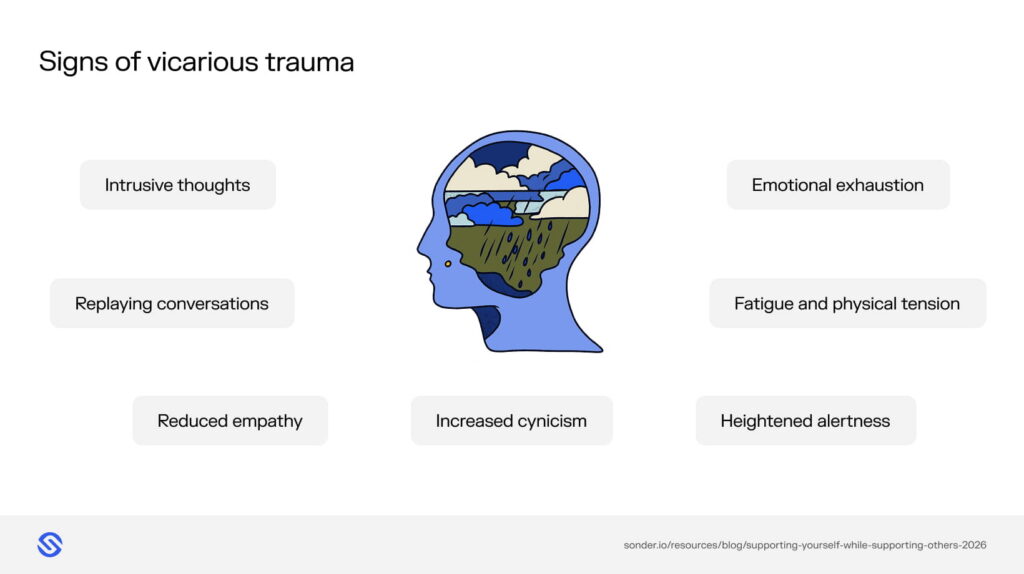
For many people, it can start to show up as:
- Replaying conversations
- Intrusive thoughts
- Emotional exhaustion
- Reduced empathy
- Increased cynicism
- Heightened alertness
- Fatigue and physical tension
Before stepping in to support someone else, check in on yourself first. Because when you’re aware of how your own nervous system is responding, you’re better able to support others without becoming overwhelmed.
“You can’t regulate somebody else’s nervous system unless you are regulated yourself.”
Rachel Tomlinson, Psychologist and Clinical Director at My Mirror
Why trauma isn’t always direct
Trauma doesn’t always come from something we experience firsthand. Sometimes, it develops through being close to someone else’s distress. This is known as vicarious trauma.
Vicarious trauma can happen when you’re repeatedly exposed to the emotional weight of other people’s experiences, especially when you’re in a role where you’re supporting, listening, or holding space for others. This might include social workers, nurses, teachers, emergency responders, customer service staff, or managers, but it can affect anyone regularly absorbing someone else’s pain.
Ultimately, this kind of exposure can build up. Trauma can move through systems: teams, families, and wider support networks. Leaders, in particular, may feel this through second- or even third-hand experiences as they support others.
Supporting someone through distress takes real emotional energy. You’re not just hearing their words in the moment; you may find yourself carrying parts of it with you afterwards.
That’s why looking after yourself matters. Being there for others is important, but it shouldn’t come at the cost of your own wellbeing.
“We need to know when to disengage from an interaction. If somebody has become overly escalated, is it safe to continue, or do they need to potentially speak to somebody else, or potentially engage with an entirely different service?”
Rachel Tomlinson, Psychologist and Clinical Director at My Mirror
How to support others through workplace trauma without absorbing their distress
You can be there for someone without carrying the full weight of what they’re going through.
Let’s explore three ways to reframe how you approach supporting others to create a more sustainable dynamic.
Start with safety, not the story
There’s a common belief that supporting someone means encouraging them to tell their full story. But detailed recounting can actually reactivate trauma — for both the person sharing and the person listening.
Instead, try focusing on what is needed right now, rather than unpacking everything all at once. This can be a simple but powerful way to bring things back to the present moment and avoid uncontained storytelling.
Example phrase: “I can hear how distressing this is — right now, let’s focus on what you need.”
Some scripting might include… right now our priority is X, Y, and Z, so respectfully, if we can pause that conversation so that we can focus on A, B, and C. Or: what you have to say is so important, and I worry I’m either not in the right role, or I don’t have the capacity to hear your story and the impact in the way that you deserve.
Rachel Tomlinson, Psychologist and Clinical Director at My Mirror
Boundaries make support safer
Practice creating boundaries by giving people clear expectations, structure, and a defined purpose of interaction.
Boundaries are not about shutting people down; they’re about creating predictability and safety. It helps avoid making false promises and creates consistency that becomes dependable.
Example phrase: “I can help you with identifying the next steps. We don’t need to go into details about what’s happened.”
“Predictability reduces threat, and clear roles prevent emotional over-involvement.”
Rachel Tomlinson, Psychologist and Clinical Director at My Mirror
Regulate the interaction, not the person
While it’s natural to feel like you’re responsible for regulating someone else’s emotions, you’re not, and there’s a better way. What you can do is help regulate the interaction itself.
Here are a few tips:
- Slow the pace and maintain a steady tone
- Use simple language and clear transitions
- Ask fewer questions and redirect when needed
- Maintain physical space between you if the setting requires it
When someone is distressed, you’re not speaking to logic; you’re speaking to a dysregulated nervous system. In those moments, tone of voice and pace are processed far more quickly than words or reasoning.
“Regulation is contagious, so the way you are coming into that interaction and presenting will directly influence the other person.”
Rachel Tomlinson, Psychologist and Clinical Director at My Mirror
How to support others through workplace trauma without trying to fix everything
It’s easy to slip into trying to rescue someone or over-identify with what they’re going through, especially when you care. You might even start to feel responsible for how things turn out.
But effective support doesn’t come from fixing the situation. It comes from creating space for someone to feel heard and understood.
Listening without judgment and validating someone’s feelings are two of the most important things you can do. When you can name what someone might be experiencing, it helps them feel seen and safe.
Problem-solving comes from a good place, but it sometimes minimises what someone is going through or moves too quickly past what they actually need in that moment.
Instead, small shifts in how you respond can make a meaningful difference:
- What’s the hardest part right now?
- What would help today?
- What’s helped before?
These kinds of questions bring the focus back to the present and give the person a sense of control and autonomy — particularly when you ask what’s helped before.
This is especially important when supporting children. Their understanding is still developing, and their imagination may lead to self-blame. Clear, simple explanations and reassurance can help restore a sense of safety.
“Sometimes people don’t need us to fix it. They just need to be heard.”
Rachel Tomlinson, Psychologist and Clinical Director at My Mirror
Nervous system regulation techniques you can use at work
There are a few simple ways to regulate your nervous system in the moment — things you can use at your desk, in a conversation, or straight after a difficult interaction.
- Grounding exercise: Place both feet on the floor and notice the sensation of being supported. If sitting, bring your attention to the contact between your body and the chair.
- (5-4-3-2-1): Engage your senses with 5 things you can see, 4 things you can feel, 3 things you can hear, 2 things you can smell, and 1 thing you can taste.
- Move your body: This might be a walk, a few star jumps, or even just standing, stretching, or changing position — release built-up tension and support regulation.
- Breath slowly: Diaphragmatic breathing — in through your nose and out through your mouth — calms the nervous system quickly.
- Progressive muscle relaxation: Tense and release muscle groups from head to toe, helping your body let go of tension.
- Cold water: Splashing your face or taking a cold sip can trigger a reflex that naturally slows your breathing and heart rate.
“You can regulate yourself in real time by giving your brain something neutral to focus on.”
Rachel Tomlinson, Psychologist and Clinical Director at My Mirror
How to sustain your capacity to support others long-term
Supporting others through trauma isn’t separate from how you look after yourself; it’s part of it. If you’re taking on too much, staying in conversations for too long, or carrying things with you afterwards, you risk losing yourself in the process.
Supporting others is also about knowing when to pause, set limits, and step back so you can keep showing up in a way that is safe and sustainable.
You have to show up for yourself before you can show up for other people.
“If you’re not looking after yourself, you can’t do a great job of looking after the people you care about.”
Rachel Tomlinson, Psychologist and Clinical Director at My Mirror
Why supporting yourself is part of supporting others
For leaders, parents, and carers navigating difficult moments, having the right support matters.
Sonder equips managers with the tools and expertise needed to lead their teams effectively, while safeguarding their own wellbeing. By providing 24/7 professional guidance and personalised resources, Sonder helps managers navigate the complexities of leadership, prevent burnout, and create productive, resilient teams.
Managers shouldn’t be expected to play the role of a psychologist for their team. With situation-specific guidance, Sonder can connect your managers and their teams to expert and appropriate care, so they don’t have to shoulder the burden alone.
Find out more here or request a demo to find out how Sonder can support your managers.
FAQs:
Vicarious trauma is the emotional and psychological impact that can develop from repeated exposure to other people’s distressing experiences. Unlike direct trauma, it builds gradually — often affecting those in caregiving, leadership, or support roles without them realising it’s happening.
Common signs include emotional exhaustion, intrusive thoughts, reduced empathy, increased cynicism, and physical symptoms like fatigue or tension. You might also notice replaying conversations after they’ve ended or feeling more reactive than usual. These aren’t character flaws — they’re signals your nervous system needs attention.
Key strategies include setting clear boundaries in support interactions, regulating your own nervous system before and after difficult conversations, and knowing when to refer someone to professional support rather than absorbing it yourself. Sustainable leadership means recognising that looking after yourself is part of looking after your team.