At a glance:
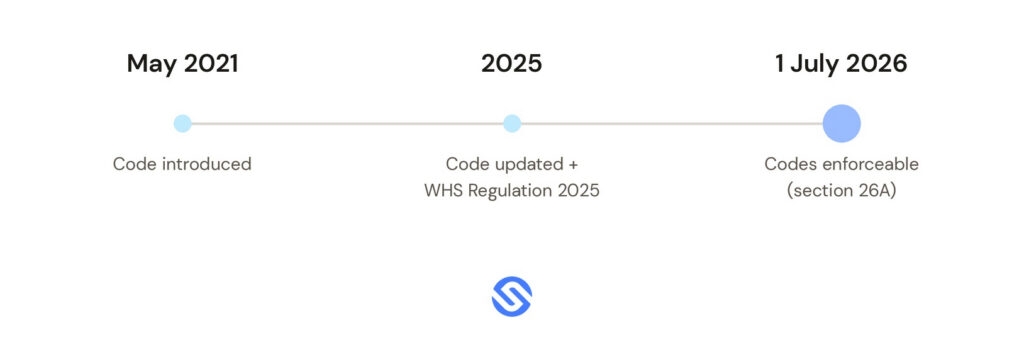
- The legal status of NSW codes has changed: Since 1 July 2026, section 26A of the Work Health and Safety Act 2011 (NSW) has meant businesses must follow an approved Code of Practice or prove they’re managing the risk to an equal or higher standard of safety.
- A new enforceable standard: The Code of Practice on managing psychosocial hazards has shifted from helpful guidance to an enforceable standard a regulator can measure you against. Your underlying duties haven’t changed. The standard of proof has.
- The risks are real, and rising: Mental health conditions made up 12% of serious workers’ compensation claims in 2023–24, up more than 14% on the year before, and SafeWork NSW has appointed inspectors dedicated to psychosocial safety.
- Compliance is practical, not overwhelming: Map your hazards to the code, apply the hierarchy of controls, consult your people and document your reviews. You don’t have to do everything at once, but you do need to show your work.
If you’ve been treating the psychosocial hazards code as ‘recommended reading’ rather than a compliance line, that changed on 1 July.
Here’s everything you need to know, whether you’re a leader in New South Wales (NSW) or elsewhere.
Disclaimer: The information contained in this article and on this website is general information only and does not constitute legal advice. Although all efforts have been made to ensure the accuracy and currency of the information presented, Sonder takes no responsibility for any errors or omissions presented. Please contact a legal representative for individual advice.
What changed on 1 July 2026?
Since 1 July 2026, Codes of Practice no longer operate as guidance. As a result of this change, businesses must either:
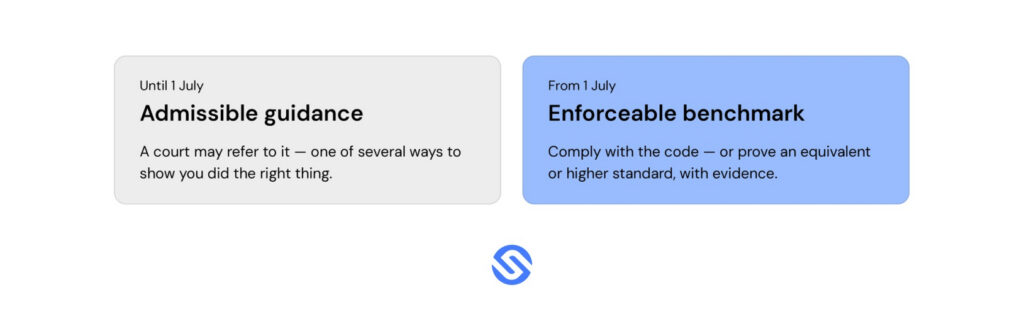
- Comply with the relevant Code of Practice, or
- Manage the hazard to an equivalent or higher standard, and be able to evidence it.
NSW has more than 30 approved codes, and they all gained this legally enforceable status at once. The Code of Practice on managing psychosocial hazards is one of the most significant, because it touches every workplace with people in it.
Before 1 July, a code was admissible guidance. Now it’s a legally enforceable standard and therefore a legal duty. Depart from it, and the onus is on you to document why your alternative is as good or better. This brings NSW into line with Queensland. It doesn’t create new duties, since your obligation to manage psychosocial risk already exists, but it raises the bar on how you prove you’re meeting it.
“Boards and executives are now expected to evidence oversight, not just intent.”
Kristen Raison, Co-founder of Humn, from our 2026 executive briefing
A wellbeing calendar and a policy on file were never the same as managing risk. But now the gap between the two is easier for a regulator to see.
Why psychosocial hazards are in the spotlight
First, a couple of definitions, because the terms can get confused.
- Psychosocial hazards are the workplace factors that can harm someone’s mental health: high job demands, low role clarity, poor support, bullying and harassment, badly managed change.
- That’s different from psychological safety, which is how safe people feel to speak up. The code is about the conditions you design, not just the culture people feel.
The statistics help explain the focus. Safe Work Australia data shows mental health conditions made up 12% of serious workers’ compensation claims in 2023–24, up more than 14% on the year before, with bullying and harassment, work pressure and exposure to workplace violence the leading causes.
“Psychosocial safety has moved from a wellbeing conversation to core business risk. Mental health now sits alongside slips, trips and falls.”
Kristen Raison, Co-founder of Humn
In our guide to psychological safety in an age of AI, Sonder analysed 9,183 psychosocial hazards tagged across support cases between May 2025 and May 2026. Nearly two-thirds fell into just three categories: job demands (23%), poor workplace relationships or conflict (21%) and poor support (20%).
“Nearly two-thirds of psychosocial hazard tags in Sonder support cases over the past year fell into just three categories: job demands, poor support, and workplace conflict.”
Ingrid Jenkins, Chief People Officer, Sonder
These are exactly the factors the code asks you to identify and control. If you’re not sure where your psychosocial risk sits, it’s a sound place to start.
What a SafeWork NSW inspector expects to see
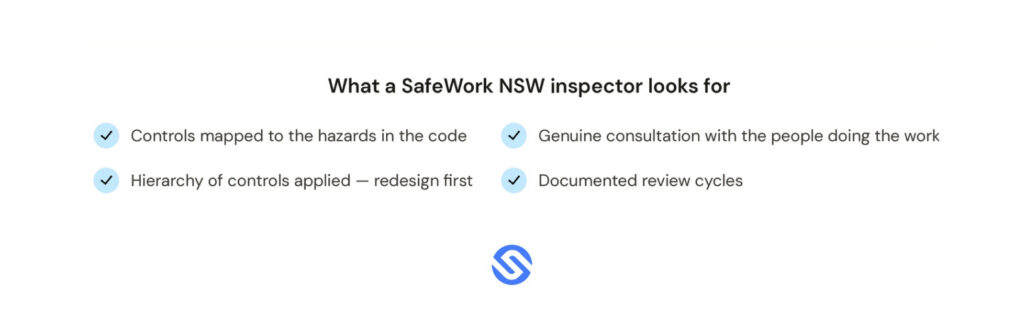
Since 1 July, inspectors have been looking for evidence that you’ve worked to the code. In practice, that means:
- Controls mapped to the hazards in the code, not a generic wellbeing plan
- The hierarchy of controls applied, with elimination or redesign of the work considered first (the NSW WHS Regulation 2025 made this explicit)
- Genuine consultation with the people doing the work
- Documented review cycles, so controls are tested over time
This is where many organisations are exposed.
“A policy in a folder is not a control.”
Sam Young, clinical psychologist and co-founder of Humn, from What’s below the surface
Support matters, but it sits downstream of the hazard. An Employee Assistance Program (EAP) helps a person after the fact; a control changes the work and is a proactive mechanism so that fewer people are harmed in the first place. The code expects the second.
This is the direction of travel, not just a NSW story
If you operate outside NSW, don’t file this under ‘someone else’s problem’. Queensland already gives codes this weight, and psychosocial risk is being regulated more firmly across every Australian jurisdiction.
How to meet the code now
You don’t need to do everything at once, but if you haven’t started, start now and show movement.
- Get familiar with any relevant codes. Read the SafeWork NSW Code of Practice on managing psychosocial hazards and any other code that may be applicable to your organisation. As Cheryl Kraft Reid of oOh!media advises in our guide to navigating psychosocial risk management, leaders should personally understand the legislation and its intent.
- Build a psychosocial hazard risk register. Identify your hazards, assess them and record the controls. Our free tools and templates give you a ready-made structure. Consider starting with a short-term plan for immediate risks, then a longer-term strategy built on continuous review.
- Apply the hierarchy of controls. Ask what you can eliminate or redesign before you reach for training or support. Workload, role clarity and how change is managed are often where the real risk sits.
- Consult the people doing the work. They’ll show you the friction you can’t see from above.
- Test that controls actually work. A control no one uses isn’t a control.
Not sure where you’re starting from? Sonder’s psychosocial risk readiness assessment is a short quiz that flags your gaps and where to focus first.
How Sonder acts as a risk control
Meeting your duty of care is about how work is designed and led. Sonder supports the human side of that: proactive, real-time medical, mental health and safety support for your people, plus the insight to help you see where risk is building and evidence the care you provide.
If the 1 July change has moved this up your list, we’re happy to talk it through. Request a demo to see how Sonder can support your people and your duty of care.
Frequently asked questions
On 1 July 2026, when section 26A of the WHS Act 2011 (NSW) commenced.
No. Your duty to manage psychosocial risk already exists. The change strengthens how codes of practice are used to judge whether you’ve met it.
You must either comply with the code or demonstrate that your approach provides an equivalent or higher standard of safety, with evidence to back it up.
The 1 July change is NSW-specific, but it mirrors Queensland and reflects a national tightening of psychosocial regulation. National employers should prepare across the board.
No. Support services help people, but they sit downstream of the hazard. The code expects you to identify and control the risk at its source first.
Related reading from Sonder
- Navigating psychosocial risk management: Our full guide on identifying, assessing and controlling psychosocial risk, with expert insights and survey data.
- How to navigate psychological safety in an age of AI: Where the most common psychosocial hazards meet new ways of working.