Psychologically safe workplaces help people do their best work. They’re more likely to retain talented staff and address concerns early before they grow into larger problems.
But for many organisations, a clear gap exists that means psychological safety is unevenly experienced depending on where someone sits within an org chart.
According to Sonder’s Safety Gap Report 2025, senior leaders tend to feel safe, supported, and confident at work. Across six core areas (from feeling included to being safe to speak up), agreement among senior leaders sits at 80% or above. But for middle management and employees further down the seniority chain, the picture is more mixed (below 65%).
Ultimately, having uncomfortable conversations makes workplaces better. Learning how to have these productive (and sometimes awkward or even difficult) conversations is a skill, one that can be taught, practised, and embedded into the way your team operates.
To help leaders do exactly that, conflict resolution expert Zandy Fell from The ZALT Group joined Sonder’s Chief People & Culture Officer Raechel Gavin to share a practical framework for getting started. Watch the full recording here, or catch up on the highlights below.
Watch the masterclass: How tough conversations foster psychological safety
Meet the expert: Zandy Fell
Master coach in conflict resolution, mediator, and restorative engagement facilitator. Founder of The ZALT Group, specialising in workplace conflict resolution, investigations, and restorative circles. Zandy works with leaders and HR teams to build the capability and confidence to have the conversations that matter.
Hear more from Zandy Fell. Sign up to our upcoming masterclass on 17 June 2026 – Difficult conversation curveballs: What would you do? for more tips on tackling unexpected conversations.
The real cost of avoiding tough conversations at work
No one wants to show up to an office filled with tension, disagreements and conflict. But leaving things unsaid, even if it “keeps the peace” in the short term, can actually do more harm than good.
In Zandy’s experience, workplace cultures that are described as harmonious and “nice” can be a red flag. While those are positive qualities, they can be signs that problems are quietly brewing in the background: one-on-ones stay surface-level, no one pushes back in team meetings and real concerns are only flagged in exit interviews.
With 50% of the ANZ workforce either actively disengaged or open to new employment, the cost of avoiding tough conversations has real, measurable consequences. It shows up in three consistent ways:
- Disengagement quietly impacts performance: Problems get normalised, innovation stalls and teams default to doing the bare minimum.
- Your best people look for the exit: High performers have options. If feedback is avoided, conflict is unaddressed and hard truths don’t get shared, they’ll look for a workplace that encourages honesty.
- Leaders end up carrying what teams won’t say: HR teams and managers spend more time on issues that could have been resolved earlier with a direct conversation, shifting from proactive leadership to perpetual damage control.
This is what Zandy calls the real risk of avoiding tough conversations: not the discomfort of having them, but the compounding cost of not having them.
Tough conversations aren't the risk. They're the remedy.
Founder of The ZALT Group
Uncomfortable vs. unsafe: a critical distinction leaders need to make
At the gym, we know the difference between a hard workout and an injury. Burning muscles, heavy breathing and the discomfort of pushing past your comfort zone are necessary to get stronger and fitter. But when sharp pain strikes, it’s time to stop.
Tough conversations are the same. Feeling nervous, sitting in uncomfortable silence and hearing feedback that stings isn’t unsafe, it’s productive. But a conversation that’s genuinely hostile, humiliating and harmful? That’s a different thing entirely.
As leaders, it’s important not to conflate discomfort with danger. Instead, it’s about setting the parameters of productive vs harmful conversations, and equipping your team with the right mindset and clear expectations for effective dialogue.
Psychological safety isn't about making everyone comfortable. It's about making discomfort useful.
Founder of The ZALT Group
The four quadrants of every difficult conversation
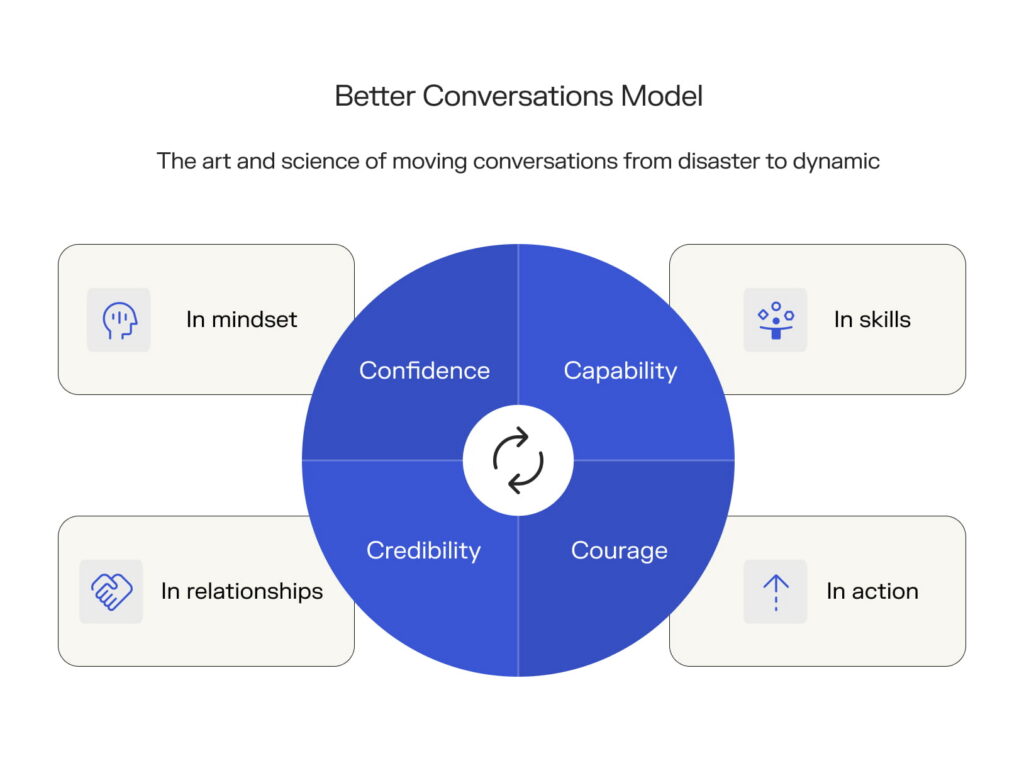
So what separates a conversation that moves things forward from one that derails entirely? Zandy’s Better Conversations framework breaks it down into four quadrants. Each element is present in every difficult discussion, whether we’re aware of it or not:
- Capability: The skills you bring to a difficult situation. This includes the ability to ask the right questions, accurately figure out what’s going on below the surface and know how to prepare and respond effectively.
- Confidence: The mindset you bring into a conversation. This is the internal soundtrack that plays during a difficult conversation and shapes how it unfolds. For example, if your internal soundtrack says “this is going to go badly”, chances are it probably will.
If you're not having difficult or slightly uncomfortable conversations, the odds are you don't work in an environment where there's psychological safety.
Founder of The ZALT Group
- Credibility: The relationships and reputation you bring into the room. This is built long before the conversation starts. If you and a colleague can work through a disagreement, that relationship has credibility. If you can’t, that’s where the work needs to happen first.
- Courage: The willingness to actually step in and have the conversation without waiting or hoping the issue resolves itself. This is where vulnerability lives: the ability to show up honestly in difficult situations and hold space when someone else does the same.
Three things leaders can do to make tough conversations part of the DNA
Psychological safety doesn’t happen by accident. The teams that have it didn’t stumble into a culture of honest, productive conversation; they built it deliberately, and they work to maintain it.
Here are three practical ways to start doing the same.
1. Articulate a conversation culture explicitly
Don’t assume your team knows how to have productive, challenging and tough conversations. Name it, define it and make it specific to where your organisation is at right now.
Zandy’s advice? Be precise and practical, and keep in mind that your conversation culture might look different in six months’ time as your team evolves.
Practical tip: Set time aside in your next team meeting to discuss what a good conversation looks like for your team. What do you expect of each other? What makes a difficult conversation productive, rather than destructive? Getting this out into the open is an act of building psychological safety.
2, Teach people how to receive feedback, not just give it
The real skills gap for most people is understanding how to receive feedback. Zandy’s top tip for receiving feedback: separate the person from the message.
The moment someone dismisses feedback because of who it came from, the content gets lost entirely. Building a team that can actually hear hard things and knows what to do with them is one of the highest-leverage investments a leader can make.
3. Balance rights with responsibilities
In a psychologically safe workplace, every right to safety comes with a corresponding responsibility. For example, the right to bring emotional reactions to work comes with the responsibility to express them without hostility.
Being explicit about both sides of this equation builds a culture of mutual accountability, rather than one-sided protection.
| Employee rights | Corresponding responsibilities |
|---|---|
| To feel deeply heard and valued | How do you make your colleagues feel heard and valued |
| Bring my creativity and allow me to grow | Listen (not just hear) to varied perspectives |
| To ask “naive” or clarifying questions without embarrassment | To be curious and open to learning, even when things feel uncertain |
| To have emotional reactions acknowledged (e.g., stress, upset) | To express emotions appropriately and without hostility |
| To not be spoken about negatively | To refrain from gossip, exclusion, or undermining others |
| To not be spoken about negatively | To refrain from gossip, exclusion, or undermining |
How Sonder can help your team have better conversations
Building a culture where tough conversations happen takes intention, skill and the right conditions. But even the best team culture gets tested: a difficult diagnosis, a relationship breakdown, a sustained period of stress.
That’s where Sonder comes in.
Psychological safety and employee wellbeing aren’t separate agendas. When people feel genuinely supported outside of the conversation, they’re more likely to show up honestly inside it.
Sonder’s 24/7 platform gives employees on-demand access to mental health, medical, and safety professionals, so leaders can focus on building the kind of culture Zandy describes, confident that their people have real support behind them.
With an average engagement rate of 40% compared to the 3-5% typical of traditional EAPs, Sonder is a support that people actually use.
See how Sonder can support your team and request a demo.