AI is transforming how we work, but is it transforming it safely?
The honest answer is: it depends on how leaders respond.
In Sonder’s new guide, How to navigate psychological safety in an age of AI, we explore how AI can exacerbate various psychosocial hazards and the practical, positive ways these tools can be leveraged to safeguard your workforce. Because true success with AI requires leaders to adopt this parallel priority: how to deploy the technology while actively protecting the people behind it.
💡 What are psychosocial hazards? Read the cheatsheet here.
What the data tells us about psychological safety risks
To understand why AI poses a psychological safety risk, let’s look at the pressure points that already exist within organisations.
Across 9,183 psychosocial hazards tagged within Sonder support cases between 11 May 2025 and 11 May 2026, nearly two-thirds of all workplace struggles stem from three specific hazards alone:
- Job Demands — 23%
- Conflict or Poor Workplace Relationships — 21%
- Poor Support — 20%

When you layer unmanaged AI adoption over these existing vulnerabilities, you create a perfect storm — or, as Dominic Price, Partner and Work Futurist at Be Luminous, shares, “We’ve got an old human operating system that is built for 2006, and we’re running the risk of doing the wrong thing faster with AI.”
"These are precisely the hazards that AI, without careful implementation, could intensify."

Chief People Officer at Sonder.
How AI compounds existing psychosocial hazards
In our new comprehensive guide, we sit down with leading work futurists, psychologists, and HR executives to unpack exactly how AI transforms traditional workplace risks.
Read the full guide or catch up on a snapshot of what was uncovered below.
1. Job demands: The trap of continuous high alert
When AI successfully automates repetitive, administrative tasks, it can leave people with a continuous stream of highly complex, cognitively heavy work. Because those smaller, repetitive tasks we often overlook? They used to provide natural mental breaks. Without them, people can find themselves operating in a state of continuous high alert.
Resilience as an organisational strategy is a way of asking individuals to absorb what the system should be fixing. If your people are burning out, the answer is not a mindfulness app. It's a serious look at what the work is actually requiring of them

Co-Founder & CEO at Humn
2. Role ambiguity: The erosion of human agency
When AI tools are handed out without clear boundaries, employees are left asking stressful questions that never quite reach the surface:
- Am I responsible if the AI hallucinates data?
- Where am I allowed to use it vs. where am I not?
- What part of this role is actually mine now?
- Am I just training my robot replacement?
People feel like the pace is no longer theirs to set. The machine can go faster, so the expectation is that they should too. But their ability to influence how work gets done doesn’t increase at the same rate.

Partner and Work Futurist at Be Luminous
3. Structural isolation: Replacing people with prompts
When it becomes easier to ask a chatbot a question than to Slack a colleague, human touchpoints disappear — often without people even realising it. This structural isolation leaves managers blind to emerging issues.
And when teams are left isolated, the risk of perceived unfairness can also skyrocket. If the systems managing their workflows feel disconnected from real human relationships, employees can lose trust in leadership, which is always a slippery slope.
People have a finely tuned sense of procedural justice. If they believe a system is making consequential decisions about them without transparency, accountability, or recourse, trust breaks down fast.
Co-Founder and CEO of Humn
What good looks like: Best practice in action
Navigating this transition is about adopting your organisation’s AI transition with human-centric guidelines and guardrails.
Two forward-thinking organisations show us how to get it right:
Case study 1: MYOB
- Instead of simply pushing new AI tools onto employees, MYOB treated the rollout as a true partnership between their People and Technology teams.
- They launched a company-wide AI Everyday program to show exactly how AI applies to normal, day-to-day work. They also picked everyday employees to act as “AI Functional Leads” to help their own teammates learn in a comfortable, peer-to-peer way.
Case Study 2: Culture Amp
- Culture Amp ensures that human judgment always stays in the driver’s seat by using a “hub-and-spoke” model to manage AI safely.
- They created a central expert team (the “hub”) that sets strict guidelines around transparency, safety, and fairness. The product teams (the “spokes”) then build those exact guardrails directly into the tools from the very beginning.
"Leaders aren’t immune to the pressures AI introduces. As these tools become more sophisticated, there’s a real risk leaders start to over-defer to AI outputs, quietly eroding confidence in the judgement they’ve spent years building. And that erosion of confidence flows downstream. AI is a powerful co-pilot. But leaders need to stay firmly in the pilot’s seat- remaining curious, critical, and engaged with their people. AI can inform good leadership. It can’t replace it."
CPO at Sonder
How prepared is your business to manage the invisible risks of the AI era?
Dive into Sonder’s guide to unlock:
- Analysis of how AI interacts with major psychosocial hazards
- The wellbeing signals leaders need to watch for
- Practical strategies to help assess risks and prevent issues
- Expert insights from people and technology leaders

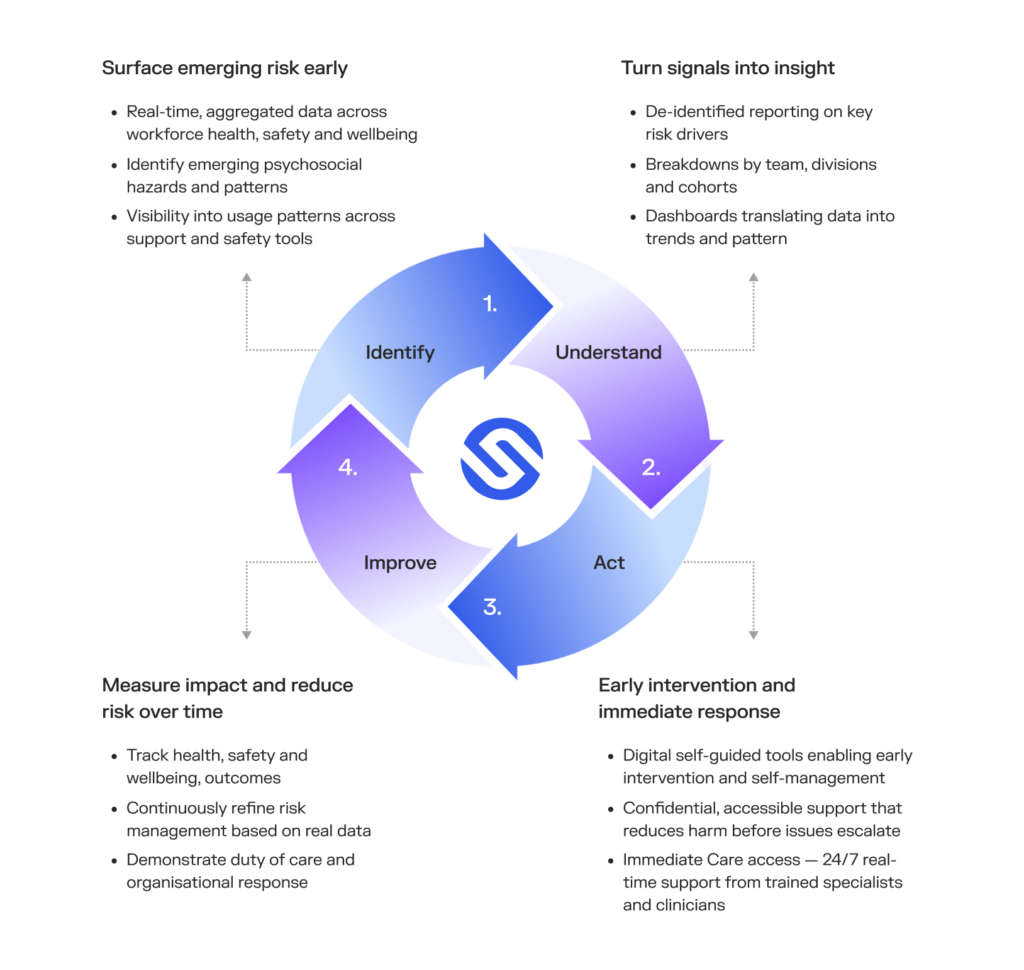
How Sonder fits into your psychosocial risk management framework
Sonder can help your business lower its risk profile by:
- Using employee data to surface emerging risks early – giving you time to intervene
- Turning people signals into risk insight – so you can identify trends and patterns
- Providing 24/7 support to your people – so they can seek care before issues escalate
- Tracking health, safety and wellbeing outcomes – so you can continuously refine your approach
Download: How to navigate psychological safety in an age of AI
Want to see how proactive, data-driven safeguarding works in real-time? Book a demo with Sonder today to discover how our 24/7 evidence-based support model drives early intervention and protects the wellbeing of your evolving workforce.