
At a glance:
- Payment from day one: From 6 April 2026, Statutory Sick Pay (SSP) is payable from an employee’s first day of absence, with no waiting period and no lower earnings threshold.
- Legislative change: The change is part of the most significant wave of UK employment law reform in a generation and means every qualifying sick day now carries an immediate payroll cost.
- Industries most at risk: High-turnover sectors, including retail, hospitality, and construction, are likely to see the costs of this change compound quickly.
- The business case for action: The financial case for early intervention has never been stronger. Getting employees the right support before absences are prolonged is now a clear cost-control strategy.
In the UK, absenteeism is soaring.
73% of workers have experienced physical symptoms that impacted their ability to work in the past year alone, according to Sonder’s State of Employee Health and Wellbeing Report 2026. Meanwhile the CIPD reports UK workers took an average of 9.4 sick days in 2025, the highest figure in 15 years.
From 6 April 2026, this issue has a new financial consequence. The removal of Statutory Sick Pay (SSP) ‘waiting days’ under the Employment Rights Act 2025 (the most significant wave of UK employment law reform in a generation) means every qualifying sick day now carries an immediate payroll cost.
With absence already at record levels and SSP now payable from day one, the financial case for early intervention has never been stronger.
Disclaimer: The information contained in this article and on this website is general information only and does not constitute legal advice. Although all efforts have been made to ensure the accuracy and currency of the information presented, Sonder takes no responsibility for any errors or omissions presented. Please contact a legal representative for individual advice.
What does day-one SSP mean for employers?
Statutory Sick Pay (SSP) is a legally mandated minimum pay UK employers must provide to eligible workers who are unable to work due to illness or injury.
But major legislative reforms to UK employment law (as part of the Employment Rights Act 2025) have overhauled the way SSP operates.
From 6 April 2026, the following changes apply:
- SSP is payable from an employee’s first day of absence; no three-day waiting period applies.
- The Lower Earnings Limit is removed; all employees qualify for SSP (no matter what they earn).
- A new rate applies to lower income earners: Rather than paying a flat weekly SSP rate, employers pay whichever is lower: £123.25 or 80% of the employee’s Average Weekly Earnings (AWE).
Previously, a three-day waiting period applied, meaning employees had to be off sick for four or more consecutive days before SSP kicked in.
Low-income earners (previously employees earning less than £125/week) did not qualify for SSP. Part-time workers, zero-hours staff, and casual employees earning below this threshold previously received nothing, too. That rule has now been abolished.
For a long time, SSP was paid at a single flat weekly rate to all qualifying employees. Now, the weekly SSP rate has risen from £118.75 to £123.25. Plus, for lower-paid employees, a proportional calculation now applies. SSP is now paid at the lower of £123.25 per week or 80% of the employee’s average weekly earnings over the eight weeks immediately before the absence begins.
Day-one SSP means up to 1.3 million workers gain SSP eligibility for the first time, including part-time and zero-hours staff.
Department for Work & Pensions
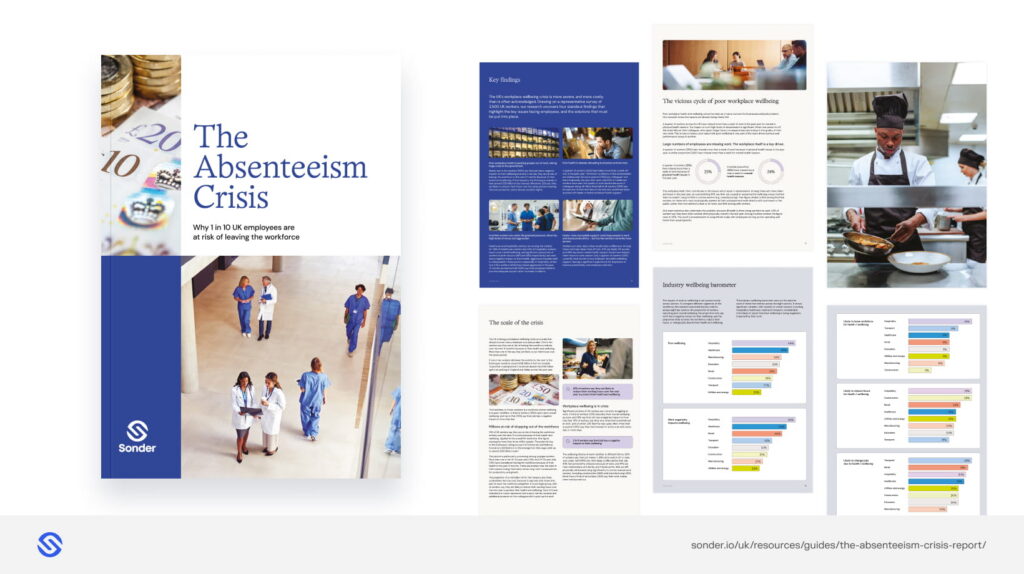
Keep reading: Sonder’s Absenteeism Crisis Report reveals 1 in 10 UK workers are at risk of leaving the workforce in the next 12 months due to health and wellbeing challenges. Download it here.
Who qualifies for day-one SSP under the new rules?
Now, every employee on payroll, regardless of how long they’ve been employed, how long they’ve been sick, or what they earn, is entitled to SSP from day one, subject to limited exceptions set out below.
| ✅ Who qualifies from 6 April 2026 | 🚫 Who remains ineligible |
| Any employee who is sick for at least one qualifying day. | Self-employed workers. |
| Employees at any income level (the Lower Earnings Limit no longer applies). | Employees who have received Employment and Support Allowance (ESA) in the past 85 days. |
| Part-time workers, zero-hour workers, and lower-paid employees who were previously excluded. |
Day-one SSP is part of several employment law changes that have come into effect from April 2026, including day-one family leave entitlements and higher redundancy penalties (doubling from 90 to 180 days per affected employee).
Keep reading: Wondering about the state of your current absenteeism rate? Sonder’s blog explains how how to calculate it in five steps.
Which employers are most exposed to day-one SSP?
The expansion of SSP means more employees will be eligible for this financial payment. As a result, many employers will now face higher costs as every qualifying sick day must be paid from day one of absence.
High-turnover sectors (such as retail, hospitality, construction, warehousing, and logistics) with a large number of short-service employees face the greatest compounding risk.
Previously, many short-term absences didn’t trigger SSP. A nasty cold or an upset stomach might only need an employee to stay home for a day or two, and wouldn’t need to be paid out.
Now, even the very first day of absence triggers it, incurring a payroll cost.
Plus, removing the lower earnings limit amplifies this cost. Part-time workers and zero-hours employees are common in these industries and were previously entirely excluded from SSP eligibility. Now, liability has expanded, and the financial impact will be felt quickly by employers.
Why waiting out absences is no longer a viable strategy
Previously, short-term absences were a resourcing challenge and admin headache. Waiting for employees to return (and hoping they didn’t trigger the SSP threshold) was the status quo. In many cases, a day or two of unpaid leave was all employees needed to get back to work.
With the arrival of day-one SSP, this approach no longer holds. Every single day triggers a payable absence. The financial incentive to intervene early before health issues escalate into prolonged absences is much stronger, too.
The UK Government estimates that day-one SSP will increase costs by around £15 per employee per year. Keep in mind this is a national average, and doesn’t take into account the disproportionate impacts to low-wage sectors.
Department for Work & Pensions
Keep reading: Discover the 7 main causes of employee absenteeism and their true cost.
What does effective early intervention look like?
Early intervention in the context of absence isn’t about rushing employees back to work while they’re still unwell. Instead, it’s an approach that delivers the right support early, reducing the likelihood, duration and severity of each absence.
Getting this right requires attention at each stage of the employee’s experience, from the moment they first feel unwell to the point they’re ready to return:
| Phase | Questions to consider |
| Access | Can employees reach medical or wellbeing support before a health issue escalates? Keep in mind that health issues don’t only arise during business hours, making 24/7 and on-demand support key. |
| Triage | Are employees being directed to the right level of care quickly? Among workers who delayed or avoided care, 42% pointed to long wait times (it took too long to get an appointment), compared with 30% in Australia. Support that connects people to help in seconds, rather than days, closes that gap.Source: State of Employee Health and Wellbeing Report 2026 |
| Follow-through | Is there a clear return-to-work pathway that’s supportive? Access to on-demand wellbeing resources can help keep employees well and speed up the path to full recovery, while proactively reducing the likelihood of future absences. |
Organisations that adopt a proactive approach are also better positioned to navigate an evolving enforcement environment. Recent reforms (such as the Employment Rights Act 2025) firmly shift workplace safety and employee health from a “nice to have” to a legal requirement and compliance mandate.
Keep reading: Discover 10 proven strategies to reduce employee absenteeism in the UK.
An employer compliance checklist for day-one SSP
With the April 2026 changes now in effect, organisations should confirm the following policies are now in place:
✅ Policy updates: Ensure SSP policies no longer include the three waiting days or lower earnings limits.
✅ Payroll systems: Ensure SSP is calculated from the first qualifying day of absence, and the 80% proportional rule is applied accurately for lower income earners.
✅ Manager training: Ensure line managers understand the new entitlements and are not holding up or inadvertently delaying SSP processing.
✅ Record keeping changes: Ensure that all absences are now accurately recorded and captured from day one.
✅ Early intervention pathways: Ensure employees can access medical, safety, and wellbeing support before issues escalate to an absence, and ensure this support is confidential, available 24/7, and readily accessible to employees on demand.
Free download: Sonder’s factsheet provides practical tools and insights to help you transform your organisation’s approach to absence. It includes the latest data, legal essentials and actionable steps.
How Sonder supports UK employers navigating the day-one SSP change
Day-one SSP arrives at a moment when workforce health, safety, and organisational risk are no longer separate conversations for most HR and People leaders. The organisations best placed to absorb the pressures of psychosocial risk, absence, and employee engagement are those that have a unified, preventive approach to care.
Sonder delivers exactly that for UK employers navigating the financial and operational implications of day-one SSP. That means:
- 24/7 holistic triage: Employees can access clinical support immediately, at any hour, before a single day of qualifying absence has been triggered. Earlier access means earlier resolution.
- Medical support: Rapid access to GPs and clinical specialists closes the gap between noticing symptoms and receiving appropriate care.
- Proactive absence management: Sonder’s absence management solution is designed around early intervention and sustainable return-to-work pathways.
- Powerful data and insights: Gain clear visibility into absence patterns by team and cohort to detect emerging risk before it escalates.
How 24/7 Sonder support reduced absence for Schools UK
Schools UK wanted a partner capable of delivering 24/7, holistic, early-intervention support. They needed a solution that would empower staff to take control of their wellbeing before small issues escalated into long-term absence. So they chose Sonder. The partnership is successfully mitigating the cost of claims by keeping staff in work and healthy.
- 60% of users confirm their interaction directly prevented an absence.
- 88% credit the service with helping them avoid potential time off.

Ready to see Sonder’s features in action? Request a demo to try it now and see for yourself.
FAQs
Day-one Statutory Sick Pay applies from 6 April 2026. The three-day waiting period has been removed, so SSP is now payable from the first qualifying day of sickness, including single-day absences.
The weekly SSP rate is £123.25, up from £118.75. For lower-paid employees, employers pay whichever is lower: £123.25 or 80% of the employee’s average weekly earnings over the previous eight weeks.
Almost every employee on payroll now qualifies, regardless of earnings or length of service. The Lower Earnings Limit has been removed, extending eligibility to around 1.3 million more workers. Self-employed individuals remain outside the scheme, as SSP applies only to employees. Employees who have already received the maximum 28 weeks of SSP, or who are receiving Statutory Maternity Pay, are also ineligible.”
Yes. Removing the Lower Earnings Limit means part-time, zero-hours and casual employees who earned below the old threshold now qualify, having previously received nothing.
The Government estimates the change will cost around £15 per employee per year on average. That figure is a national average, so high-turnover, lower-wage sectors like retail, hospitality and warehousing are likely to feel the impact far more.
Early intervention is now the clearest cost-control strategy. Because every qualifying sick day is payable from day one, getting people the right support quickly, before a minor issue becomes a prolonged absence, directly reduces the number of paid sick days.