At a glance:
- Sonder’s Absenteeism Crisis Report reveals 1 in 10 UK workers are at risk of leaving the workforce in the next 12 months due to health and wellbeing challenges.
- If this happens, there is set to be a £38bn annual loss in tax revenue to the Exchequer.
- A quarter of workers (25%) have taken a week or more off sick in the past year, and 87% say their job caused or worsened their wellbeing issues.
- Nearly 6 in 10 say a sick day could’ve been avoided with faster or better employer health support, but 3 in 4 don’t have access to any.
UK workplaces are facing a crisis hiding in plain sight. Ill health and wellbeing are causing employees to leave work or struggle to return, according to Sonder’s latest UK The Absenteeism Crisis report. Our survey revealed that 1 in 10 UK workers are at risk of leaving the workforce in the next 12 months due to their health and wellbeing.
This poses a serious risk. Absenteeism ripples through teams, putting pressure on those left behind, increasing the risk of burnout and sparking a vicious domino effect across organisations.
In partnership with Strand Partners, Sonder’s The Absenteeism Crisis report 2026 surveyed 2,500 UK workers (a representative sample of the overall UK workforce) to uncover four standout findings about the scale of the crisis.
Download Sonder’s full Absenteeism Crisis Report to explore the complete findings, including industry-by-industry data on which sectors are most at risk. Or,; dive into the highlights below.
How many UK workers are at risk of leaving their jobs?
The scale of the UK’s workplace health and wellbeing crisis is widespread, and gaining increasing attention in government policy decisions and public discourse.
The Keep Britain Working review reveals that over 1 in 5 working-age people in the UK are already out of work and not looking for work, with many citing ill health as a key factor.
In 2025 alone, the UK lost 148.8 million working days to sickness and injury.
Sickness absence in the UK labour market: 2025
Sonder’s research shows how many might join this cohort, with 1 in 10 workers at risk of leaving their jobs in the next 12 months due to poor health and wellbeing. 22% of workers also say they are likely to reduce their working hours over the next year to protect their health and wellbeing, too.
Young workers are disproportionately affected. More than 1 in 10 (14%) of 18-to 24-year-olds have considered leaving the workforce in the past 12 months. Losing early-career workers is particularly impactful as it can have significant long-term effects on productivity and growth across organisations.
“The disruption of widespread poor employee wellbeing is already being felt. Absenteeism is rippling through teams, putting pressure on colleagues who then become more likely to burn out themselves. This shows the danger of a vicious cycle that needs to be averted, one where poor wellbeing and sickness in some employees have a domino effect for others.”
Craig Cowdrey, Co-founder and CEO, Sonder
What is driving the UK’s workplace wellbeing crisis?
Sonder’s research suggests significant portions of UK workers are currently struggling at work. The data show that 33% describe their overall wellbeing as poor, while 39% say their job has a negative impact on how they feel.
But there is no single reason why UK workers are struggling at work. In fact, several structural pressures are compounding one another, with many workplace support systems not built to meet the challenges modern employees face.
Factor 1. The demands of work itself
The way work is organised is putting significant strain on employees’ health and wellbeing. From unrealistic job demands to inadequate support and even poor managerial decisions, structural factors are causing employees to experience poor health and wellbeing.
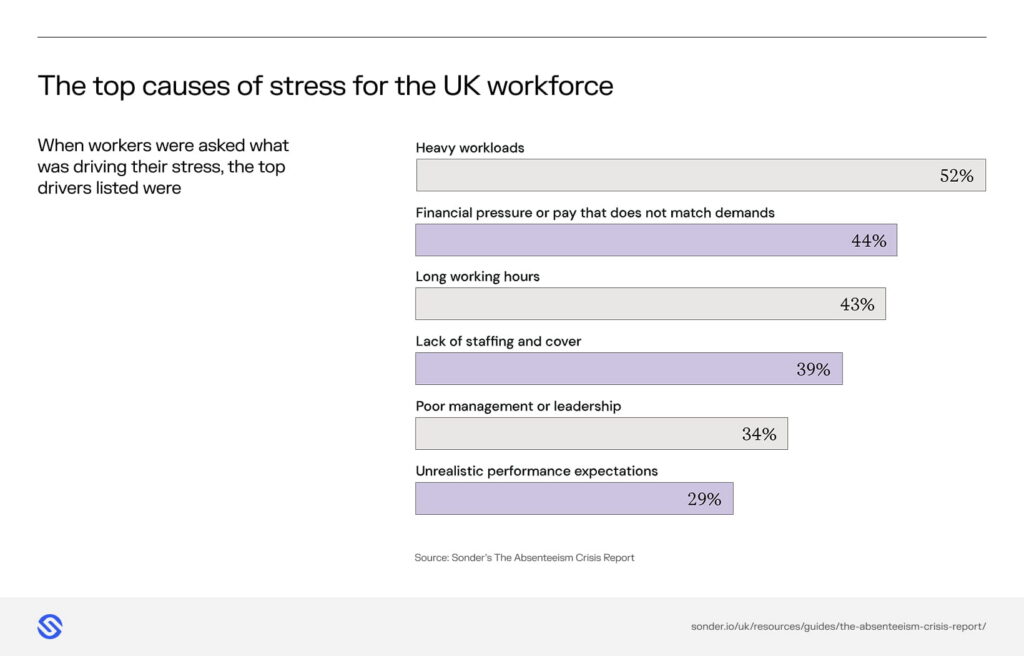
Stress and anxiety are on the rise, with more than a quarter of UK workers saying they feel stressed at work every day or most days.
Sonder’s Absenteeism Crisis Report
And these wellbeing issues persist even after an employee has clocked off. 60% of employees say their job makes it difficult for them to switch off or relax, while others report issues with sleep, exhaustion, and even tension and conflict in personal relationships.
Factor 2. The vicious cycle of poor workplace wellbeing
Poor health and wellbeing isn’t an individual issue. It has far-reaching consequences that flow across an entire team, department, and organisation.
Almost a quarter of workers (23%) say colleague sickness frequently disrupts their work.
Sonder’s Absenteeism Crisis Report
When one person is off sick, other team members have to step in to pick up the slack. If an employee is away for an extended period, the remaining coworkers may need to stretch and overextend themselves to meet deadlines and keep projects moving. Long hours, late nights, and a heavy workload are a recipe for burnout, heightened stress, and poor sleep.
Over time, this can lead other employees to need time off. Without intervention, poor wellbeing in one part of the workforce erodes the wellbeing of the rest.
Factor 3. Support exists on paper, but rarely in practice
Unfortunately, there is a gap between the support employees need to stay well, and the support most employers currently offer.
Sonder’s data reveals only 25% of workers have any employer wellbeing support. Even when support exists, it’s often limited in scope, difficult to access, or available only during office hours.
6 in 10 workers say that at least one of their sick days in the past year could have been avoided if they had received faster or better support.
Sonder’s Absenteeism Crisis Report
What needs to change?
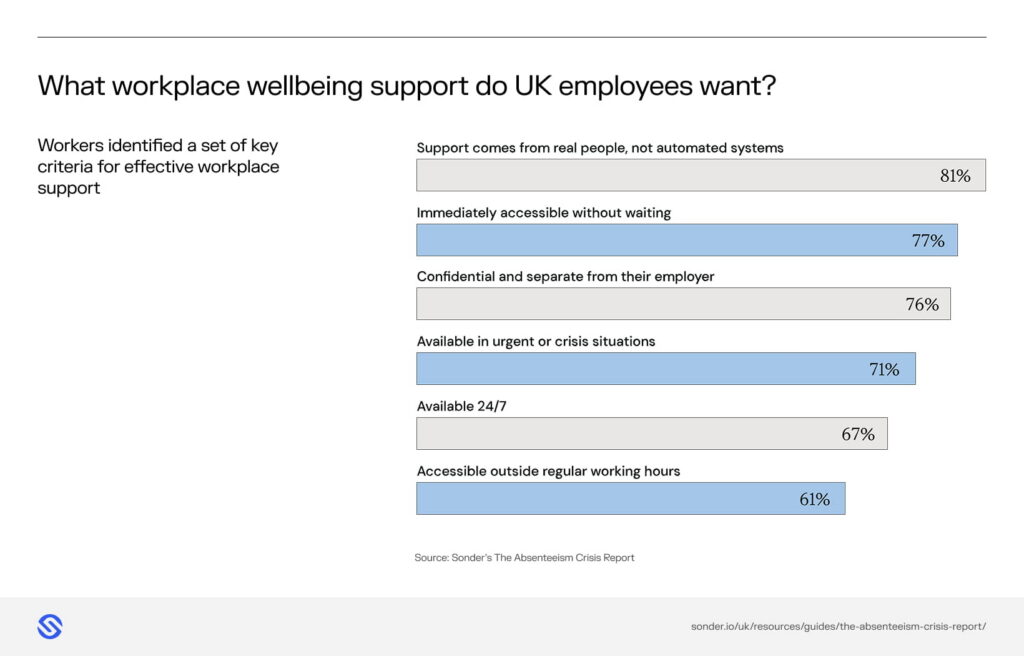
UK employers have an opportunity to take a preventative approach to employee health and wellbeing. Think: faster access to a GP, quicker mental health support, and access to healthcare professionals 24/7 (not just during office hours).
Among workers who have taken time off, practical support could have made a tangible difference, with almost half (47%) saying faster access to a GP would have helped them return to work sooner, and 39% saying faster access to mental health support would have helped.
By tackling the root cause of employees’ ill health and wellbeing, employers stand to gain a more engaged, healthier, and more loyal workforce. The changes required are simple: human-led care, faster response times, and digital tools that put care in employees’ hands.
How Sonder supports organisations tackling absenteeism
Reducing absenteeism starts with catching problems before they turn into extended leave. Sonder gives employees 24/7 access to real medical, mental health, and safety support, so a stressed or unwell team member can speak to a qualified clinician the same day, rather than waiting weeks for a GP appointment or pushing through until it becomes a longer-term absence.
For employers, that means addressing the root cause of ill health early, rather than managing the fallout after someone’s already off work.
See how Sonder can help reduce absenteeism in your organisation. Book a demo.
Now’s the time for UK employers to act
The findings in this report set out the scale of the challenge, but they also point to a real opportunity: employers who close the support gap stand to gain a healthier, more engaged, and more loyal workforce.
Download Sonder’s full Absenteeism Crisis Report to explore the complete findings, including industry-by-industry data on which sectors are most at risk.