Whether it’s new competitors in your industry or AI’s impact on your day-to-day workflows, change in the workplace is constant and unavoidable. However it’s completely natural to feel daunted or even fatigued by the constant rate change in the workplace.
For those stepping into leadership this raises an important question: how can we do more than just cope with change? How can we anticipate it and adapt in ways that turn it to our advantage, instead of letting it sweep us along? And how can we support our teams through it?
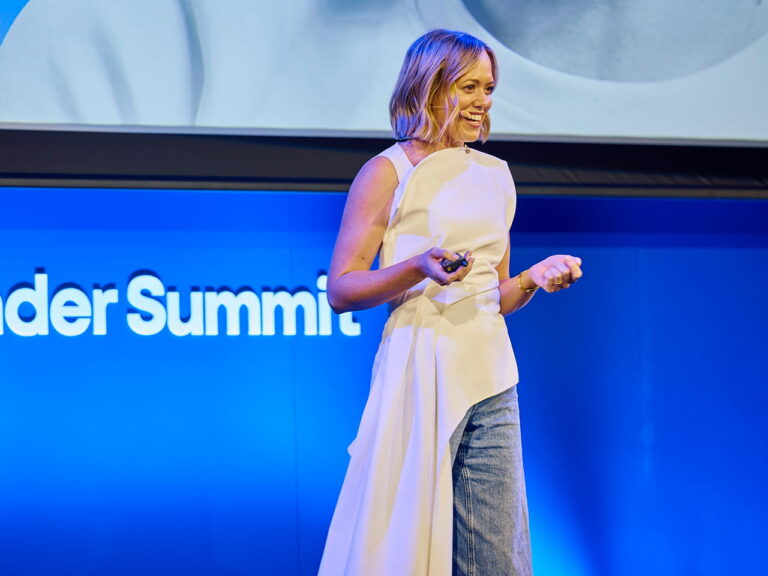
To explore this, Sonder was joined by work futurist and leadership expert Andrea Clarke in a masterclass, where she shared practical insights and strategies for building adaptive intelligence and navigating change with intention.
Catch up on the highlights below.
Meet the expert: Andrea Clarke
Andrea is an award-winning author, work futurist, and expert in leadership and adaptability. Drawing on her own life-defining moments — from a mid-air engine failure at 9,000 feet to walking away from a decade-long journalism career in Washington, D.C. — Andrea makes the case for a different kind of AI: your own Adaptive Intelligence.
Adaptive intelligence: The capability we already have
When we talk about adapting to change, the conversation often turns to tools, systems, or increasingly, artificial intelligence. Andrea Clarke invites us to look somewhere far more immediate: our own capacity to adapt.
Adaptive intelligence isn’t something new that we need to learn from scratch. It’s a capability we already have, but one that often goes underused.
Adaptive intelligence shows up in the way we:
- Read situations
- Adjust our thinking
- Respond to uncertainty
The challenge is that in fast-moving environments, we tend to default to reacting rather than consciously engaging that adaptive capability.
One of the most relatable ways Andrea brings this to life is through the simple experience of arriving early — like getting to the airport well before a flight.
When we’re early, we’re more prepared, we have more options. We can think more clearly, make better decisions, and respond to unexpected changes without panic.
The same principle applies to how we navigate uncertainty more broadly. When we can “arrive early” to change by noticing patterns, asking questions, and preparing mentally, we shift from feeling overwhelmed to feeling more in control.
How do I manage workplace change? How do I anticipate change?
The way we frame change matters more than we often realise.
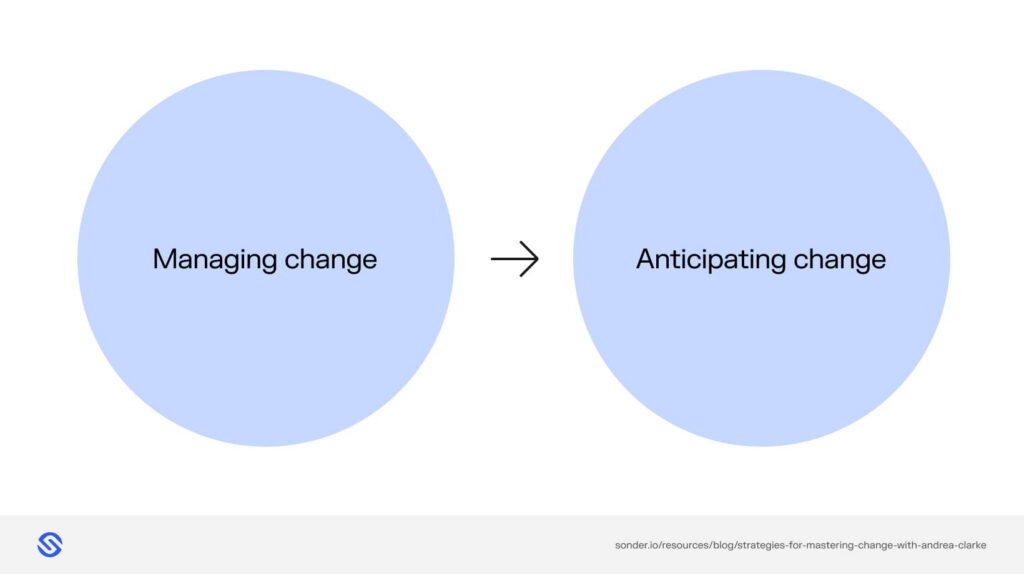
Many of us approach it with the mindset that change is something to be managed as it arrives — or, as the saying goes, we’ll cross that bridge when we come to it.
While that way of thinking is understandable, it keeps us in a reactive position. We’re waiting until change is knocking on our front door before we decide what to do. This often reinforces feelings of pressure or a lack of control.
“How do I manage change?” is a question she hears often signals that many of us are still approaching change as something that happens to us, rather than something we can actively shape.
Instead, she believes there’s a more useful question we should be asking ourselves regularly: How do I anticipate change?
“I spent a lot of time with leaders talking about how adaptability can help us turn a safe today into a safer tomorrow… When we start anticipating change, we start thinking like a futurist, and that is when we start considering the options that we have when we understand what is changing around us. And that is when we can be an active player in change.”
From here, Andrea introduces three practical habits to help build that mindset and strengthen our adaptive intelligence.
Mastering change habit 1: Scan for signals
If anticipating change is the goal, then the first step is learning how to see it coming. This is where the idea of “signals” becomes useful as a practical way of paying attention.
Signals are the early signs that something is shifting. They’re often small, easy to overlook, and rarely announced in obvious ways. More often than not, they show up in everyday moments: subtle changes in behaviour, recurring frustrations, shifts in how people are working or communicating. Perhaps it’s a new term your customers keep using in conversations.
The challenge is that most of us are wired to prioritise stability. We focus on what’s familiar, what’s working, and what needs to get done today. That makes sense, but it also means we can miss what’s changing around us — until it becomes impossible to ignore.
Andrea encourages widening our lens. Instead of only noticing big, headline-grabbing changes, she suggests paying attention to the human signals underneath them: not just what is changing, but how people are responding. By spotting these patterns early, we give ourselves space to reflect, ask questions, and adjust before change becomes urgent or overwhelming.
“You can gather your team once a week, once a quarter, or once a month, and invite everyone to bring with them a signal of change that they’re seeing across the market. This is how we start understanding how we can all arrive early at a problem.
You’ll be so surprised by what people show up with, because what we want to know is, are you seeing what I’m seeing? And if you’re seeing what I’m seeing, maybe we need to dig a bit deeper into the signal and see how it’s going to affect us, our team, our business, our people, our consumers.”
Some reflective questions to guide this practice:
- What am I noticing more of lately (behaviours, frustrations, delays, conversations)?
- Is this a one-off, or is a pattern emerging?
- Is this a short-term reaction (noise) or a longer-term shift (signal)?
- Where might I be denying or ignoring change because it feels uncomfortable?
- What is changing in how people are coping, behaving, or responding?
- If this continues, what might it mean for the future?
Mastering change habit 2: Test the truth
Anticipating change also means being willing to question what we believe to be true.
Many of our assumptions (about work, success, identity, or the future) are shaped by past experiences or societal norms. While these beliefs can be useful, they aren’t set in stone.
Testing the truth means challenging those internal assumptions and seeing if they still hold up in a changing world. It’s about staying curious, keeping a growth mindset, and spotting the barriers that we’re (often subconsciously) holding on to that limit what’s possible.
This can feel uncomfortable, especially when beliefs are deeply ingrained. But it’s often in that discomfort that new opportunities appear. Reconsidering what’s possible creates room for growth that wasn’t visible before.
Andrea gives examples like shifting career paths, doing something you never thought you would, or changing cultural norms around retirement to show how quickly “truths” can evolve. What once felt fixed can become flexible, and what once seemed unlikely can become normal.
This practice reminds us that adaptability isn’t just about responding to what’s happening around us; it’s also about updating how we see ourselves and the world.
A few reflective questions Andreas encourages us to try:
- What did you believe to be true about yourself ten years ago that is no longer true?
- If something I’ve believed in my whole life is now being reimagined, what does that mean for me? For my team? For my business?
“This is the power of testing the truth, because what it does is it reveals how fragile our assumptions are about ourselves and the future. I think we drastically underestimate our ability to change.”
Mastering change habit 3: Let go
If scanning for signals is about noticing what’s emerging, and testing the truth is about questioning what we believe, then letting go is about creating space for what comes next.
Letting go means recognising when something is no longer aligned with where we’re heading. This could be an outdated habit, a belief system, a tradition, a routine, a piece of tech, or Andrea’s personal favourite, unhelpful social expectations.
In fast-changing environments, holding onto outdated approaches creates friction. It limits our ability to adapt because we’re carrying things that no longer fit. When we remove what’s no longer necessary, we make room for new ideas, perspectives, and ways of operating.
Andrea Clarke shares the story of Rob McEwen, who was running a gold mine in Canada in the early 2000s. The problem was simple: he couldn’t find any gold. So what did he do?
Instead of sticking with traditional approaches, Rob did something radical for mining leadership at the time: he open-sourced his geological data and held a competition to see who could find gold.
He invited 1,500 people to analyse the data, and their efforts uncovered 110 new drill sites, ultimately leading to 8 million ounces of gold and taking the company’s market cap from $50 million to $8 billion almost overnight.
Rob’s “masterstroke” wasn’t introducing a new tool or method; he simply let go of what leadership in mining was supposed to look like. This bold release upended the game for everyone involved, from the company to the families working alongside him. Andrea highlights how this is an incredible example of letting go of old-school, traditional ways of doing things.
So, what are you carrying that is no longer fit for purpose or for where you are going?
From reactive to proactive change management
Change doesn’t have to leave us feeling reactive or overwhelmed.
By scanning for signals, testing the truth, and letting go of what no longer serves us, we can anticipate change, make thoughtful choices, and shape a future rather than simply respond to it.
Tools like Sonder can support this process by giving individuals and teams the confidence and space to reflect, adapt, and act early — helping us stay resilient and proactive in a world that’s constantly evolving.
To hear more from Andrea, check out our Sonder Summit fireside chat where Andrea sat down with Sonder’s CEO Craig Cowdrey to discuss how empathy and trust drive performance.
To dive in deeper, get in touch to discuss how Sonder can support you and your team today.