At a glance:
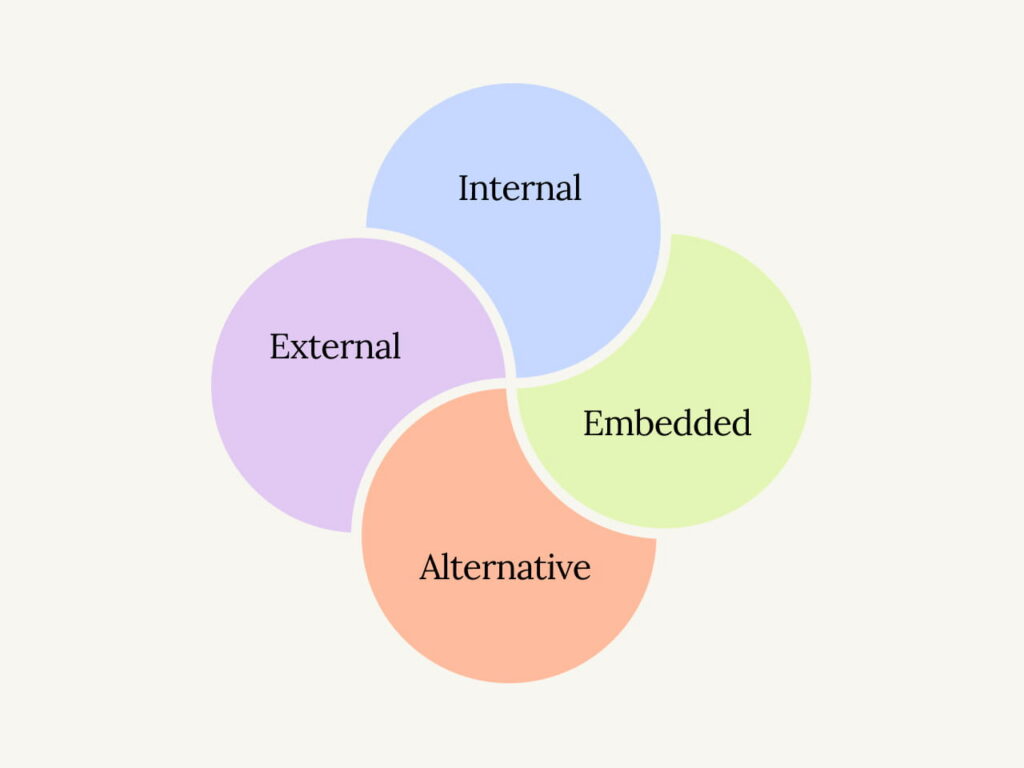
- There are four common types of EAP: External, internal and embedded EAPs, plus modern alternatives that go beyond counselling.
- Each type has trade-offs: Cost, scope of care, access and confidentiality vary widely between models.
- Uptake of traditional EAPs is low: Around 5% of covered employees use their EAP in Australia, and 3.34% in the UK.
- Modern alternatives act earlier: Platforms like Sonder bring mental health, medical and safety support together 24/7, so organisations can act before issues escalate.
The four main types of employee assistance programs (EAPs) are external EAPs, internal EAPs, embedded EAPs and EAP alternatives. Each offers a different balance of cost, scope of care and access, so the right choice depends on what your people need and how you’ll know it’s working.
EAPs are popular ways to provide employee support. Around 80% of Australia’s top 500 companies have one, and more than half of UK employees (55%) have access to one. But uptake is low: around 5% of covered employees in Australia, and 3.34% in the UK.
Low awareness, limited coverage, wait times and privacy concerns all play a part. But there are modern alternatives that offer more holistic coverage, which have better uptake. Here’s how each type of EAP compares, so you can choose support that fits your people and your organisation.
What is an EAP?
An employee assistance program (EAP) is typically an employer-funded, mental health-focused program that offers confidential counselling to employees and their immediate family members. This counselling is often free, short-term and focused on personal or work-related problems.
Many providers belong to an EAP member association. These voluntary associations share knowledge and best practice, but they can’t enforce service quality or clinical governance.
Type one: What is an external EAP?
Many organisations contract third-party providers to run their EAP. Known as external EAPs, this approach can cover everything from mental health counselling to financial advice.
External providers are the preferred option for traditional EAPs. Organisations can choose the services they offer to keep costs down, and external programs scale easily as a team grows.
To use an external EAP, employees need to know which services they can access, how to book and what they’re entitled to. That puts the onus on HR teams to keep promoting it.
Pros of external EAPs
- Specialist support: Providers offer specialised services in a confidential environment.
- Cost control: Organisations pay only for the services their team needs.
- Separate from the workplace: Because the provider sits outside the organisation, employees may feel more comfortable seeking support.
Cons of external EAPs
- Low awareness: Employees may not know what they can access, which keeps utilisation low.
- Limited support: Help is often siloed and capped at a set number of sessions or a period of time.
- Minimum headcounts: Some established providers require a minimum headcount, which can leave smaller organisations without access.
- Narrow scope: Support is often limited to mental health, with no medical or safety support.
Type two: What is an internal EAP?
Internal EAPs bring support in-house, with counselling and wellbeing services delivered by an organisation’s own team members rather than a third party.
Larger organisations may be able to build a team of psychologists, counsellors and other specialists. For smaller businesses, hiring for these roles is a significant investment.
Some internal EAPs upskill existing team members, such as managers or HR professionals, to offer support. This can make it harder to deliver consistent quality and to create a space where people feel safe sharing their concerns.
Pros of internal EAPs
- Flexibility: Services can be tailored to employees’ needs.
- Continuity of care: Employees can see the same familiar person over time.
- Easier access: Support is close by, which can lower the barriers to reaching out.
Cons of internal EAPs
- Limited scope: Hiring costs mean it’s rarely feasible to cover every area of need.
- Variable quality: If the program relies on upskilled managers, people may be asked to work outside their core capabilities.
- Confidentiality concerns: Employees may hesitate to share concerns with a colleague, which can lower uptake.
Type three: What is an embedded EAP?
Some organisations access EAP services as part of another product, such as a health insurance policy or an existing subscription. These are known as embedded EAPs.
Embedded EAPs can feel ‘free’, but their cost is built into the fees you already pay. Their scope varies widely, from discounts on services through to full support programs, and organisations may have limited say over what’s included.
Pros of embedded EAPs
- No extra investment: Organisations can offer some support without a separate contract.
- Less admin: The service comes with an existing product, which reduces set-up work.
Cons of embedded EAPs
- Variable coverage: Some embedded services offer limited support, or discounts rather than direct care.
- Less control: Organisations may have little say over which services their people can access.
Before relying on an embedded service, ask what’s included, who delivers it and what reporting you’ll receive.
Type four: What is an EAP alternative?
As employee needs and expectations have changed, so has the support landscape. EAP alternatives take a broader view, adding medical and safety support to mental health care, because it’s hard for people to perform at their best if they feel unsafe or unwell.
Sonder, for example, is a people risk intelligence and prevention platform with EAP coverage and more. It brings mental health, medical and safety support together, so organisations can act earlier rather than only after harm has occurred.
How Sonder works
- 24/7 support, fast: Members can reach a Care Specialist via the app or phone, day or night. In most cases, they connect with someone in 30 seconds or less.
- Holistic triage: Every case starts by assessing physical, mental, social and safety needs, before connecting people to the right care pathway.
- Stepped care: Support ranges from self-help through to booked therapy, face-to-face sessions, social worker support and specialist clinical intervention.
- Medical support: Registered nurses provide medical triage and advice, with access to GPs when needed.
- Personal safety tools: Features like Track My Journey, Check on Me and Help Alerts help people stay safe at work and on the move.
- Critical incident response: Trained Sonder Responders can attend sites in person to support people after a critical incident.
- Support for families: With Family Access, organisations can extend support to employees’ partners and family members.
Sonder is accredited by the Australian Council on Healthcare Standards (ACHS). Employers such as McDonald’s, Woolworths, HOYTS, Allianz, IAG, Mirvac and Charter Hall trust Sonder to support their people.
“Sonder has created a framework for us that, no matter where you sat in the business, you were able to get support. It’s very different from a traditional EAP service. It’s a holistic model of care.”
Katie Thompson
HUB24’s People and Culture Advisor
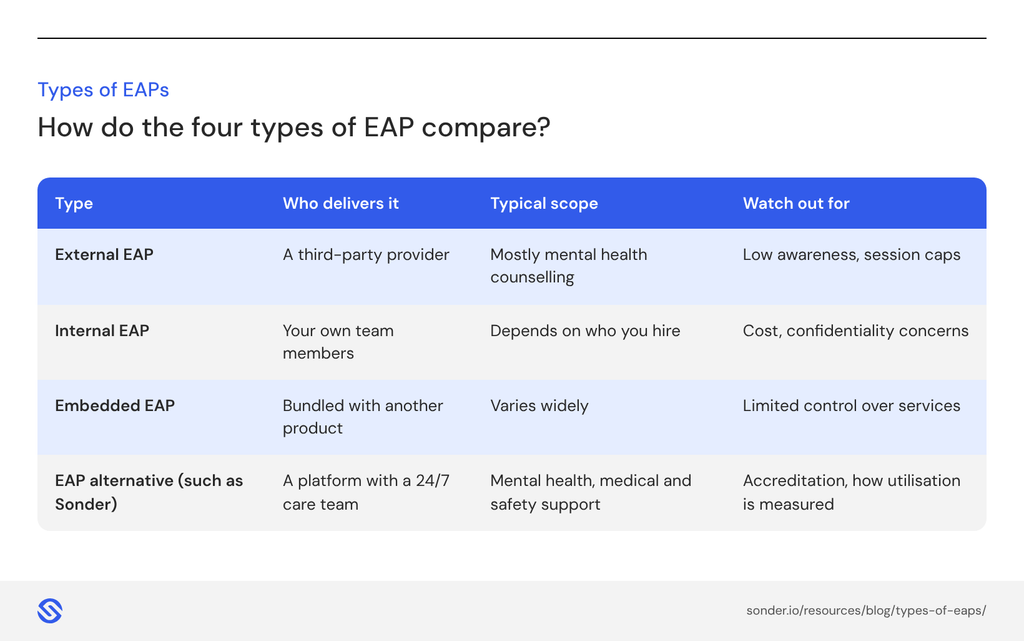
How do the four types of EAP compare?
Here’s how each type compares at a glance.
| Type | Who delivers it | Typical scope | Watch out for |
| External EAP | A third-party provider | Mostly mental health counselling | Low awareness, session caps |
| Internal EAP | Your own team members | Depends on who you hire | Cost, confidentiality concerns |
| Embedded EAP | Bundled with another product | Varies widely | Limited control over services |
| EAP alternative (such as Sonder) | A platform with a 24/7 care team | Mental health, medical and safety support | Check accreditation and how utilisation is measured |
How do you choose the right type of EAP?
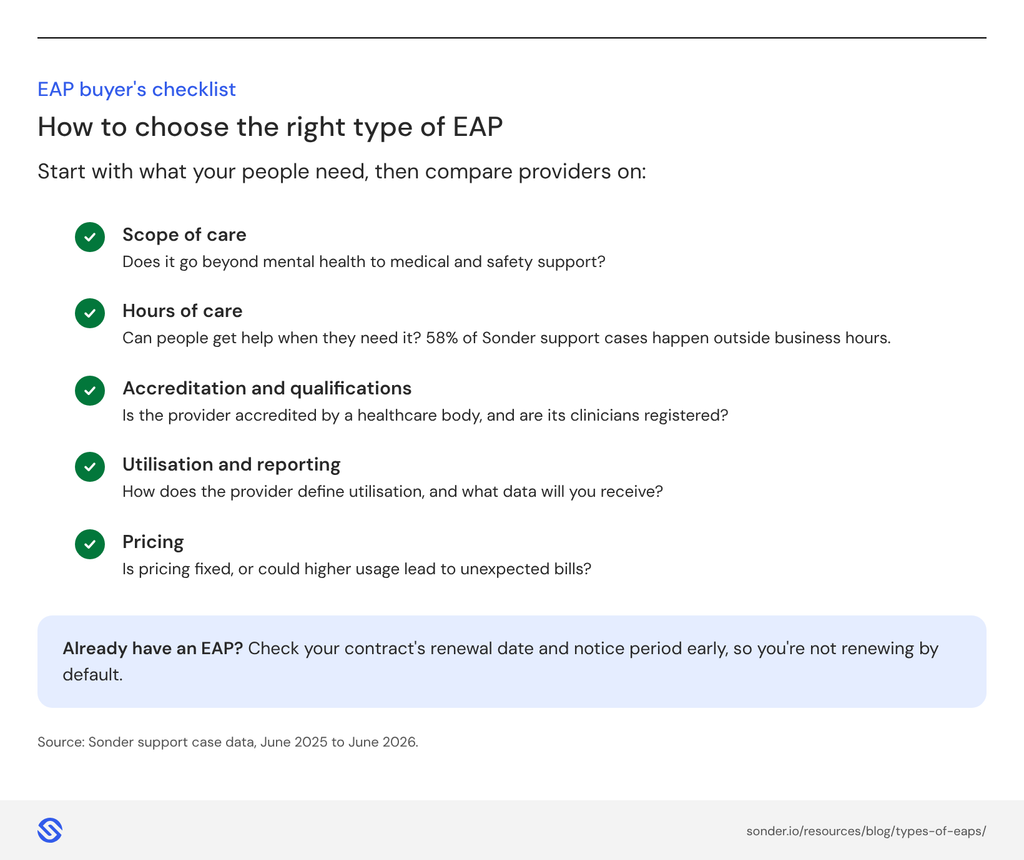
Start with what your people need. Ask employees which support they’d value most, because not everyone needs counselling. Then compare providers on:
- Scope of care: Does it go beyond mental health to medical and safety support?
- Hours of care: Can people get help when they need it? 58% of Sonder support cases between June 2025 and June 2026 happened outside business hours.
- Accreditation and qualifications: Is the provider accredited by a healthcare body, and are its clinicians registered?
- Utilisation and reporting: How does the provider define utilisation, and what data will you receive?
- Pricing: Is pricing fixed, or could higher usage lead to unexpected bills?
Already have an EAP? Check your contract’s renewal date and notice period early. Australian Government guidance recommends a formal review whenever you’re deciding whether to extend a contract, so you’re not renewing by default.
Compare EAPs with our insider’s guide
Our updated How to compare EAPs guide includes a 10-step comparison checklist, insider tips and a plan for switching providers without gaps in support. It will help you:
- Learn how to compare vendor offerings
- Discover what makes EAP alternatives different
- Write a convincing business case
- Plan a smooth switch from your current provider
Download the guide or talk to our team about what earlier support could look like for your people.
FAQs
The four main types are external EAPs, run by a third-party provider; internal EAPs, delivered by an organisation’s own team; embedded EAPs, bundled into another product such as insurance; and EAP alternatives, which combine mental health, medical and safety support in one platform.
An internal EAP is delivered by your own team members, such as in-house counsellors or trained managers. An external EAP is delivered by a third-party provider. External EAPs usually offer more specialist services and more separation from the workplace, while internal EAPs can offer more continuity of care.
An EAP alternative goes beyond traditional counselling to include medical and safety support, often available 24/7. Sonder, for example, is a people risk intelligence and prevention platform that brings mental health, medical and safety support together, so organisations can act earlier.
Traditionally, EAPs focused mainly on mental health counselling. Newer models and EAP alternatives offer more holistic support, which can include medical and safety support as well.
Compare scope of care, hours of access, accreditation, clinician qualifications, utilisation data, reporting and pricing. Ask each provider how they define utilisation, and request sample reports before you sign.
It doesn’t have to be. Most of the work is in the planning: checking your current contract’s notice period and renewal date, making sure employees mid-treatment can finish their sessions, keeping critical incident cover in place throughout, and relaunching the new service so people know how to use it. A good provider will manage much of this with you.