At a glance:
- Traditional EAPs average around 5% uptake: In Australia, uptake is estimated at around 5% of covered employees. In the UK, it’s less than 4%.
- Rates vary by industry: Uptake sits around 1% in safety and law enforcement, and around 9% in financial and insurance services.
- Definitions matter: App downloads, integrations and counselling sessions all produce very different numbers, so ask every provider how they count utilisation.
- Earlier, simpler support lifts engagement: Sonder typically sees around 40% engagement across its members, because people can reach out early, 24/7, for mental health, medical and safety needs.
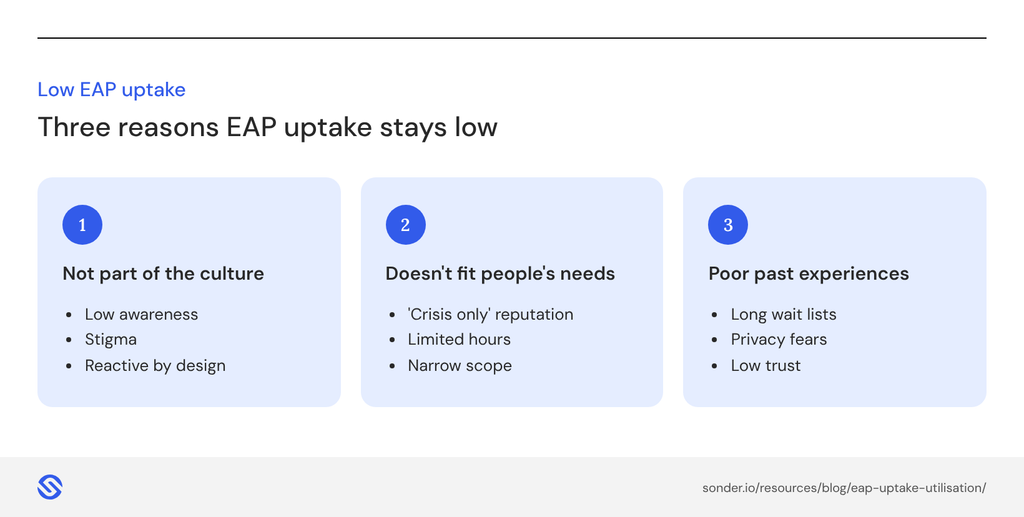
A good employee assistance program (EAP) utilisation rate is one that sits well above the 5% industry average. Traditional EAPs are typically used by around 5% of covered employees in Australia and 3.34% in the UK. Models that bring mental health, medical and safety support together can see far higher engagement: Sonder typically sees around 40% across its members.
We’re often asked what a ‘good’ utilisation rate looks like. As a a people risk intelligence and prevention platform, Sonder is an EAP and more. But HR and safety leaders often compare us with their current EAP data, so here’s what the numbers say and how to read them.
Why do EAP utilisation rates matter?
An employee support program can only deliver results if people use it. That’s why people leaders are increasingly asking providers for evidence of utilisation.
Employee expectations have risen. Now more than ever, employees want their employers to share the responsibility for their wellbeing. For many, their health and safety depend on it. If they can’t talk to a doctor in a medical emergency, speak with a professional during a mental health crisis, or get support in a domestic violence situation, their lives could be at risk.
Senior leaders are paying attention too. Absenteeism, presenteeism, workers’ compensation and turnover cost organisations millions of dollars each year. In the UK alone, poor mental health costs employers £51 billion a year.
Low uptake has a cost. In Australia, the median time lost from work for a serious mental health condition claim is 35.7 working weeks, almost five times the median across all serious claims. The longer people go without support, the worse their situation can become, which is why acting early matters.
What is the average EAP utilisation rate?
Around 80% of Australia’s top 500 companies have an EAP, yet uptake is estimated at around 5% of covered employees. In the UK, more than half of employees (55%) have access to an EAP, but average usage is just 3.34%.
Rates also vary by industry:
- Lower uptake: around 1% in safety and law enforcement
- Higher uptake: around 9% in financial and insurance services
These averages reflect traditional EAP providers. Platforms that combine mental health, medical and safety support usually aren’t counted in EAP industry figures.
Why is EAP uptake so low?
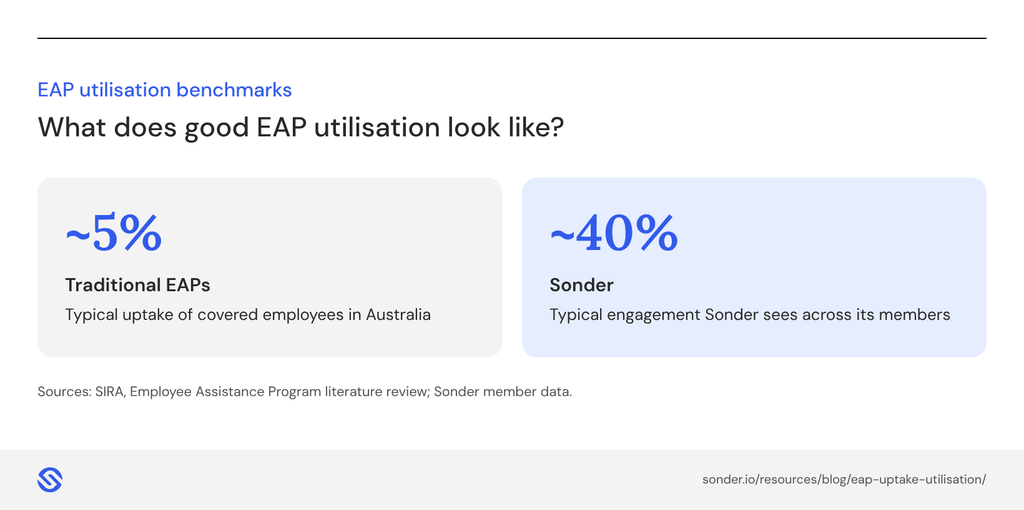
Low uptake isn’t only down to the provider. Employers also play a part in building a culture where people feel comfortable reaching out. In our experience, three things tend to hold uptake back.
Support isn’t part of the culture
Internal promotions don’t reach everyone, and people forget how to access their EAP. Some leaders don’t encourage it, and many employees still worry about stigma. Most EAPs are also reactive, so people only think of them once they reach crisis point.
The support doesn’t fit people’s needs
EAPs are often dismissed as ‘mental health only’, ‘work-related only’ or ‘crisis only’. Some aren’t available after hours, aren’t open to family members, or offer counselling with complicated referral pathways beyond it.
Past experiences have been poor
Long wait lists, double bookings and cancellations erode trust. Employees may worry their details will be shared with their employer, and it’s hard to trust a service before you’ve built a relationship with it.
By the time someone reaches a counsellor through a traditional EAP, they’ve often been struggling on their own for quite a while. That delay matters clinically. Most people don’t need intensive treatment if we reach them early, but they do need a way in that feels easy, immediate and safe.

VP of Clinical Services, Sonder
How is EAP utilisation measured?
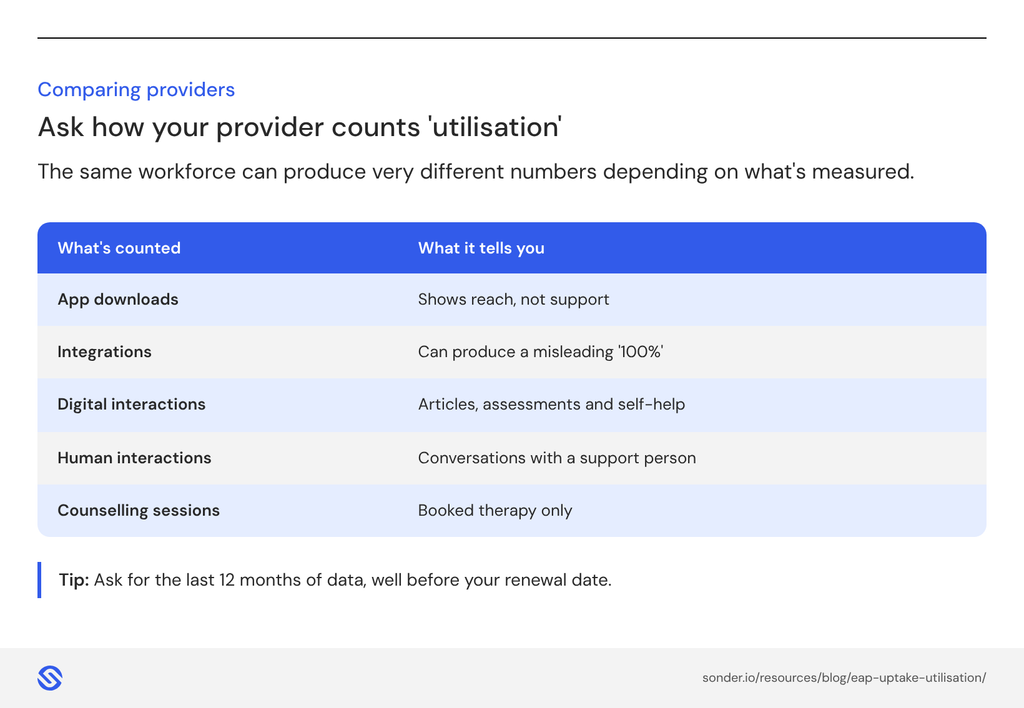
Before you compare providers, ask how each one defines ‘utilisation’. It could mean app downloads, digital interactions, human interactions, counselling sessions or something else. Integrations can even produce a misleading ‘100%’ rate.
At Sonder, utilisation is the number of active members divided by the number of activated members, and is shown in the Sonder Portal. All reporting in the Sonder Portal is aggregated and de-identified, so leaders see the trends without seeing individual cases.
If you already have an EAP, ask for the last 12 months of utilisation data well before your renewal date. It’s the clearest way to judge whether your provider has earned another term.
Measurement matters for compliance too. Comcare notes that an EAP can be a work health and safety control for managing psychosocial hazards. Safe Work Australia’s model Code of Practice says a control that isn’t working effectively must be reviewed and modified or replaced.
What is a good EAP utilisation rate?
There’s no single benchmark, because providers measure utilisation differently. A good rate is well above the traditional 5%, measured the same way over time, and backed by evidence that support is reaching people early.
Sonder typically sees around 40% engagement across its members. A one-stop-for-help model makes support simpler to find and builds trust across every service. In fact, 78% of Sonder members surveyed between June 2025 and July 2026 said Sonder empowered them to seek support when they otherwise wouldn’t have.
Timing matters too. 58% of Sonder support cases between June 2025 and June 2026 happened outside business hours, when many traditional EAP phone lines offer limited or crisis-only support.
In our data, 63% of mental health cases were resolved with early support alone. That’s the clinical case for proactive care. Traditional EAPs were largely built around counselling sessions booked once someone is already in distress, so they often meet people at their lowest point, rather than when we as clinicians can help most.’
VP of Clinical Services, Sonder
What happens to utilisation when organisations switch?
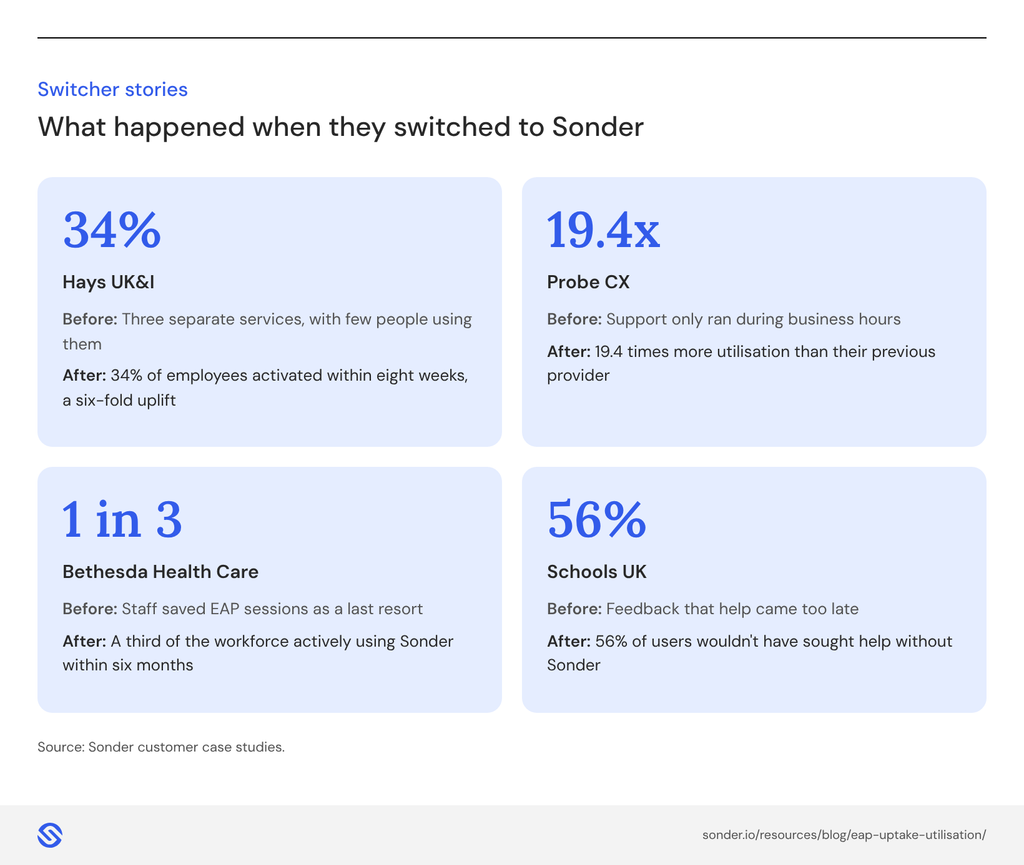
- Hays UK&I: Hays was running three separate services: a digital doctor, an EAP and a wellbeing app. Within eight weeks of moving to Sonder, 34% of employees had activated it, a six-fold uplift on their previous offering.
- Probe CX: Support only ran during business hours. In a three-month Sonder trial, Probe CX saw 19.4 times more utilisation than its previous provider, with 60% of support happening outside business hours.
- Best&Less: Best&Less went from three to 146 employees reaching out for support in one month when they switched to Sonder.
- Bethesda Health Care: Staff were saving their EAP counselling sessions as a last resort. Six months after launching Sonder, a third of the workforce was actively using it.
- Schools UK: The previous EAP kept getting the same feedback: help came too late. A year after launching Sonder, 56% of users said they wouldn’t have sought help without it.
“Our engagement levels with Sonder have far surpassed anything we had previously. Over 55% of our employees have used Sonder, whereas previously we had less than 5% using our previous EAP provider.“
Hannah Pearsall, Head of Wellbeing, Hays
How can you improve EAP utilisation?
- Launch it properly: Promote support across several channels, brief managers on when and how to refer, and keep promoting it well after launch day.
- Give people one place to go: A single entry point for mental health, medical and safety support helps people remember where to turn.
- Make support available around the clock: Many people need help outside business hours, so check what’s on offer at 2am, not just 2pm.
- Ask for activation help: Ask your provider what launch resources they offer, and how many customers each account manager looks after.
- Track against a baseline: Compare monthly and quarterly reporting against your starting point, so you can show leaders what’s changed.
Every Sonder customer starts with a kick-off call, access to the Sonder Customer Toolkit with launch resources and promotional assets, and a dedicated Customer Success Manager.
How is Sonder different from a traditional EAP?
Sonder is a people risk intelligence and prevention platform. Our app gives people immediate, 24/7 support from a team of safety, medical and mental health professionals, plus onsite help for time-sensitive situations. In most cases, members connect with someone in 30 seconds or less.
We deliver care that starts before crisis, helping organisations detect risk earlier, intervene faster and reduce harm before it escalates. Sonder is accredited by the Australian Council on Healthcare Standards (ACHS).
Employers such as McDonald’s, Woolworths, HOYTS, Allianz, IAG, Mirvac and Charter Hall trust Sonder to support their people.
Compare EAPs with our insider’s guide
Our updated How to compare EAPs guide includes a 10-step comparison checklist, insider tips and a plan for switching providers without gaps in support.
Download the guide or talk to our team about what earlier support could look like for your people.
Frequently asked questions
Traditional EAPs average around 5% uptake in Australia and 3.34% in the UK, so a good rate sits well above that. Because providers define utilisation differently, make sure you’re comparing like with like. Platforms that combine mental health, medical and safety support can see much higher engagement. Sonder typically sees around 40% engagement across its members.
It depends on the provider. Some count app downloads or digital interactions, while others count human interactions or counselling sessions. Integrations can produce a misleading ‘100%’ rate. Ask each provider for their definition. At Sonder, utilisation is the number of active members divided by the number of activated members.
Common reasons include low awareness, stigma, limited hours, long wait times, privacy fears and a ‘mental health only’ or ‘crisis only’ reputation. Many EAPs are also reactive, so people only think of them once they reach crisis point.
Yes. EAP uptake sits around 1% in safety and law enforcement, and around 9% in financial and insurance services.
Ask your provider for the last 12 months of utilisation, wait times and reporting, well before your renewal date. Check how they count utilisation and whether the numbers are improving. Safe Work Australia’s model Code of Practice says a control that isn’t working effectively must be reviewed and modified or replaced.
It doesn’t have to be. Most of the work is in the planning: checking your contract’s notice period and renewal date, making sure employees mid-treatment can finish their sessions, keeping critical incident cover in place throughout, and relaunching the new service so people know how to use it. A good provider will manage much of this with you.