Blog
It’s crucial to know if your EAP investment is truly delivering the support your employees need. Our benchmarking checklist helps you move beyond assumptions and gain a clear understanding of your provider’s performance.
The challenge for HR leaders:
Ensure your EAP delivers with our 10-point checklist and comparison table, designed to help you assess your investment and choose the right solution for your team.
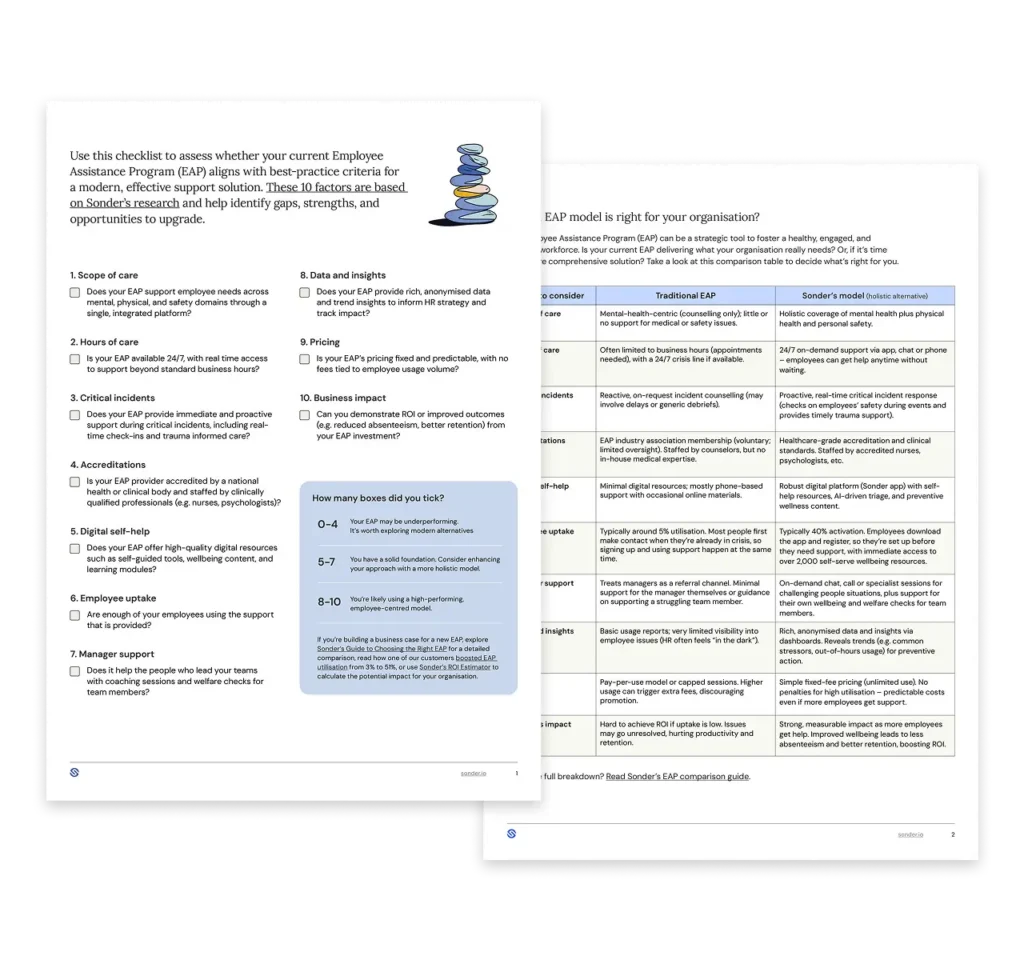
Our checklist helps you assess if your EAP delivers:
Download your copy of the checklist now
Renewing your Employee Assistance Program (EAP) can feel like a formality. The contract rolls over and the year starts again. But if only a small share of your people ever use it, it’s worth asking whether it’s still the right fit.
This checklist covers the 10 factors that show whether an EAP meets the needs of a modern workforce. Work through each one, tick the boxes that apply and use your score to decide your next step.
An Employee Assistance Program (EAP) is a workplace benefit that gives employees access to confidential support, most often short-term counselling. Many organisations offer one as part of their wider approach to employee wellbeing.
Not all EAPs work the same way. Some focus almost entirely on counselling. Others take a broader, more proactive approach.
Most organisations don’t choose the wrong EAP. They choose one that made sense at the time, then renew it because switching feels like a lot of work.
The challenge is that a traditional EAP can look fine on paper and still go largely unused. Typically, around 5% of employees use a traditional EAP. Most first make contact when they’re already in crisis, so signing up and getting help happen at the same time.
When support goes unused, issues can go unresolved. That can affect productivity, absenteeism and retention: the very outcomes the EAP was meant to protect.
Use these questions to assess your current provider, or any provider you’re considering.
Ask: Does your EAP support employee needs across mental, physical and safety domains through a single, integrated platform?
People’s challenges rarely sit neatly in one category. A worrying symptom, a stressful week at home or a walk to the car park that doesn’t feel safe can all affect how someone shows up at work. A traditional EAP is mostly counselling, with little or no support for medical or safety issues. A holistic model covers mental health, physical health and personal safety in one place.
Ask: Is your EAP available 24/7, with real-time access to support beyond standard business hours?
Stress doesn’t keep office hours. Shift workers, parents and people working across time zones often need help outside 9am–5pm. Many traditional EAPs rely on booked appointments during business hours, with a crisis line after hours if one is available. Look for on-demand support by app, chat or phone, so people can get help any time without waiting.
Ask: Does your EAP provide immediate and proactive support during critical incidents, including real-time check-ins and trauma-informed care?
When something serious happens, timing matters. A reactive, on-request model can mean delays or generic debriefs. A proactive approach checks on people’s safety while events unfold and provides timely trauma support.
Ask: Is your EAP provider accredited by a national health or clinical body and staffed by clinically qualified professionals, such as nurses and psychologists?
EAP industry association membership is voluntary and comes with limited oversight. Healthcare-grade accreditation means care is held to recognised clinical standards. Ask who your people will be speaking to, and what qualifications they hold.
Ask: Does your EAP offer high-quality digital resources such as self-guided tools, wellbeing content and learning modules?
Not everyone wants to talk to someone straight away. Self-guided tools let people build skills early and get help on their own terms. If your EAP is mostly phone-based with occasional online materials, you may be missing the early stage where small issues are easiest to manage.
Ask: Are enough of your employees using the support that is provided?
This is often the most telling question. Support only works if people use it. Ask your provider for utilisation data and compare it with your headcount.
How people are onboarded makes a difference. When employees download an app and register before they need it, support is already in their pocket when it counts. Sonder typically sees around 40% activation, with immediate access to more than 2,000 self-serve wellbeing resources. Learn more about improving EAP uptake and utilisation.
Ask: Does it help the people who lead your teams with coaching sessions and welfare checks for team members?
Managers are often the first to notice when someone is struggling. Yet traditional EAPs tend to treat them as a referral channel, with little support for the manager themselves. Look for on-demand advice for challenging people situations, support for managers’ own wellbeing and welfare checks for team members.
Ask: Does your EAP provide rich, anonymised data and trend insights to inform HR strategy and track impact?
Basic usage reports can leave HR teams in the dark. Anonymised insights into trends, such as common stressors or out-of-hours use, help you spot emerging issues and act earlier.
Ask: Is your EAP’s pricing fixed and predictable, with no fees tied to employee usage volume?
Pay-per-use or capped models can trigger extra fees when usage rises. That creates an awkward incentive not to promote the support you’re paying for. Fixed-fee pricing with unlimited use means you can encourage people to reach out without worrying about the bill.
Ask: Can you demonstrate ROI or improved outcomes, such as reduced absenteeism or better retention, from your EAP investment?
It’s hard to show a return when few people use the service. When more employees get help early, it becomes easier to connect support with outcomes like fewer absences and stronger retention. If you’re building a business case, Sonder’s ROI Estimator can help you calculate the potential impact for your organisation.
Look at 10 key factors: scope of care, hours of care, critical incident support, accreditations, digital self-help, employee uptake, manager support, data and insights, pricing and business impact. Together, they show whether a provider offers support your people will actually use.
Start with uptake. Ask your provider how many employees are using the service and compare that with your headcount. Then look at whether the reporting you receive helps you understand trends and connect support with outcomes like absenteeism and retention.
Traditional EAPs typically see around 5% utilisation. Low uptake often happens because people only make contact when they’re already in crisis, rather than having support set up before they need it.
An EAP alternative goes beyond the counselling-led model of a traditional EAP. It offers 24/7 support across mental health, physical health and personal safety, with proactive care that starts before a crisis. Sonder is one example: a people risk intelligence and prevention platform that helps organisations support their people earlier.
Yes. Ask each provider the same 10 questions and score them side by side. It’s a simple way to compare options consistently and build a clear case for your decision-makers.