At a glance:
- AI reshapes work, it doesn’t remove it: Automating repetitive tasks strips out the natural recovery breaks employees relied on, leaving people in near-constant, high-effort mode — and both too much and too little of what remains carries risk.
- Job demands are the #1 psychosocial hazard right now: Sonder’s support data shows job demands appeared in 23% of 9,183 cases tagged between May 2025 and May 2026, more than any other hazard.
- Workforce confidence is shaky: Only 48% of workers feel secure in their jobs, and just 30% are confident their organisation will manage AI-related talent disruption well.
- Leaders can act now: Map what AI is removing from roles, monitor workforce data for early warning signs, and keep conversations about change ongoing.
Artificial intelligence was supposed to make work easier and more efficient.
The initial promise included automating repetitive tasks, improving productivity, and giving people more time to focus on meaningful work. Yet for many organisations, the reality has been more complicated.
As a senior leader, it’s important to recognise that while AI can offer positive opportunities, it isn’t necessarily reducing workloads. As expectations shift, new pressures are emerging. Employees are being asked to learn unfamiliar tools, adapt to changing roles, and navigate uncertainty about what the future of their jobs might look like.
At the same time, leaders are under pressure to drive productivity gains while ensuring their people remain engaged, supported, and psychologically safe. And according to Sonder’s latest report, How to navigate psychological safety in an age of AI, these impacts are already showing up across workplaces today.
What Sonder’s support data tells us about job demands right now
When organisations or their senior leaders think about psychosocial risks, they often focus on major events or critical incidents. However, the most common challenges affecting employees are often embedded within everyday work itself.
Sonder’s support data provides a real-world snapshot of what employees are experiencing. Between May 2025 and May 2026:
- Job demands emerged as the most common psychosocial hazard, appearing in 23% of 9,183 support cases
- Poor support was the next most common psychosocial hazard identified, representing 20% of those cases
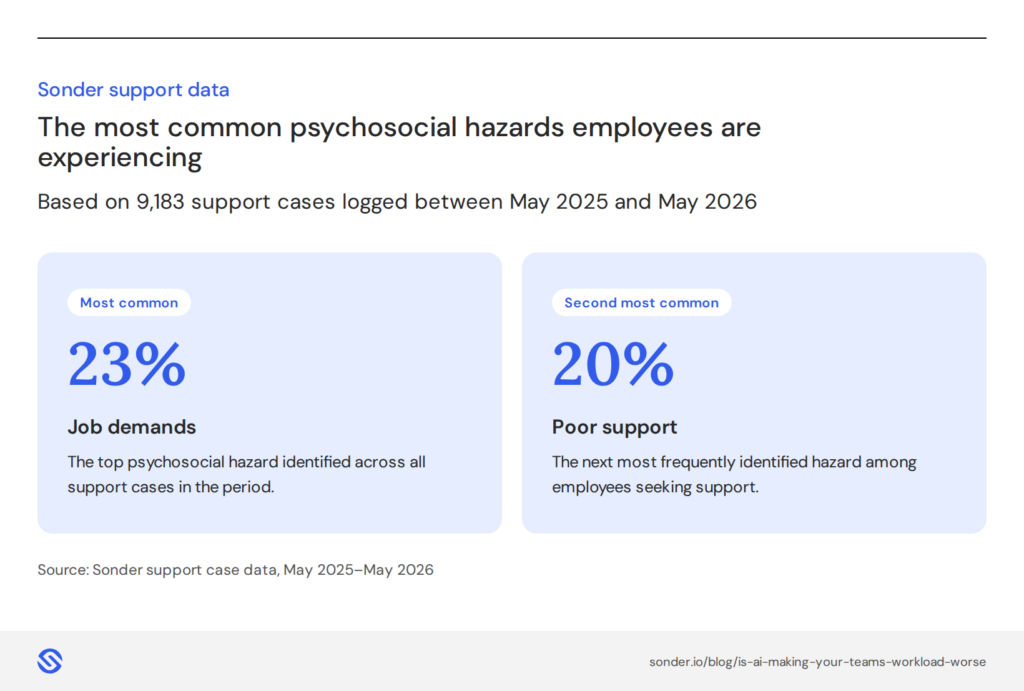
Together, they paint a picture of workplaces where employees are managing increasing demands while often feeling under-supported as they navigate new terrain. And AI has the potential to amplify all these hazards simultaneously.
As organisations introduce new technologies, employees may face:
- Higher performance expectations
- Uncertainty around changing responsibilities
- Pressure to quickly develop new skills
Without the right support structures, these changes can increase both workload pressures and workplace tension.
Broader workforce sentiment reflects this uncertainty. According to Accenture, only 48% of workers feel secure in their jobs, while just 30% are confident their organisation will manage AI-related talent disruption effectively. For leaders, this highlights how AI implementation is as much a people challenge as it is a technology initiative.
“The positivity reverberating across the C-suite does not align with what their workforce is experiencing.”
Accenture Pulse of Change Report
Why AI doesn’t reduce work, it reshapes it
When routine or repetitive tasks are automated, the work that remains can be more complex, cognitively demanding, and emotionally taxing. Employees spend less time completing straightforward tasks and more time solving problems, making decisions, handling exceptions, and managing ambiguity. While this work may be more valuable, it also requires greater mental effort.
Historically, repetitive tasks often provided natural moments of recovery throughout the workday. Employees could switch between high-focus activities and lower-intensity work, creating opportunities for brief mental breaks. As AI removes many of these lower-intensity tasks, employees can find themselves operating in a near-constant state of concentration and decision-making — a clear route to burnout.
As Dominic Price notes in the report, many organisations are attempting to run an old human operating system within a rapidly changing environment. Technology allows work to happen faster, but that doesn’t necessarily mean people can sustainably absorb more work.
We've got an old human operating system that is built for 2006, and we're running the risk of doing the wrong thing faster with AI. We're producing more, faster, but not necessarily better.

Work Futurist, Be Luminous
And high job demands aren’t the only concern. At the opposite end of the spectrum, AI can also create challenges through reduced job demands. When technology begins taking over core elements of a role, employees may start questioning their value or future contribution.
Questions such as “If AI can do the core parts of my job, where does that leave me?” are becoming increasingly common.
This is why AI-related psychosocial risks cannot be viewed solely through a productivity lens. Both excessive demands and insufficient demands can affect wellbeing, engagement, and psychological safety
What are the warning signs of AI-related burnout?
Often, the first signs of AI-related change emerge through subtle shifts in behaviour, performance, and wellbeing.
| For employees experiencing high job demands, leaders may notice: | For employees experiencing reduced job demands, indicators may include: |
| Ongoing stress and elevated anxietyIncreased fatigue and reduced recovery between work periodsMore frequent mistakes or quality issuesDifficulty concentrating or prioritising tasksSigns of emotional exhaustion | Flat motivation or disengagementReduced participation and initiativeIncreased absenteeismWithdrawal from team interactionsLower confidence and diminished sense of purpose |
The signal everyone's missing with AI isn't the tech story — it's the human story. Strong, healthy people are not coping.

Author and Futurist – Mastering change with Andrea Clarke
Organisations may benefit from approaching it as a broader organisational transformation, and MYOB offers a useful example. The organisation established shared ownership between its People and Technology teams from the outset, recognising that AI implementation would affect workforce capability, culture, and employee experience alongside technical systems.
Its “AI Everyday” learning program helped build confidence across the workforce, while more than 2,000 internally developed AI agents were created throughout 2025 to support business operations.
What can leaders do to reduce AI-related job demands?
As AI continues reshaping work, leaders need visibility into both the tasks being removed and the demands being created.
Kristen Raison, Co-Founder of Humn and contributor to our latest guide, highlights an important consideration: organisations should actively map what AI is taking away from a role and what it is leaving behind. This helps leaders identify whether employees are being left with a concentration of highly demanding work or whether key aspects of purpose, mastery, and engagement are disappearing altogether.
Practical actions leaders can take include:
Assess how AI is changing job demands
Look beyond productivity metrics and evaluate how roles are evolving.
Consider:
- Which tasks have been automated?
- What types of work remain?
- Has cognitive or emotional effort increased?
- Are employees spending more time managing exceptions, reviewing outputs, or making complex decisions?
For a deeper dive, explore our guide to understanding the risk and impact of imbalanced job demands.
Use workforce data to identify emerging risks
AI-powered workforce analytics tools can help identify patterns that may indicate rising psychosocial risk.
Examples include:
- Increased after-hours activity
- Meeting overload
- Uneven workload distribution across teams
- Declining collaboration or peer-to-peer interaction
- Reduced use of leave entitlements
These signals can provide early warning signs before burnout or disengagement becomes a more serious issue.
Maintain ongoing conversations about change
Employees need more than technical training when new technologies are introduced.
Regular conversations about role clarity, workload expectations, career development, and wellbeing can help reduce uncertainty and strengthen psychological safety.
Creating opportunities for employees to ask questions, raise concerns, and contribute to AI-related decisions can also improve trust and engagement throughout periods of change.
To learn more about how both human potential and AI are shaping the future of work together, we brought together senior HR leaders and expert voices for a panel discussion. Watch it below.
Why sustainable AI adoption starts with your people
As Kristen Raison notes, psychosocial obligations remain regardless of how work is being performed. The challenge for leaders is understanding how those risks evolve as AI reshapes roles, expectations, and workplace experiences.
Similarly, Ingrid Jenkins, Sonder’s CPO, highlights that productivity doesn’t come from simply deploying new tools. Sustainable outcomes come from bringing people along on the journey.
The conversations about AI at work are usually centred on unlocking productivity. But productivity doesn't come from just deploying tools; it comes from bringing your people with you. The real risk is leaving teams behind.

Chief People Officer at Sonder
The organisations that succeed with AI are those that balance innovation with employee wellbeing, ensuring technology enhances work without exacerbating existing risks or creating new ones.
Only 30% of workers are confident their organisation will manage AI-related talent disruption well. If that number concerns you, Sonder’s How to Navigate Psychological Safety in an Age of AI is the place to start. Expert insights, original data, and practical guidance across six psychosocial hazard categories. Download the report.
FAQS
Not always. AI tends to reshape work rather than remove it — automating repetitive tasks but concentrating what’s left into more cognitively demanding, high-effort work, without the natural breaks repetitive tasks used to provide.
Yes. When AI takes over core parts of a role, employees can start questioning their value and purpose. Both excessively high and excessively low job demands carry risk.
Increased after-hours activity, meeting overload, uneven workload distribution, declining peer collaboration, and reduced use of leave entitlements are all early signals worth monitoring.
Assess how AI is changing roles and workloads, use workforce data to catch emerging risk patterns early, and keep ongoing conversations going about role clarity and wellbeing as change continues.