
At a glance:
- Real support is a practice, not a moment: R U OK? Day 2026 falls on Thursday 10 September 2026. This year’s theme is “Ask R U OK? Any Day”, a reminder that real support isn’t one good conversation a year; it’s noticing early, adapting how you ask, and following through with practical, tailored support.
- The gap between struggling and speaking up is wide: According to Sonder’s State of Employee Health and Wellbeing Report 2026, 77% of employees experience poor mental health symptoms. Yet 78% don’t identify as having a mental health condition, which is exactly why leaders need to know how and when to check in.
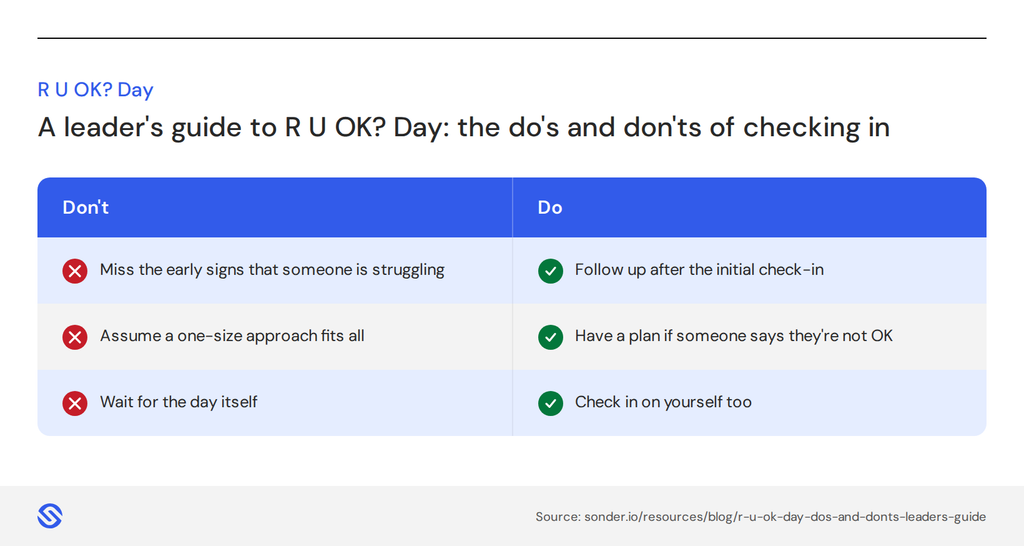
- Understanding the do’s and don’ts of checking in is crucial: This guide covers six dos and don’ts for leaders: spotting early signs, tailoring the conversation, following up, having a plan for “no,” and making it a year-round practice.
Right now, many of your team members are struggling in silence. According to Sonder’s research, nearly half of employees have experienced stress in the past 12 months, with 2 in 5 experiencing anxiety and 1 in 5 navigating depression.
Despite this, only 13% sought professional support. Too often, mental health symptoms are brushed off as “just work”, “a busy season”, or “just part of life”. Many feel their situation isn’t serious enough to seek formal support. Across ANZUK, Sonder’s research shows that 1 in 3 employees put off medical care in the past year, with 42% saying their symptoms “weren’t serious enough.”
As a leader, you have an important role to play in breaking this cycle. R U OK? Day is fast approaching, marking a timely reminder to normalise seeking support in your workplace. But as this year’s theme (Ask R U OK? Any Day) highlights, checking in with your team shouldn’t be a one-and-done initiative. In fact, R U OK? research has found an overwhelming majority (90%) of people who are regularly asked R U OK? feel more supported, connected and cared about.
In this guide, discover six do’s and don’ts for checking in on your team. Plus practical tips, strategies for how to handle these conversations with compassion and care.
What are the early warning signs that a colleague is struggling?
⚠️ Don’t miss the early signs
The signs that someone is struggling can be subtle and easy to miss.
Skipping coffee runs, staying quiet in team meetings, and no longer contributing to social moments can easily be brushed aside as someone having an “off day” or “busy week”.
The first signs of stress, fatigue, and poor mental health are rarely dramatic or obvious. Even things like working long hours but producing little quality work can be an early flag that someone is struggling. That’s why it’s important to tune into the subtle shifts and patterns of behaviour that can indicate it’s time to check in.
Silence is one of the most reliable early warning signs of psychosocial risk.

Co-Founder, Humn
A few common early warning signs to look out for include:
- Silence or withdrawal: Retreating from social interactions (such as sitting alone at lunchtime or skipping casual team chats) can be a sign that someone lacks the mental energy to socialise.
- Changes in work quality or punctuality: A rise in mistakes, missed deadlines, regularly arriving late to work, and an overall decline in productivity and quality of work can signal someone is struggling with stress, burnout and overwhelm.
- Uncharacteristic behaviour: Sudden mood swings, increased irritability over minor incidents, and heightened emotional reactions are common signs that a team member might need extra support.
- Disengagement from things they usually care about: A lack of initiative, apathy, or a total loss of interest in projects they previously enjoyed can signal someone is struggling.
As an employer, proactively protecting the psychological wellbeing of your employees isn’t just a compassionate act. Under WHS law, you are legally obligated to identify psychosocial hazards (such as imbalanced job demands and poor organisational change management) and eliminate or minimise them through proactive risk management. Learn more about your legal obligations to create psychologically safe workplaces.
Is there a “right way” to ask if someone’s okay?
⚠️ Don’t assume one size fits all
Starting a conversation with someone who appears to be struggling can be daunting. But the key thing to remember is that everyone needs a different kind of support, and coming to these interactions with an open, flexible mindset can help you tailor support to their unique situation.
There’s no one-size-fits-all approach or “right way” to ask someone if they’re okay. Start by considering the person and your relationship, and draw on these strategies below to start a conversation that could change someone’s life.
| Approach | What it looks like | Best for |
| Direct, one-to-one conversation | A private, seated conversation: office, meeting room, or a scheduled call | People who are comfortable with direct eye contact and formality, or when the concern feels serious enough to need dedicated time |
| Shoulder-to-shoulder conversation | Side-by-side, doing something else at the same time: walking, driving, working alongside on a task | People who find face-to-face conversation confronting: often men or frontline/shift workers who don’t have a quiet office moment available |
| Casual, low-pressure moment | Grabbing a coffee, a break-room chat, catching someone as they’re packing up | People who’d feel put on the spot by anything that looks like a “meeting,” or early-stage check-ins where you’re not yet sure something’s wrong |
Men always react better to walking shoulder to shoulder than looking across a coffee table.

Founding Director R U OK?
Why shouldn’t leaders wait for R U OK? Day?
⚠️ Don’t wait for the day itself
This year’s theme explicitly calls on leaders, coworkers, family, and friends to make checking in on each other a regular practice, not an annual event.
Mental health struggles are ongoing challenges that require more than an annual morning tea or generic staff-wide emails that fail to address the systemic issues impacting a workforce. In fact, tokenistic gestures can erode trust and prevent employees from speaking up when they need support.
According to Sonder’s research, 63% of employees didn’t access support because they didn’t feel they needed it, while 15% didn’t feel comfortable asking for help and 10% worried their manager would find out.
Building real psychological safety means that seeking support is actively encouraged. From confidential check-ins to 24/7 access to mental health experts, leaders can play a crucial role in normalising conversations about mental health and ensuring support is accessible to teams.
What happens after you ask, and why does follow-up matter?
✅ Do follow up
One of the most important steps you can take as a leader is to make checking in an ongoing conversation, rather than a one-off event.
The first conversation you have with a struggling team member opens the door; a follow-up is what tells someone the door is still open. Consistency is what builds trust and psychological safety and gives team members the opportunity to speak up and seek help early, rather than waiting until small issues spiral into major mental health crises.
In practice, following up looks like:
- A casual “How’s things been since we spoke?” a few days later in your next 1:1 conversation
- Referencing something specific they mentioned (“You said work had been full-on; has that eased at all?”) to show it was actually heard
- Checking in via a channel that suits them: a quick message rather than pulling them aside again or a short chat at the end of a shift
What should a leader do if someone says they’re not okay?
✅ Do have a plan
So, what happens when someone tells you, “No, I’m not okay”? Planning for this situation and having solutions ready is key to becoming a trusted first point of contact for your team.
The goal isn’t for you to become an accidental counsellor. Instead, your role is to triage the situation and point your team in the right direction to seek professional help.
Here’s a simple structure to follow:
- Listen without rushing to fix: Resist the urge to immediately problem solve, and focus on actively listening to what the other person has to say.
- Validate their concerns: A line as simple as “thank you for sharing this with me” or “that sounds really tough” goes a long way.
- Know your pathways: Have clear next steps and multiple support pathways up your sleeve (such as pointing your team to the resources and 24/7 support available from Sonder) so the conversation leads to tangible action.
Keep reading: Discover more practical steps you can take to support someone who is struggling.
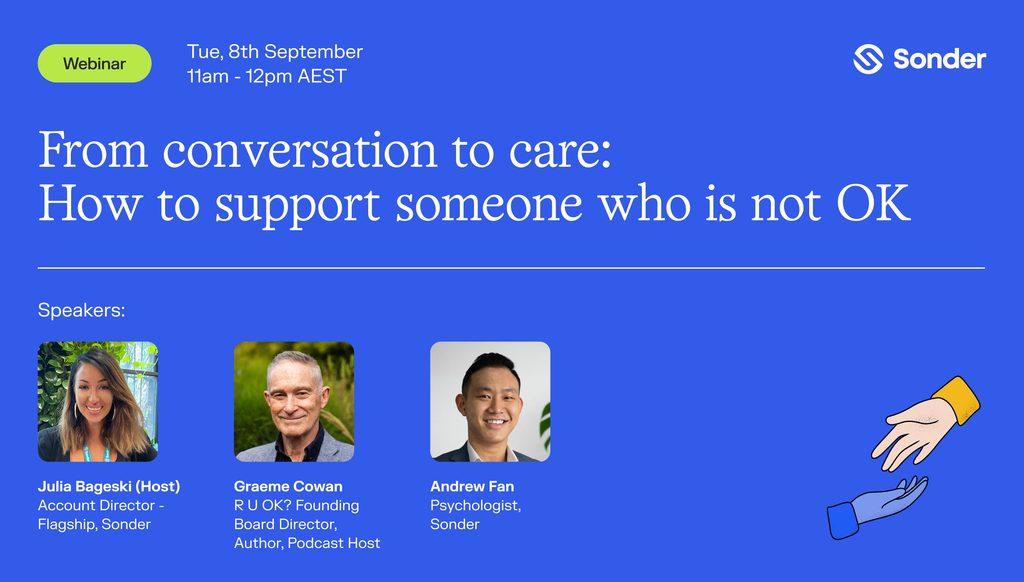
Our recent webinar focused on how to support someone who is not OK. It’s designed to empower leaders to approach these conversations with confidence, whatever the answer. Graeme Cowan, Founding Board Director of R U OK? and Andrew Fan, psychologist at Sonder joined Julia Bageski. Watch it here on demand.
Why is it important for leaders to check in on themselves too?
✅ Do check in on yourself too
R U OK? Day encourages managers to spot signs, start conversations, and follow up with team members who are struggling. But leaders aren’t immune to the same pressures and mental health challenges.
Carrying a team’s wellbeing on top of a demanding workload and the expectations of a leadership team takes a toll. It’s difficult to support others when you’re pouring from an empty cup.
Taking care of yourself is just as important as regularly following up with your direct reports. Build in time to decompress after tough conversations with your team, set firm boundaries around your personal time, and access the same external support you’re encouraging your people to access, too.
Looking for practical tools to safeguard your wellbeing as a manager? With situation-specific guidance, Sonder can connect you and your teams to expert and appropriate care, so you don’t have to shoulder the burden alone.
Make support accessible to your whole organisation
R U OK? Day gives leaders a reason to ask the question. What happens next is what matters.
Spotting the early signs, adapting how you check in, following up, having a plan for “not okay,” and looking after yourself along the way; none of that fits into one day a year.
Leaders don’t have to build that practice alone. Sonder gives your team round-the-clock access to real support, so when someone says they’re not okay, there’s always a clear next step ready.
Book a Sonder demo today and experience how 24/7 access to safety experts, mental health and medical professionals can help you build a supported, healthy workforce.
If you or someone you know needs help, call:
- Emergency on 000 (or 112 from a mobile phone)
- Lifeline on 13 11 14
- MensLine Australia on 1300 789 978
- Suicide Call Back Service on 1300 659 467
FAQs
In 2026, R U Okay? Day fell on Thursday, September 10th. The 2027 date is yet to be announced, but will be an annual reminder to check in on your friends, family, and colleagues and start open conversations about mental health and wellbeing.
The key to starting this conversation and getting it right is to be considerate in how you ask and when you ask the question. Making the question more specific and mentioning a behaviour you’ve noticed in a curious, compassionate way can help to build trust and ground the question in a concern for their wellbeing. Plus, actively listening, not rushing to offer advice, and gently offering a range of support options can show you’re here to help whenever they’re ready.
Start by validating how they’re feeling, avoid rushing to offer advice, and focus on listening. Simple lines like “I’m really sorry to hear that” or “I can see this is really hard for you” are great places to start. Following up with open-ended questions can help the person to share as much as they’re comfortable with, and can help you figure out what kind of support might be a good fit. Finally, suggest some places they might access more support.