At a glance:
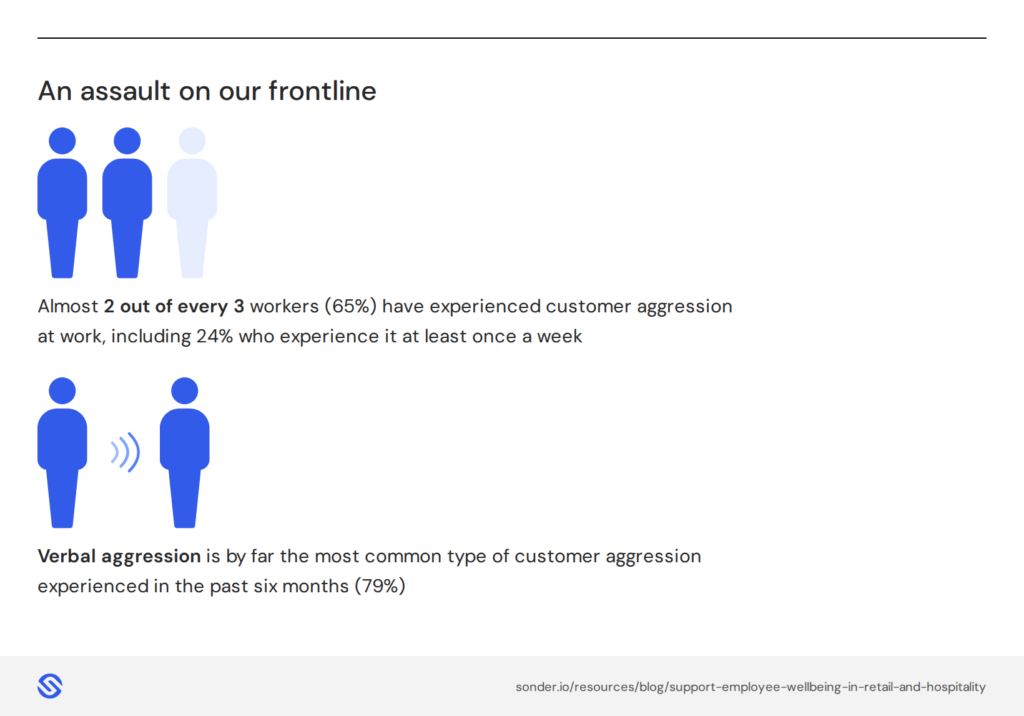
- Customer aggression is a growing frontline reality: Sonder’s Safety Gap Report reveals 65% of workers have experienced customer aggression at work, with 24% experiencing it at least weekly, most commonly in the form of verbal abuse.
- Support gaps remain significant: The same data from Sonder indicates nearly half of retail workers (49%) and 44% of hospitality workers who experience customer aggression report receiving no support afterwards, highlighting a gap in post-incident care.
- Wellbeing pressures extend beyond the workplace: Emotional labour, irregular shift work, and safety concerns during commutes all contribute to a broader and ongoing wellbeing challenge for frontline employees.
- What effective support looks like in practice: Organisations are increasingly adopting accessible, 24/7, mobile-first support models that enable hospitality and retail employees to access help in the moment and strengthen workforce resilience.
Retail and hospitality have always been customer-focused industries. But in prioritising customer needs, workers have too often been expected to shoulder difficult interactions with little recognition of the toll they can take.
While many workplace attitudes have shifted for the better, many retail and hospitality workers still face these experiences today. Customer aggression is often viewed as a customer service issue or simply ‘part of the job’. But it influences how safe employees feel at work, whether they see a long-term future in the role or industry, and even how they feel outside of work.
It might be inherent in the work that there's a risk — but it's not part of the job to be harmed by it.

Australian Psychology Services
What wellbeing pressures do retail and hospitality workers face?
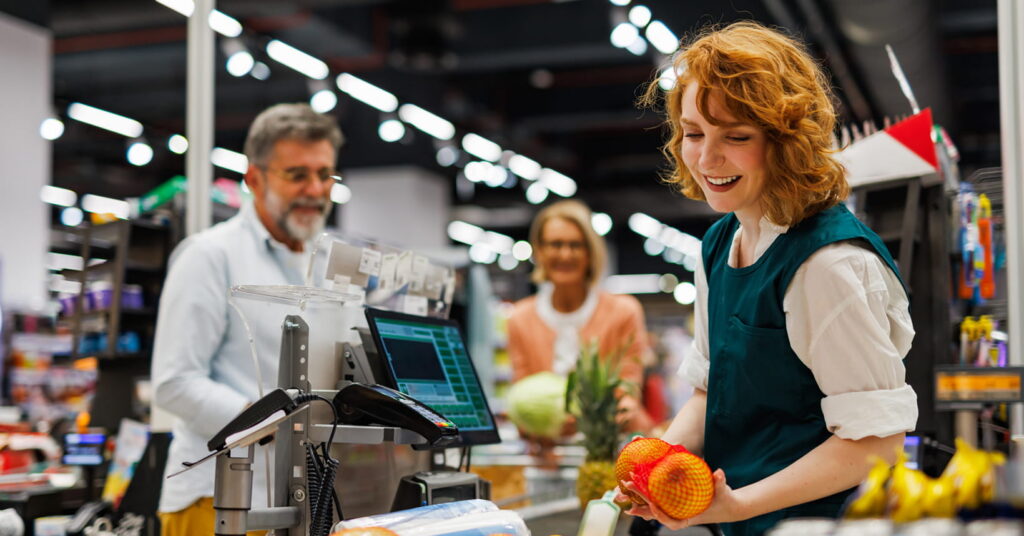
Customer-facing roles require employees to manage competing demands every day:
- Delivering excellent service
- Maintaining professionalism under pressure
- Handling complaints
- Responding to unpredictable situations as they arise
And they’re doing so against a backdrop of rising customer hostility and growing concerns about personal safety. According to Sonder’s Safety Gap Report, 65% of workers have experienced customer aggression at work, with 24% experiencing it at least weekly.
Verbal abuse remains the most common form of aggression, affecting 79% of workers who have experienced customer hostility. However, discrimination, harassment, threats, and physical aggression also remain concerns across frontline industries.
Craig Cowdrey, CEO and Founder of Sonder, has spoken publicly about the types of incidents the organisation supports each week. These incidents may last only minutes, but their impact extends far beyond the interaction itself.
We receive requests for assistance directly from retail staff far too often. This has included acts of physical and verbal abuse and sexual harassment.

CEO and Founder of Sonder
More support is needed: What retail and hospitality data reveals
One important finding from Sonder’s Safety Gap research is not just how common customer aggression has become, but how many workers receive little or no support afterwards.
Among employees who experienced customer aggression:
- 49% of retail workers received no support following the incident
- 44% of hospitality workers received no support following the incident
In environments where customer aggression has become normalised, employees’ difficult experiences can feel minimised. But for managers and senior leaders it’s worth remembering that the response after an incident often shapes how employees perceive their workplace. It influences trust, psychological safety, and whether employees feel supported.
When support is absent, the impact of an incident can linger long after the situation itself has ended.
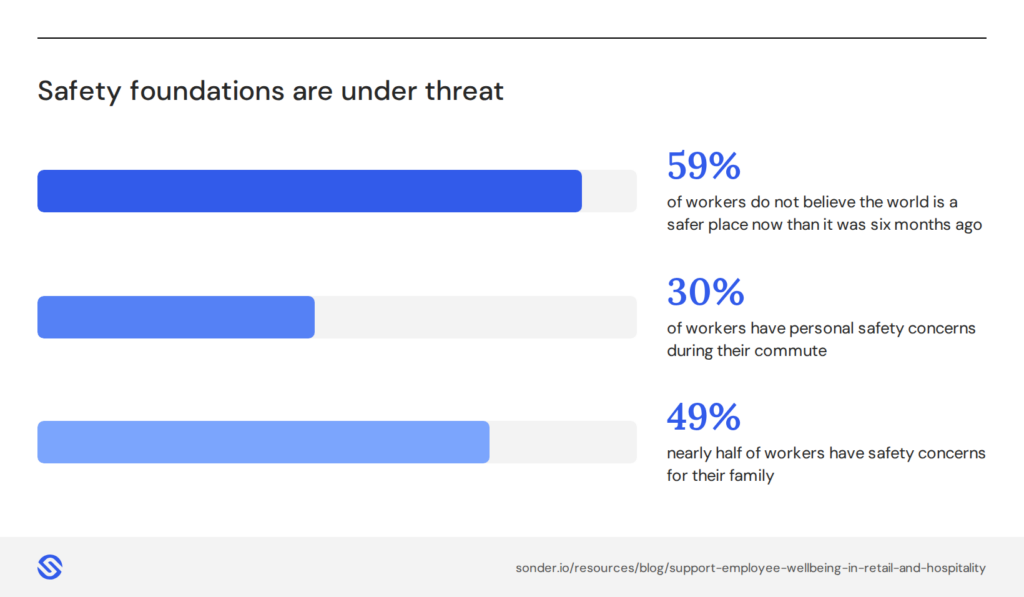
The safety risks also don’t stop when the shift ends either. For hospitality workers finishing late-night shifts and retail employees travelling during early mornings or evenings, personal safety concerns can become part of the broader employee experience. Sonder’s Safety Gap Report found that:
- 30% of workers have concerns about their personal safety during their commute
- While almost half (49%) have safety concerns for family members
Discussions at 2025’s Sonder Summit events reinforced a common theme: many frontline employees want support that is easy to access, practical, and available when challenges arise.
Is an EAP for frontline employees worth it?
Many organisations have invested in traditional Employee Assistance Programmes (EAPs) for decades, but these programs don’t always reflect the realities of frontline work. Shift workers, hospitality staff, retail employees, and healthcare teams often work irregular hours, making it difficult to access support that relies on scheduled appointments and standard business-hour availability.
And accessibility isn’t the only challenge. Employees also need confidence that support is confidential. Research from Sonder’s State of Employee Health and Wellbeing Report found that concerns about privacy can prevent people from seeking help.
For employers, this highlights how an EAP can be a valuable part of a wellbeing strategy, but its impact depends on whether frontline workers can:
- Access it easily
- Trust in its confidentiality
- Use it when they need it most
What is a good EAP for customer service workers?
Retail and hospitality employees need access to support that reflects the realities of their work. Incidents don’t wait for business hours, and neither should support.
24/7 access helps ensure employees can reach someone when they need it, whether that’s after a difficult customer interaction, during a late-night shift, or on the journey home. Equally important is having support available in the moment. Immediate assistance can help prevent situations from escalating and give employees confidence that they don’t have to navigate challenging experiences alone. It can also help people regulate and recover after a stressful or distressing experience.
Effective support should also recognise that managers can’t carry the entire responsibility for employee wellbeing. In retail and hospitality environments, leaders are often balancing customer demands, staffing challenges, operational pressures, and employee needs simultaneously. Providing access to specialist support can help ease that burden while ensuring employees receive the right level of care when they need it.
What are the best wellbeing tools for retail and hospitality workers?
As organisations rethink how they support frontline teams, many are looking beyond traditional wellbeing programs and incorporating personal safety support into their employee wellbeing strategies.
Five ways Sonder can support frontline teams:
- 24/7 access to professional support
- Mobile-first access designed for shift workers
- Confidential and independent support pathways
- Personal safety features for commuting and lone work
- Immediate assistance following workplace incidents
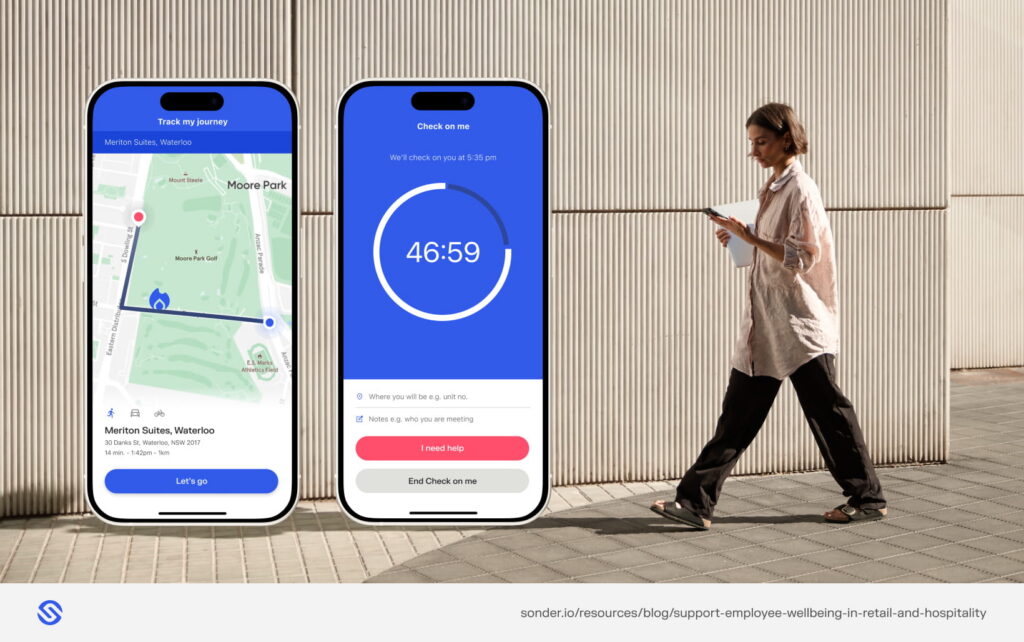
Sonder’s in-app safety features, including Track My Journey and Check on Me, help employees feel supported during commutes, lone work, and situations where they may feel vulnerable.
Here are some examples of ways in which retail and hospitality teams have used Sonder:
- A retail worker who experienced a confrontational customer spent his break chatting to a Sonder Care Specialist on instant chat. He was listened to, empathised with and the Care Specialist was able to recommend some in-app resources. The member felt calmer and more confident returning to his afternoon shift.
- A restaurant worker who has closed up the bar for the night used ‘Track My Journey’ on her commute home. The knowledge that a Sonder Care Specialist was discreetly monitoring her route, and that she could tap a button for immediate assistance, made her feel safe on the night bus.
- A bartender, who was caught up in a violent customer altercation two weeks ago, couldn’t sleep. After thinking he was initially ok after the incident, he found himself ruminating on the event and needed someone to talk to. So he reached out to Sonder.
It's not uncommon for us to see affected employees reach out and engage in Sonder's support via chat at 2am, up to three or four weeks after an incident.

Critical Incident Manager, Sonder
“When incidents do occur – and they will – a person-centred approach is crucial. This means offering varied support options rather than mandating one-size-fits-all interventions… It’s not just the immediate, in the moment response, it’s later that night, later that week, in a month’s time, when the team member is ruminating and can’t sleep, that the lasting impact of occupational violence and aggression can be truly felt. The feedback loop is long term; it’s important that impacted employees know where they can turn in the times that matter to them after the event.”
Nathan Halliday, Chief of Member Operations, Sonder
How retail and hospitality businesses are taking care of their frontline workers
TFE Hotels has integrated Sonder features into its approach to employee safety, requiring Check on Me for managers working alone and encouraging ‘Track My Journey’ for team members travelling to and from work.
Sonder is mapped in TFE Hotel's enterprise risk management framework as a control measure against various risks in our risk profile. It's embedded into our serious incident response process too. We also include Sonder's anonymous utilisation data in our quarterly reporting for our audit risk committee and board, which enables us to have an ongoing conversation across the business around the various risks and identifying opportunities to do more.

Director of Safety and Wellbeing at TFE Hotels
Best&Less has also embedded Sonder into its approach to workforce wellbeing and safety.
As Fadia Nassif, WHS and Injury Manager at Best&Less, explains: “Sonder has become an essential toolkit for keeping our Best&Less ‘Besties’ safe and well, not only in the workplace but also at home. The personal safety tools such as smart check-ins and journey tracking are particularly vital for our frontline workers, especially given the rise in anti-social behaviour. We strongly encourage our Besties to utilise these functions when travelling to and from work.”
For frontline industries where employee wellbeing, personal safety, and customer-facing work are closely connected, having support that is accessible, practical, and available when it matters most can make a meaningful difference to both employees and employers.
Best&Less has seen a 6% reduction in turnover among employees who engage with Sonder, alongside an 8% increase in employee engagement scores. Those improvements have contributed to approximately $1.1 million in savings to the company’s bottom line, reinforcing the business case for investing in employee health, safety, and wellbeing.
Comprehensive health and safety support for frontline workforces
Sonder provides 24/7 early intervention safety, medical, and mental health support for frontline workers, all through one app. Companies like Woolworths, McDonald’s, and Guzman y Gomez trust Sonder to mitigate risk, improve engagement and retention, and protect their frontline workforces.
93% of members were satisfied with Sonder’s response after critical incidents, including aggression at work.
While every organisation’s challenges will look different, the principle remains the same. When employees feel safe, supported, and have access to 24/7 support, the benefits can be felt across the workforce.
FAQs
Customer aggression is hostile behaviour directed at frontline workers, most commonly verbal abuse, but also discrimination, harassment, threats and physical aggression. Sonder’s Safety Gap Report found 65% of workers have experienced it, with 24% experiencing it at least weekly.
Often not. Among workers who experienced customer aggression, 49% of retail workers and 44% of hospitality workers received no support afterwards.
One that reflects how frontline work actually happens: 24/7 access, mobile-first design for shift workers, confidential and independent support, and immediate in-the-moment help, rather than support limited to business-hours appointments.
Personal-safety tools extend support to commutes and lone work. Sonder’s Track My Journey monitors a worker’s route in real time and Check on Me runs discreet safety check-ins, so help is one tap away late at night or travelling home.