
At a glance:
- Most of the work is in the planning. A switch that starts well before your renewal date rarely feels rushed, and rarely leaves gaps in support.
- Timing is the biggest trap. Automatic renewal clauses and notice periods are what lock most organisations in, not the effort of changing.
- No one has to lose their counsellor mid-treatment. A short overlap between providers lets people finish their sessions while everyone else moves across.
- A switch is a chance to relaunch support. Reintroducing a new service to your whole workforce is often what lifts uptake, not the change of provider alone.
If your employee assistance program (EAP) isn’t delivering, you’re not alone. Average EAP utilisation sits at around 5% in Australia and just 3.34% in the UK, yet many organisations roll their contract over year after year.
It’s rarely because they’re happy. When we speak with HR, safety and wellbeing leaders, the same reasons come up again and again:
- The renewal date crept up
- The team is already juggling a new HR system
- Changing providers just feels like a lot
Those concerns are real, but they’re also very solvable. This guide walks through the eight steps organisations use to move on from their EAP without gaps in care, plus how to handle the questions your leaders, your team and your current provider are likely to ask along the way.
Why organisations stay with an EAP that isn’t working
These are the five reasons we hear most often from organisations reviewing their EAP.
‘We missed the renewal window’
This is the most common. A contract renews automatically, the notice period passes, and the decision is made by default. Some leaders only find out their EAP was locked in for another year or more when they start asking questions.
‘We’re already managing too much change’
A new HR platform, a restructure, an acquisition. Many people leaders tell us they can’t ask their workforce to adopt one more system this year. That’s a fair concern, and it’s why a switch is best planned as a relaunch rather than another rollout.
‘We’ve had the same provider for decades’
When an EAP has been in place for 10, 20 or even 30 years, it can feel like part of the furniture. Changing it means bringing in procurement, building a business case and getting sign-off from leaders who may never have questioned it.
‘It’s cheap, and it’s fine’
A low-cost EAP can look like a safe line item. But if only a handful of people use it each year, the cost per person helped is higher than it appears, and the risk of people struggling without support doesn’t show up on the invoice at all.
‘Our provider promised to fix it’
Some organisations raise concerns, their provider relaunches the service, and the pressure eases. But that’s only a good outcome if uptake genuinely improves. The test is whether the numbers move in the following 12 months.
None of these is a reason to stay, and all can be solved with earlier planning.
We often hear that a renewal has crept up, or the team is already rolling out a new system and can’t face another change. But these aren’t reasons to keep an underperforming EAP in place. My advice is to start the conversation well before your renewal date. That gives you time to build the business case, in partnership with your new provider, plan the handover and turn the switch into a relaunch – rather than one more thing on the list.

Senior Account Executive, Enterprise, Sonder
How do you switch EAP providers?
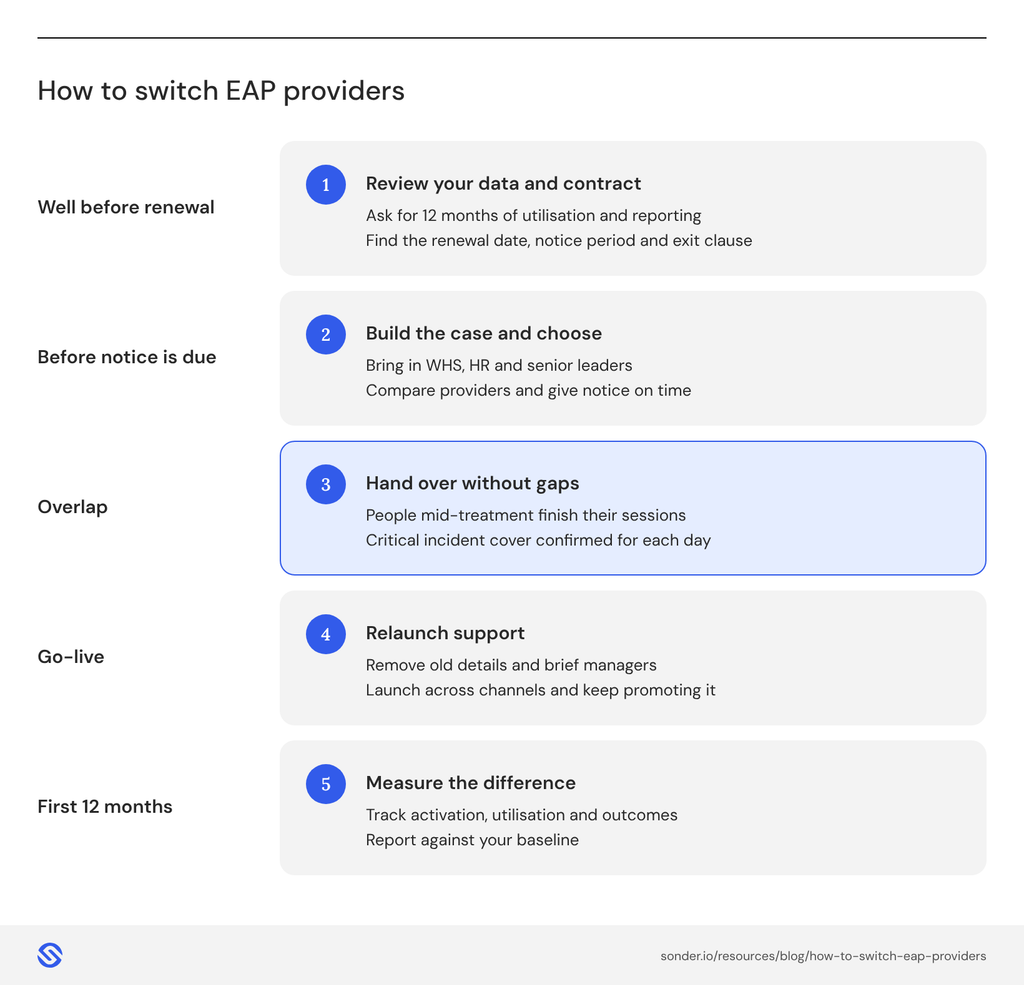
To switch EAP providers without gaps in care, start well before your renewal date and work through eight steps:
- Start with your current data
- Check your contract early
- Bring WHS and HR into the decision
- Protect people who are mid-treatment
- Keep critical incident cover in place
- Clear out the old details
- Launch the new service properly
- Measure the difference
Step 1: Start with your current data
Ask your current provider for the last 12 months of utilisation, wait times and reporting. Check how they define utilisation, because providers count it differently and figures often aren’t comparable.
This gives you a baseline to compare providers against, and a clear case for change. If you suspect the reporting doesn’t match what you’re hearing from your team, note that too. Gaps between the data and lived experience are worth raising with any provider you’re considering.
Tip: Ask for this data well before your renewal date. It’s the clearest way to judge whether your provider has earned another term. And for more tips on comparing EAPs and modern alternatives, check out our guide: (Add link)
Step 2: Check your contract early
Find your contract and look for four things:
- The contract term and end date
- Any automatic renewal clause
- The notice period you need to give
- What happens to your data when the contract ends
If you’ve already missed the window, it’s worth asking your provider for a shorter renewal term. Australian Government guidance recommends a formal review whenever you’re deciding whether to extend a contract, and leaving it to the last minute can mean renewing by default.
Step 3: Bring WHS and HR into the decision
An EAP can be part of how you manage psychosocial hazards. Comcare notes that an EAP can be a work health and safety control, and Safe Work Australia’s model Code of Practice says a control that isn’t working effectively must be reviewed and modified or replaced.
That makes your EAP review a shared decision. Involve your WHS team, health and safety representatives and senior leaders early. In some organisations safety sits within People, in others it’s a separate team. Either way, their input will strengthen your business case and help the change stick.
Tip: If procurement needs three quotes or your board needs a recommendation, build that time into your plan from the start.
Step 4: Protect people who are mid-treatment
This is often the question that stalls a switch: what happens to someone halfway through counselling?
Agree with your current provider that employees already in counselling can finish their booked or requested sessions. Many organisations run a short overlap where both services are live, so people mid-treatment stay with their counsellor while everyone else moves to the new service.
Tip: Individual case notes are confidential and stay with the treating provider. Any transfer of records should only happen with the employee’s consent.
Step 5: Keep critical incident cover in place
A changeover week is no time to be unsure who responds to an incident. Confirm in writing which provider will respond to a critical incident on each day of the transition, and share the new contact details with on-site managers before go-live.
If your contract ends before your new service is ready, don’t leave a gap. A short extension with your current provider, or an earlier start with your new one, is far easier to arrange in advance than in the middle of an incident.
Step 6: Clear out the old details
Remove the old provider’s phone numbers, links and logos from your intranet, induction packs, manager guides and anywhere else they live. That way no one calls a service that’s no longer there.
Tip: Ask managers and site leads to check their own team noticeboards and shared drives. Old details tend to hide in unexpected places.
Step 7: Launch the new service properly
A switch is a chance to reintroduce support to your whole workforce. Many people won’t know what their old EAP covered, or how to reach it. Treat this as a fresh start, particularly if your new provider, like Sonder, goes beyond traditional EAP support. Show people real examples of how they can use medical and safety support, not just mental health.
- Plan a launch across several channels, from team meetings and email to your intranet and on-site materials
- Consider timing it with a moment that matters, such as R U OK? Day, Mental Health Month or the start of a new financial year
- Brief managers on when and how to refer people, and what support is there for them too
- Consider creating internal champions. A few well-placed champions keep momentum going without the full load falling on HR and safety teams.
- Keep promoting it well after launch day, not just in the first week
If your team is already managing a lot of change, a well-planned launch makes the switch feel like one simple message: here’s where to go for help now.
Best practice examples of Sonder launches and promotions:
Launch: Premier Constructions Australia’s Sonder launch included site visits, team briefings and hands-on demonstrations to help their people understand the benefits and features available through Sonder. ‘It was fantastic to see our teams getting involved, asking questions and exploring everything the app has to offer.’
Launch: Before John Holland rolled out Sonder to their workforce, they invited us to their roadshow, showcasing Sonder alongside their other health and wellbeing services.
Reminders: To keep Sonder top of mind for their employees, both Medline Australia and Waipā Networks used Mental Health Month to remind their people about Sonder and its benefits.
Reminders: Woolworths hosted a Wednesday Wellness Day and invited a representative from Sonder to walk the team through the support services and show how accessible help really is. ‘Seeing the team engage, connect, and walk away feeling supported made all the planning completely worth it.’
Step 8: Measure the difference
Track the new service against the baseline you set in Step 1, with monthly and quarterly reporting. Look at activation (people who’ve signed up and can get help the moment they need it), utilisation (people who’ve used a service) and, where you can, outcomes.
This is how you show leaders the impact of the change, and it sets you up for a much easier conversation at your next renewal.
How Sonder supports the switch
Sonder is a people risk intelligence and prevention platform, offering care that starts before crisis. Depending on your package, our app gives your people immediate, 24/7 access to safety, medical and mental health professionals, plus on-site help for time-sensitive situations.
We’ve helped organisations like Woolworths Group, Hays UK&I and Probe CX move on from traditional EAPs.
‘From a tech onboarding perspective it was actually very, very smooth and very easy. We’re a nationally dispersed organisation. And we were actually able to launch quite seamlessly, and focus on the messaging while we’re doing it, as opposed to having to focus on, and spend a heap of time on, the operational side of it.’
Ben Cividin, People Manager, Charter Hall
We know a switch only works if the handover is smooth, so we plan it with you.
- Critical incident contacts and reporting set up before launch: we collect your critical incident contacts and configure your reporting portal before you go live
- Launch materials ready to go: every customer gets the Sonder Marketing Toolkit, with launch resources, email templates, videos, QR codes and promotional assets that can be co-branded
- Hands-on change support: Premium Onboarding adds a dedicated Onboarding Manager, a shared onboarding workbook, product and communications workshops, enablement sessions for members, leaders and People and Culture teams, and regular check-ins through launch and activation
- Ongoing support: If you choose Premium Onboarding, support doesn’t end at launch. Your Customer Insights Partner will provide ongoing communications support, so you can position Sonder for maximum impact, and champion-training sessions, to embed Sonder and boost uptake.
- One place to go for help: the Sonder app can hold your own workplace policies and resources alongside our services, so people aren’t left choosing between numbers.
A switch can feel like a big project, but customers are never doing it alone. Before launch, our implementation team collects your critical incident contacts, sets up your reporting portal and gives you the Sonder Toolkit to plan your launch. Once you’re live, we work alongside you to track activation, keep Sonder front of mind and make sure the change keeps delivering long after launch day.

Senior Customer Success Manager, Sonder
Customer stories: what happened when they switched
Hays UK&I was running three separate services: a digital doctor, an EAP and a wellbeing app. Usage caps and confusion over which to use meant few people used them. Within eight weeks of moving to Sonder, 34% of employees had activated it.
‘Our engagement levels with Sonder have far surpassed anything we had previously — over 55% of our employees have used Sonder, whereas previously we had less than 5% using our previous EAP provider.’
Hannah Pearsall, Head of Wellbeing, Hays UK&I
Probe CX‘s frontline teams had support, but only during business hours. In a three-month trial with Sonder they saw 19.4 times more utilisation than with their previous provider, with 60% of support happening outside business hours. They went on to roll Sonder out across Australia and New Zealand.
Best&Less went from three to 146 employees reaching out for support in one month after switching to Sonder.
Hear it from an organisation that made the switch
Still have questions? Ask them live in our webinar on 19 November.
You’ll hear from Vicinity Centres who moved on from a traditional EAP to Sonder. They’ll share what prompted the change, how they managed the handover and what happened next. Register for the webinar here.
Ready to talk through your own switch? Book a demo and we’ll walk you through how Sonder would work for your organisation, including your transition plan.
FAQs
It doesn’t have to be. Most of the work is in the planning: checking your contract’s notice period and renewal date, making sure people mid-treatment can finish their sessions, keeping critical incident cover in place and relaunching the new service so people know how to use it. A good provider will manage much of this with you.
As early as you can. Check your contract’s end date and notice period first, then work back from there, leaving time for procurement, leadership sign-off and a proper launch. Starting late is the most common reason organisations end up renewing by default.
It depends on your contract. Look for a cancellation or exit clause, and ask your provider directly. If you can’t exit early, ask whether you can move to a shorter renewal term or a month-to-month arrangement while you review your options.
They can usually finish their booked or requested sessions with their current counsellor. Agree this with your current provider in advance and consider a short overlap where both services are live. Case notes stay confidential with the treating provider unless the employee consents to a transfer.
Not always, but a short overlap is sometimes the simplest way to avoid gaps. It gives people mid-treatment time to finish, and gives everyone else time to sign up to the new service before the old one ends.
Set a baseline from your current provider’s data before you switch, then track activation, utilisation and outcomes monthly and quarterly. Ask any provider you’re considering to show you sample reports and explain how they define each measure. Sonder customers get a self-serve reporting portal, set up during onboarding, so you can track activation and engagement from launch.
It depends on your notice period, procurement process and launch plans. Once a contract is signed, Sonder’s standard onboarding typically takes about two weeks from kick-off to launch, depending on setup and stakeholder alignment.
Ask them to walk you through their transition plan: who manages the handover, how critical incident cover will be maintained during the changeover and what reporting you’ll get after launch.