At a glance:
- Most difficult conversations at work don’t fail because of poor delivery. They fail because leaders are solving the wrong problem.
- In this Sonder masterclass, conflict resolution practitioner Zandy Fell (The Zalt Group) unpacked three real workplace curveballs: mental health vs. performance, a high performer quietly undermining the team, and a relationship where trust has completely broken down.
- Her key takeaway: the best leaders aren’t better at talking; they’re better at diagnosis and understanding the real problem before deciding what to say.
The biggest misconception about difficult workplace conversations is that they go wrong because leaders lack the skills and techniques to navigate them. In reality, most experienced leaders know how to structure and navigate conversations. The challenge is, they’re often solving the wrong problems.
When a manager focuses on the emotions instead of the concern, the complaint, not the cause, or the incident rather than the pattern, tricky conversations can be derailed.
And today’s managers are expected to do more with less. According to Sonder’s Manager Support Guide, only 50% of managers agree their employer has provided sufficient support and training to help them support their team’s wellbeing, while 72% say they’re being asked to do more with fewer resources.
According to Zandy Fell, a conflict resolution practitioner, the best leaders aren’t great conversationalists; they’re great at diagnosing problems. With the right training, guidance, and support, leaders can respond to difficult conversation curveballs with confidence.
Zandy joined us for a masterclass to share practical tips on handling three common conflict scenarios. Watch the full recording here, or catch up on the highlights below.
Meet the expert
Zandy Fell is a Director and Employee Relations Consultant at The Zalt Group with over 15 years of experience in workplace conflict resolution. With a background spanning law, industrial relations, and diversity, she specialises in translating complex workplace conflict and culture challenges into practical, human-centred strategies.
Scenario 1: How do you balance compassion and accountability when you suspect burnout?
Most leaders will face this situation during their career: a team member is clearly struggling, but won’t admit it.
The situation: A high achiever has gone quiet. Suddenly, they’re missing deadlines, getting defensive in check-ins, and other coworkers are picking up the slack. While you suspect burnout is the cause, they haven’t mentioned it and deflect when you ask how they’re going.
The trap: As a leader, it’s tempting to wait until you have the full picture to say anything, slip into “amateur psychologist” mode, or keep the conversation vague (“just checking in, how’s it going?”) to avoid conflict.
The solution: Great managers shift the conversation from “what’s wrong?” to “what’s affecting work?”. Once you’ve observed behaviour and its impact on work, that’s enough information to start a conversation. The key is to balance compassion and accountability, and remember you’re not a psychologist (and you’re not expected to be one).
Mental health may explain behaviour, but it doesn’t automatically remove accountability for it.

The Zalt Group
Scenario 2: What do you do about the high performer who’s quietly undermining the team?
“Grey area” people issues are often harder to tackle than clear examples of misconduct. Consider this scenario: No single moment feels serious enough to call out, but a pattern is emerging that’s changing how your whole team shows up.
The situation: An influential, respected team member is starting to sigh, roll their eyes, question decisions, and carry a sceptical tone in meetings. Over time, the rest of the team are getting quieter, decision-making confidence has dropped, and team-wide negativity is creeping in. But nothing in isolation feels significant enough to flag on its own.
The trap: As a leader, it’s easy to treat each moment as an isolated incident (rather than a pattern of behaviour). Waiting for a major incident before acting and avoiding difficult conversations are common; it’s easy to assume that because the behaviour is subtle, the impact is minor, too.
The solution: Zandy encourages leaders to address this as a cultural issue, rather than a conduct one. Ask yourself: “If this continues for six months, what culture am I building?” What can be helpful here is setting clear expectations for attitude (not just performance), and making the whole team aware of what constructive criticism (vs. undermining comments) looks like.
People watch for a leader’s tolerance level. Every unaddressed behaviour becomes a cultural signal, and the issue is rarely the individual comment; it’s the cumulative effect.
The Zalt Group
Scenario 3: What happens when two colleagues say they simply don’t trust each other anymore?
Does this situation sound familiar? There’s no misconduct issue or policy breach, but two people have decided their working relationship is beyond repair.
The situation: Two employees who have previously worked closely together openly admit they no longer trust each other. There are no allegations of bullying, but both describe the relationship as broken beyond repair. Perhaps HR is being asked to step in as the pair believe they can no longer work together.
The trap: In this scenario, managers can find themselves trying to force a reconciliation before either party is ready or framing this as a purely interpersonal issue (without understanding the business risks that need to be addressed). Plus, it’s common for leaders to want trust to be fully restored before allowing the working relationship to continue.
The solution: Before you can repair broken trust, you need to know what’s actually broken. Zandy uses a model from Charles Feltman’s The Thin Book of Trust, which breaks trust down into four separate dimensions: competence, reliability, sincerity, and care.
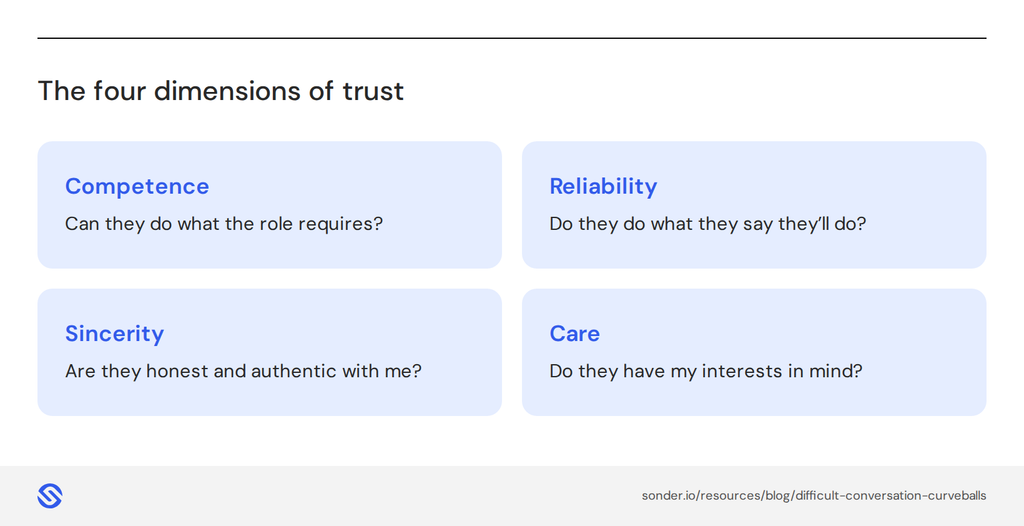
Remember: trust and working relationships are related, but not identical. You don’t need full trust restored for two people to keep working together.
The real leadership challenge is not just repairing the relationship; it’s preventing that breakdown from affecting everyone else.
The Zalt Group
What separates ‘good’ from ‘great’ in a difficult conversation?
Across all three scenarios, the same pattern shows up. “Good” leaders handle the moment well. “Great” leaders zoom out: thinking beyond the one conversation to the system, the team, and the culture it’s building.
| Scenario | Good | Great |
| Mental health and performance | Has the conversation, even if imperfectly Holds support and accountability together, not one or the other Asks “what’s affecting work,” not “what’s wrong with you” | Holds three outcomes at once: the person, the team absorbing the load, and the standard of work Names the shift to a formal process early, rather than springing it Checks: “what’s mine to support, what’s theirs to own” |
| Quiet undermining | Addresses the pattern, not just the latest incident Separates the content (often valid) from the behaviour (not okay) Sets clear expectations about attitude, not just performance ones | Reframes the conversation around influence and responsibility, not just behaviour Asks what conditions let this influence outweigh formal leadership Considers the rest of the team, not just the undermining individual |
| Broken trust | Diagnoses which dimension of trust is strained Treats trust as a spectrum, not all-or-nothing Asserts the organisation’s own expectations clearly | Builds trust back through small, demonstrated commitments Separates “trust” from “working relationship”; one doesn’t require the other to function Contains the impact on the wider team, not just the two people involved |
So what does “great” actually look like in practice? Here’s the checklist to run through before your next difficult conversation.
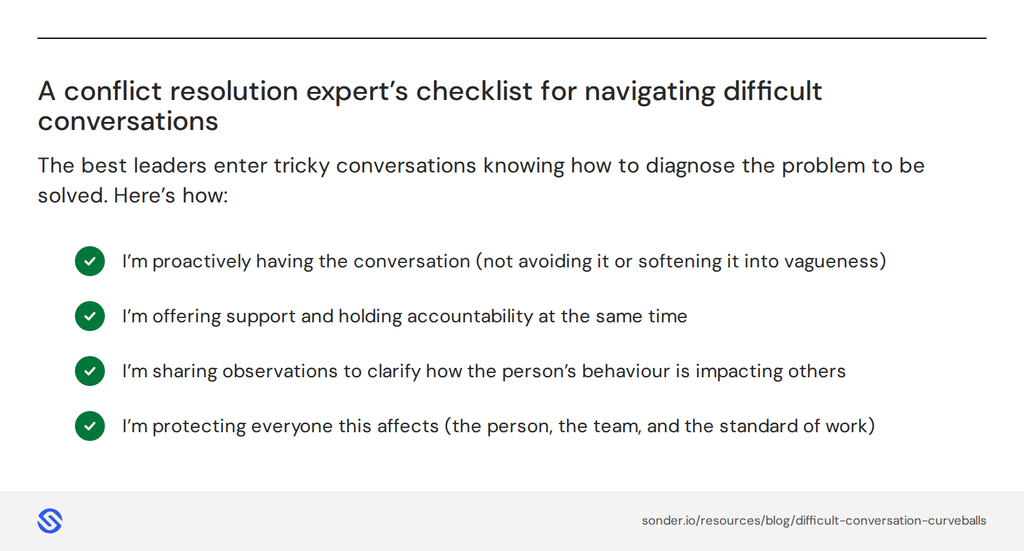
How Sonder can empower your managers to have difficult conversations with confidence
Diagnosing the right problem is one thing. Having the confidence (and the right support) to act on it is another.
That’s where Sonder’s Manager Support program comes in. Rather than leaving leaders to navigate these conversations alone, managers can book a session to discuss the exact situation they’re facing.
Sonder’s 24/7 platform gives employees on-demand access to mental health, medical, and safety professionals, so leaders can focus on building great cultures, confident that their people have somewhere to turn when things get hard. With an average engagement rate of 40% compared to the 3-5% typical of traditional EAPs, Sonder provides support that people actually use — including the managers navigating these conversations themselves.
See how Sonder can support your managers. Request a demo.