At a glance:
- Matrescence is the transition into motherhood: It spans the physical, hormonal, neurological and identity shift through pregnancy, birth and early parenting.
- It affects a large share of your workforce: Three in four UK mothers with dependent children were in work in 2021, and up to 26% of new and expectant mothers experience perinatal mental illness.
- The brain adapts during pregnancy: A 2025 study found the changes were concentrated in areas linked to social cognition and decision-making, and were tied to the strength of mother–baby bonding.
- Leaders don’t have to do it alone: Ask rather than assume, offer a phased return, and pair manager check-ins with 24/7 professional support.
Understanding matrescence in the workplace means recognising that employees becoming mothers are going through a major physical, psychological and identity transition, and adapting how you support them before, during and after parental leave.
Matrescence is the transformational process of becoming a mother: the physical, hormonal, neurological, psychological and identity shift that happens through pregnancy, birth and the first years of parenting.
But while medical anthropologist Dana Raphael coined the term back in the 1970s, it’s taken this long to reach the mainstream. Even now, autocorrect rejects it and the word is still missing from most dictionaries.
A 2026 campaign by parenting brands Peanut and Tommee Tippee pointed out that ‘IDGAF’ made it into dictionaries before ‘matrescence’ did. Peanut’s own survey found that 67% of mothers had never heard the term, despite it describing something the vast majority of them had personally lived through. And if the majority of mothers themselves haven’t heard of the term, how many leaders would say the same?
Language matters, for both mothers and managers. You can’t equip your managers to support a transition they don’t know exists.
This blog explains what matrescence is, why it belongs in workplace conversations and how leaders can support women through it.
What changes in the brain during matrescence?
Matrescence rewires the brain, reshapes identity, and reorders a woman’s entire sense of self. Psychologist Jacquie Ward calls it “one of the most significant identity reorganisations a person can undergo”.
A 2025 study published in Nature Communications, led by researchers at Universitat Autònoma de Barcelona, followed 127 first-time mothers from before conception to six months after birth, alongside non-gestational mothers and women without children. Senior author Oscar Vilarroya summarised the findings: 94% of grey matter showed up to a 5% reduction in volume during pregnancy, following a U-shaped pattern that partially recovers postpartum.
Changes were concentrated in areas linked to social cognition and decision-making, and tracked closely with hormone shifts and the strength of maternal-infant bonding.
What people often misunderstand is that it isn’t just a brief phase. It progresses and evolves as the child grows. It means continually adapting, and in many ways, it’s the beginning of integrating a new identity as a parent.

Registered Clinical Psychologist at Sonder
How many working women go through matrescence?
Matrescence isn’t a niche experience. It’s one of the most common, and most under-discussed, transitions your workforce goes through.
Working mothers make up a large share of the UK workforce. In April to June 2021, three in four mothers with dependent children (75.6%) were in work in the UK, according to the Office for National Statistics.
The transition into parenthood can also take a toll on mental health. Up to 26% of new and expectant mothers experience perinatal mental illness, according to NHS England. That’s why it matters that leaders know the warning signs.
The career and financial impact can last for years. According to the Office for National Statistics, five years after the birth of a first child, mothers’ monthly earnings in England are on average 42% lower (£1,051 a month) than in the year before birth. Part of this drop comes from mothers leaving paid employment.
What changes when a new mother returns to work?
When a new mother returns to work, her priorities, stress tolerance and sense of identity may all have shifted. There’s often a gap between what workplaces think maternity leave is and what becoming a mother involves.
The practical reality for leaders is that if you hire someone before she has children, then welcome her back after parental leave, you may be managing someone who has genuinely changed. Not worse. Not less capable. But different.
Her priorities may have shifted. Her tolerance for certain kinds of stress might have changed. Her sense of identity, at work and outside it, may still be settling. Sleep deprivation and the sheer cognitive load of caring for a baby don’t switch off the moment someone logs back in.
Framing this as a deficit (‘baby brain’) is both reductive and misses what the research actually shows. This is a developmental stage, not a decline. But treating a returning parent as if nothing has changed can be just as unhelpful as assuming the worst.
In a Sonder webinar on supporting working parents, Emma Walsh, CEO of Parents At Work and Founder of Family Friendly Workplaces, shared National Working Families Survey findings showing that the cost of getting this wrong is often attrition.
‘One in four are actually considering leaving their current employment because of the tension that they feel between work and family life.’
Emma Walsh, CEO of Parents At Work and Founder of Family Friendly Workplaces
How can leaders support women through matrescence?
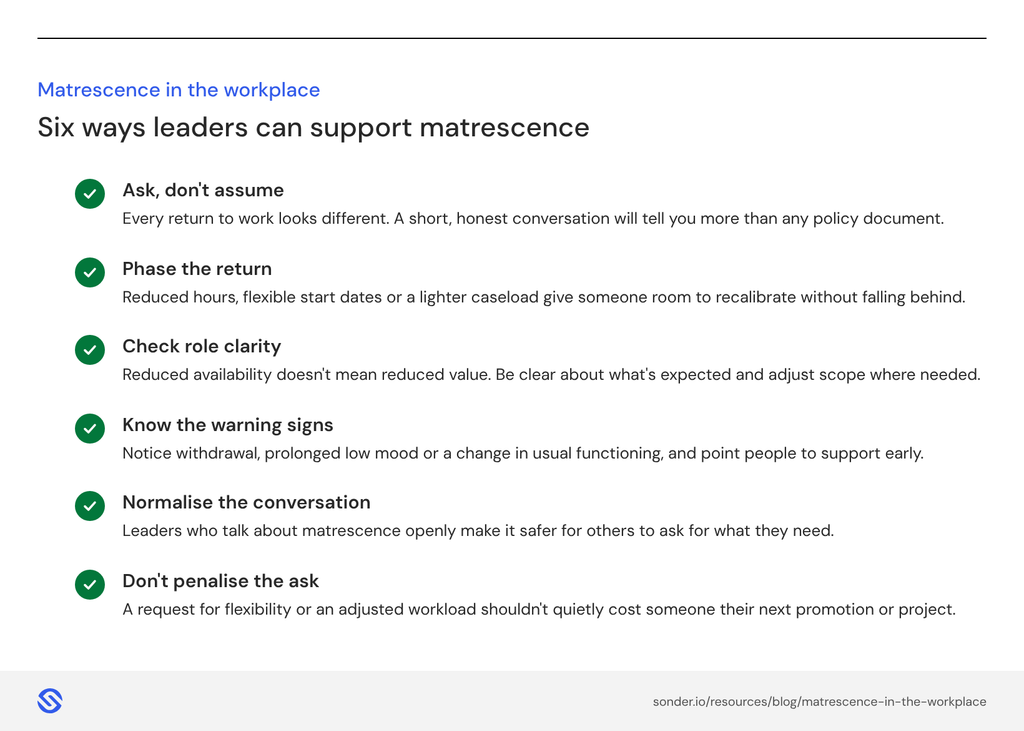
Leaders can support women through matrescence by asking rather than assuming, offering a phased return, keeping roles clear and normalising the conversation. It isn’t about grand gestures or lowering expectations. It’s about a handful of specific, consistent behaviours.
- Don’t assume ‘back to normal’. Ask instead. Every return to work looks different. A short, honest conversation about what’s changed, what support is needed, and what a realistic ramp-up looks like will tell you more than any policy document.
- Build in a phased return where you can. Reduced hours, flexible start dates, or a lighter caseload in the first few weeks all give someone room to recalibrate without falling behind.
- Check role clarity, not just hours. Reduced availability doesn’t have to mean reduced value. Be clear about what’s expected, and adjust scope where needed rather than leaving someone to quietly struggle with an unchanged workload. Sonder’s own data shows job demands are the most common psychosocial hazard raised in support cases, making up 23% of 9,183 hazards tagged between May 2025 and May 2026.
- Know the warning signs of perinatal anxiety and depression. You’re not there to diagnose, but you are there to notice withdrawal, prolonged low mood, or a marked change in someone’s usual functioning, and to point them towards professional support, like Sonder, early.
- Normalise the conversation. If matrescence is never mentioned, employees will assume it’s not something they can raise. Leaders who talk about it openly make it safer for others to ask for what they need.
- Don’t penalise the ask. A request for flexibility or adjusted workload shouldn’t quietly cost someone their next promotion or project. As Emma Walsh put it in the same webinar: ‘That’s not a flexibility problem. That’s actually a management problem. It’s a performance management problem.’
A manager should be guided by the returning parent – assume competence but not necessarily sameness. A lot of things shift during this stage of life, including priorities. The manager’s role is to stay curious and be guided by the employee.’
Registered Clinical Psychologist at Sonder
Why does supporting matrescence matter for retention?
This isn’t only about doing right by your people. There’s a clear business case too.
Turnover linked to poor parental leave and return-to-work experiences is expensive, and the pressure on working parents is widespread. In Bright Horizons’ Modern Families Index 2025, a survey of 3,000 UK working parents and carers, nearly a third said they were feeling very stressed. The Working Families Index 2025 found four in 10 mothers couldn’t take the time they needed after birth, but where employers offered enhanced leave, mothers took six more weeks on average.
Leaders who manage this well stand to retain their experienced, capable people. They can also build trust that extends well beyond parental leave, and impact how supported every employee feels through future life transitions.
Getting this right helps organisations retain talent and capability. When returning parents feel trusted and able to renegotiate their work, employers are more likely to preserve experience, organisational knowledge and employee engagement.
Registered Clinical Psychologist at Sonder
Managers shouldn’t be expected to do it all
None of this means managers need to become mental health experts. Most aren’t trained for it, and shouldn’t be expected to carry it on top of everything else on their plate.
‘[Leaders] can’t probably just turn up and do it and magically be good at this. We do need to think about training and development for them.’
Emma Walsh, CEO of Parents At Work and Founder of Family Friendly Workplaces
This is where having the right support in place matters. Sonder, a people risk intelligence and prevention platform, can take some of that mental load off both the employee and the manager, so leaders can focus on what they’re actually equipped to do: showing up, checking in, and creating a safe environment, while professional support handles the rest.
Through Sonder, employees going through matrescence can access:
- 24/7 medical support: A child’s 2am fever is less stressful when you can chat to or call a registered nurse, day or night.
- Professional mental health support: Counsellors can help with parenting, family, identity and relationship issues, as well as mild to moderate anxiety and depression.
- A wellbeing resource library: Articles, audio and video on wellbeing topics, including parenting.
- Self-paced digital learning programs: Short, self-paced programs on topics such as managing stress and building resilience.
- Family access: Where your organisation offers Family Access, partners navigating the same transition at home get the same support.
‘Last night my son came up in a rash, I used the medical element of Sonder and had an answer from one of the nurses in 15mins and the reassurance I needed. She was thorough and even asked for a follow up the next day which I thought was wonderful! She was lovely and a great reassurance for myself! Very pleased with the app.’
Sonder member
Good intentions and good will matter, but are not always enough to navigate this complex transition. Professional support gives both parties a confidential and neutral space to work through questions and identify appropriate support.
Registered Clinical Psychologist at Sonder
Matrescence happens to a large share of the workforce and is backed by real neuroscience, yet it’s barely spoken about at work. Leaders who understand it are better placed to support their people well, and to keep them.
Sonder’s care starts before crisis, including through life transitions like this one. Talk to our team about supporting your people and managers through matrescence.
FAQs
Matrescence is the process of becoming a mother. It covers the physical, hormonal, neurological, psychological and identity changes that happen through pregnancy, birth and the early years of parenting. Medical anthropologist Dana Raphael coined the term in the 1970s, but it’s still missing from most dictionaries and many workplaces have never heard of it.
No, matrescence isn’t the same as postnatal depression. Matrescence is a normal developmental transition every new mother goes through to some degree. Perinatal anxiety and depression are clinical conditions that can happen during it, affecting up to 26% of new and expectant mothers, according to NHS England. Leaders should know the warning signs.
Matrescence has no fixed end point. A 2025 study in Nature Communications tracked brain changes from pregnancy to six months after birth and found only partial recovery by then. The wider identity shift often continues long after a mother returns to work, and keeps evolving as her child grows.
Managers can support an employee going through matrescence by asking what’s changed rather than assuming, offering a phased return, keeping role expectations clear and watching for signs of perinatal anxiety or depression. They don’t need to be mental health experts. Professional support, like Sonder, can cover what sits outside a manager’s role.