At a glance:
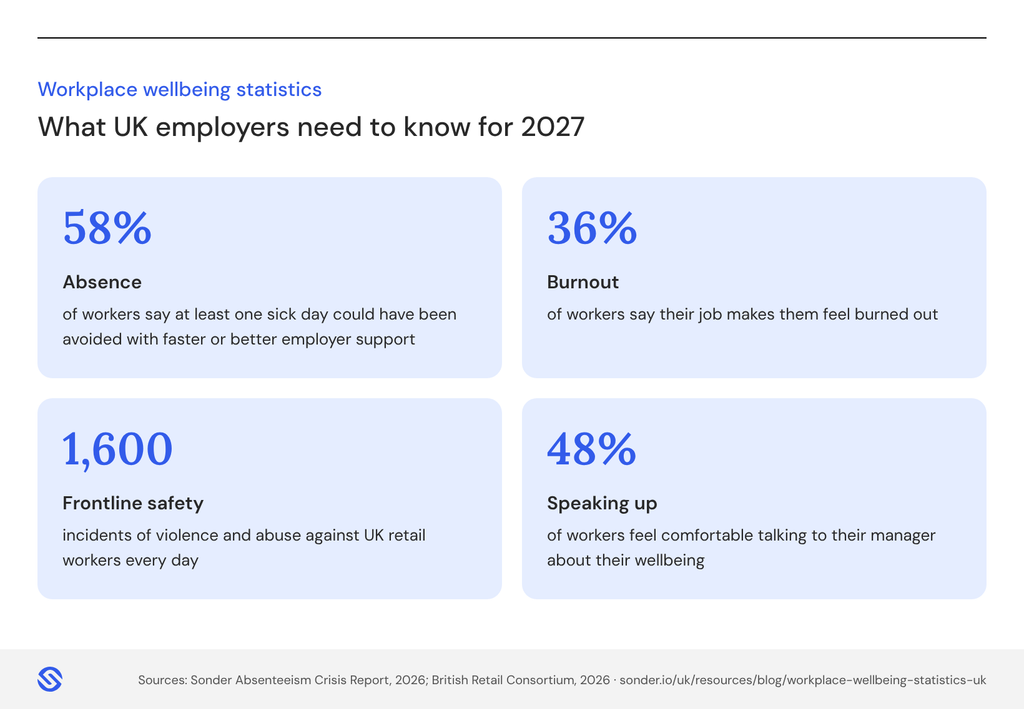
- Absence is costly, and much of it is avoidable: 58% of workers say at least one sick day in the past year could have been avoided with faster or better employer support, according to Sonder’s Absenteeism Crisis Report. And one in 10 say they’re at risk of leaving the workforce within 12 months because of their health and wellbeing, a potential £38 billion a year hit to the Exchequer.
- Stress starts with how work is set up: Heavy workloads (52%), financial pressure (44%) and long hours (43%) are the top drivers of work stress, and 36% of workers say their job makes them feel burned out, according to Sonder’s Absenteeism Crisis Report.
- Frontline teams are absorbing the pressure: UK retail workers face an average of 1,600 incidents of violence and abuse every day, according to the British Retail Consortium, and more than half of retail workers (52%) have faced aggression in the past 12 months.
- People are struggling in silence: Fewer than half of workers (48%) feel comfortable talking to their manager about their wellbeing, and only one in four (25%) have access to any employer-provided wellbeing support, according to Sonder’s Absenteeism Crisis Report.
These UK workplace wellbeing statistics for 2027 suggest that absence costs employers more than many realise, people are struggling in silence and frontline and young workers are under the most pressure.
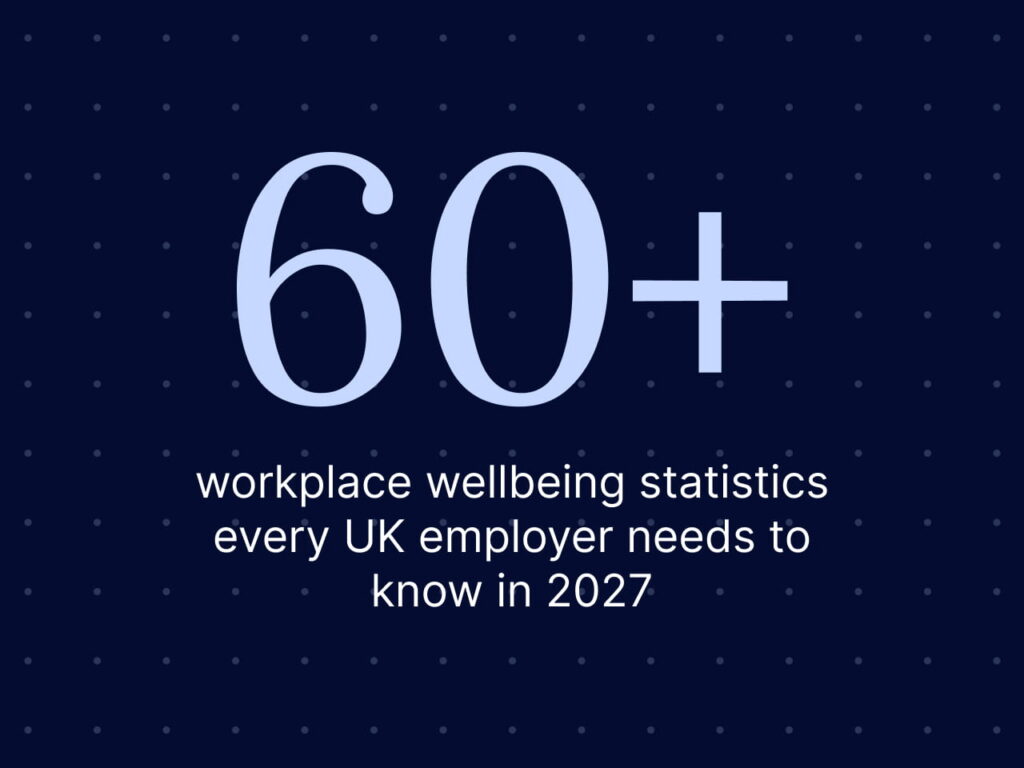
If you’re planning your 2027 workplace wellbeing strategy, this guide brings together 60+ UK statistics every leader needs to know, plus insights from Sonder’s experts, to help you decide where to focus.
How we chose these statistics: This guide focuses on UK data published between 2023 and 2026 by government bodies, charities, researchers and Sonder. Each statistic names its source, with the full reference list at the end of the guide.
Top 10 UK workplace wellbeing statistics for 2027
| Statistic | Source | Year |
| Sickness-related costs to UK employers total around £85 billion a year | Keep Britain Working review | 2026 |
| 2.8 million people are economically inactive due to health conditions | Keep Britain Working review | 2026 |
| 58% of workers say at least one sick day in the past year could have been avoided with faster or better employer support | Sonder Absenteeism Crisis Report | 2026 |
| One in 10 workers say they’re at risk of leaving the workforce in the next 12 months due to their health and wellbeing | Sonder Absenteeism Crisis Report | 2026 |
| 964,000 workers in Great Britain experienced work-related stress, depression or anxiety in 2024/25 | Health and Safety Executive | 2025 |
| Nine in 10 workers (91%) experienced high or extreme pressure in the last year | Mental Health UK | 2026 |
| Fewer than half of workers (48%) feel comfortable talking to their manager about their wellbeing | Sonder Absenteeism Crisis Report | 2026 |
| Retail workers face an average of 1,600 incidents of violence and abuse every day | British Retail Consortium | 2026 |
| Nearly 1 million young people aged 16 to 24 are not in education, employment or training | Department for Work and Pensions | 2026 |
| Nearly 3 million unpaid carers are in paid employment | Carers UK | 2026 |
How much is absenteeism costing UK employers?
Absenteeism is costing UK employers in multiple ways. There are obvious costs (like sick pay) and hidden costs (like paying someone to cover the shift, recruitment costs if they leave and the pressure on everyone left in the team to pick up the slack).
Ill health is the biggest driver of absenteeism, and much of it starts at work. But employers can also play a key role in preventing absenteeism. Earlier, faster access to support is one of the most effective ways to resolve ill health and get employees back to work sooner. Plus, reconsidering how work is designed can help prevent ill health in the first place.
Absence numbers only capture who didn’t turn up. They miss the person who did turn up but was struggling, mentally checked out, running on empty, or just getting through the day. That’s presenteeism, and for young workers it’s often the bigger, less visible cost.

VP & General Manager UK, Sonder
Absenteeism statistics in the UK: key stats at a glance
The scale of the UK’s absence problem
- Over one in five working-age people in the UK are now out of work and not looking for work, with ill health a key driver (Keep Britain Working review, 2026).1
- 2.8 million people are now economically inactive due to health conditions. 800,000 more people are now out of work with health problems than in 2019 (Keep Britain Working review, 2026).1
- An estimated 148.8 million working days were lost because of sickness or injury in 2025, with an average of 4.4 days lost per worker (ONS, 2025).2
The cost of absence to UK employers
- UK employers lose £120 per day per sick employee and face recruitment costs exceeding £11,000 per replacement. Sickness absence is at a 15-year high, with sickness-related costs totalling around £85 billion a year (Keep Britain Working review, 2026).1
- The potential loss to the Exchequer from UK workers leaving the workforce because of poor health and wellbeing, including income tax and National Insurance contributions on the average full-time wage, adds up to around £38 billion a year (Sonder Absenteeism Crisis Report, 2026).4
The number of UK workers who are at risk of leaving
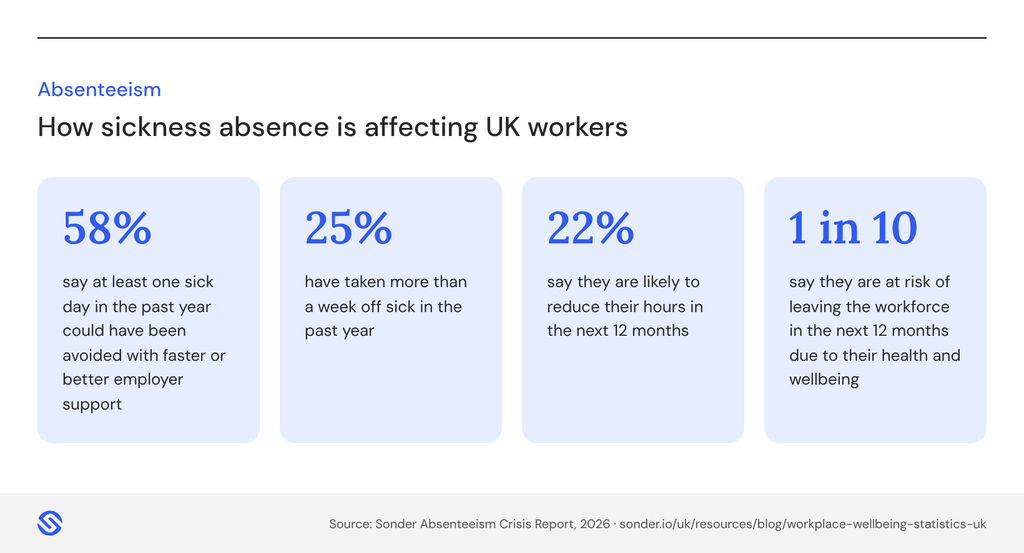
- One in 10 workers say they are at risk of leaving the UK workforce entirely over the next 12 months due to their health and wellbeing. Plus, 22% say they are likely to reduce their hours over the same period (Sonder Absenteeism Crisis Report, 2026).4
- A quarter of workers (25%) have taken more than a week off sick in the past year (Sonder Absenteeism Crisis Report, 2026).4
- Almost a quarter (23%) say colleagues’ sick leave frequently disrupts their work (Sonder Absenteeism Crisis Report, 2026).4
- More than half of workers (58%) say at least one sick day in the past year could have been avoided with faster or better employer health support (Sonder Absenteeism Crisis Report, 2026).4
Barriers to getting support
- Long wait times (37%) are the most common practical barrier to seeking medical support across the UK, Australia and New Zealand, while cost is a barrier for just 9% of UK employees (Sonder State of Employee Health and Wellbeing Report, 2026).14
- 75% of employees across the UK, Australia and New Zealand are aware of workplace support services, but only 17% used them in the past year (Sonder State of Employee Health and Wellbeing Report, 2026).14
- Typical employee assistance program (EAP) usage sits at just 3–5%, while Sonder averages 40% usage (Sonder State of Employee Health and Wellbeing Report, 2026).14
What can employers do to address absenteeism?
- Tell people what support exists: Only a quarter of workers (25%) currently have access to any employer-provided wellbeing support (Sonder Absenteeism Crisis Report, 2026).4 Plus, many employees don’t know what’s on offer. Mention it at onboarding, in team meetings and at shift handovers, rather than expecting employees to find it hidden on your intranet.
- Adjust the work, not just the worker: Look at rosters, workloads and cover arrangements first. If the job’s demands or organisational structure is driving the absence, a breathwork workshop won’t fix it.
- Make support available when people need it: Faster GP access (47%) and faster mental health support (39%) would make the biggest difference to employees (Sonder Absenteeism Crisis Report, 2026).4 That means 24/7 access by app, phone or chat, so someone finishing a late shift can ask for help the same day. Waiting two weeks for an appointment can turn a few days off into a few weeks. Sonder offers 24/7 support by app, phone or chat, delivered by directly employed UK Registered Nurses plus a UK subcontractor network, all under Sonder’s clinical governance.
- Give people a way in that doesn’t run through their manager: Offer confidential support with real people on the other end. Managers still matter, but they shouldn’t be the only way your people can ask for help.
- Plan cover properly: Check in with the people picking up the slack, adjust deadlines to accommodate lower staffing levels, and make it clear that remaining employees aren’t expected to absorb a colleague’s workload while on sick leave.
Keep reading: With the arrival of Day One Statutory Sick Pay (SSP) in the UK, every qualifying sick day now carries an immediate payroll cost. Learn why early intervention is now an employer’s best financial decision.
Why are young UK workers heading for the exit?
Young UK workers are working in the toughest jobs, often with the least support, which is driving many to leave jobs and the workforce entirely. Many start their careers in retail and hospitality, where workloads are high, customer aggression is common and shifts can be unpredictable. Early-career workers also have little power to push back: speaking up can feel like a risk to their employment, their reputation or their next promotion.
As a result, young workers suffer in silence and push through until it becomes too much. For some, that means changing jobs. For others, it means leaving paid employment altogether.
Older employees are like established granite rock. Their professional boundaries have calcified over years of experience. They know where they end and where the job begins.
Younger workers are like soft, spongy coral. They absorb everything around them—the toxic dynamics, the stress, the unreasonable demands—because their professional outer shell hasn’t hardened yet.

Registered Counsellor, Sonder
Young worker statistics in the UK: key stats at a glance
- Nearly 1 million young people aged 16 to 24 in the UK are not in education, employment or training (one in eight young people) (DWP, 2026).3
- Six in 10 young people who are NEET today have never had a job, up from four in 10 in 2005 (DWP, 2026).3
- The estimated cumulative annual cost to the UK economy of almost 1 million NEET young people is £125 billion (DWP, 2026).3
- A 22-year-old leaving work due to ill health is estimated to lose over £1 million in lifetime earnings (Keep Britain Working review, 2026).1
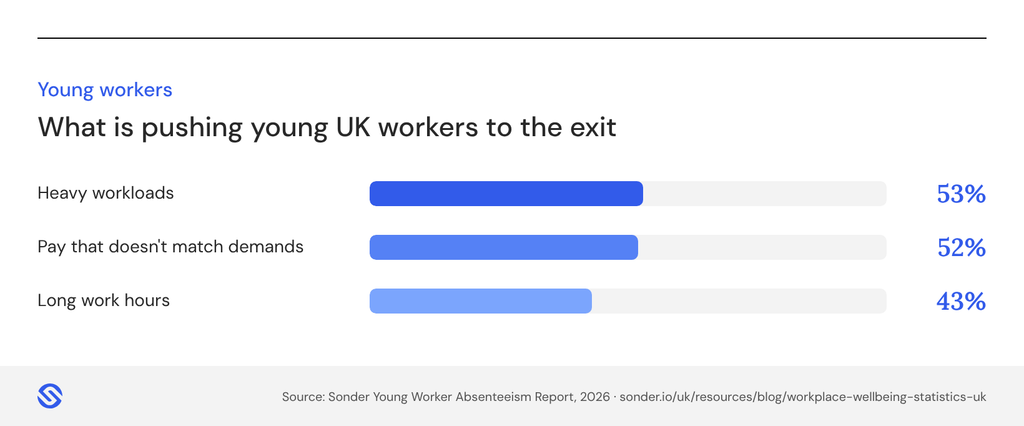
- The key drivers pushing young workers to the exit include heavy workloads (53%), pay that doesn’t match demands (52%) and long work hours (43%) (Sonder Young Worker Absenteeism Report, 2026).7
What can employers do to stop young talent walking out the door?
- Fix the workload, pay and hours first: These are the top reasons young people give for feeling stressed. Check whether work demands and hours are realistic before you add a wellbeing perk on top of them.
- Replace “my door is always open” with structured check-ins: Make wellbeing a standing topic in one-on-ones. That way, young staff don’t have to raise the alarm.
- Give them someone to ask, “Is this normal?”: Pair new starters with a peer buddy who isn’t their manager. Early-career workers often don’t know what’s acceptable, and they’re scared of how asking will look.
- Make safety responses immediate: Offer easy, real-time ways to report aggression or lone-working concerns, not a form to fill in afterwards. Check in with the person straight after an incident.
- Show the action you took after an incident was reported: If you fix something someone raised, say so. Young workers who see action will speak up again, and those who don’t will stop.
- Offer support that works around shifts: Make 24/7, confidential help with a real person available outside 9am–5pm. Many young people work frontline shifts and can’t wait weeks for an appointment.
To make raising wellbeing concerns safe for young workers, organisations must shift from reactive, self-reporting frameworks to proactive, structural support systems.
Registered Counsellor, Sonder
What’s driving work-related stress and burnout?
Most work-related stress stems from how the job is set up. From unrealistic expectations to heavy workloads and long hours, UK workers are struggling in workplaces where job demands don’t match the pay they receive. Add in the pressure to be ‘always on’ and the constant stream of work calls, emails and messages after hours, and it’s not hard to see why most employees can’t switch off.
If left unaddressed, stress turns into burnout, and burnout turns into time off, avoidable mistakes and even resignations. The good news is that employers are well-placed to rethink how work is structured to tackle the root causes of workplace stress and burnout.
Work-related stress and burnout statistics in the UK: key stats at a glance
The state of stress and burnout among UK workers
- A third of workers (33%) describe their overall wellbeing as poor, and nearly two in five (39%) say their job negatively impacts their wellbeing (Sonder Absenteeism Crisis Report, 2026).4
- Nine in 10 (91%) of workers report experiencing high or extreme pressure in the last year (Mental Health UK, 2026).5
- More than a quarter (26%) say they feel stressed or anxious at work every day or most days (Sonder Absenteeism Crisis Report, 2026).4
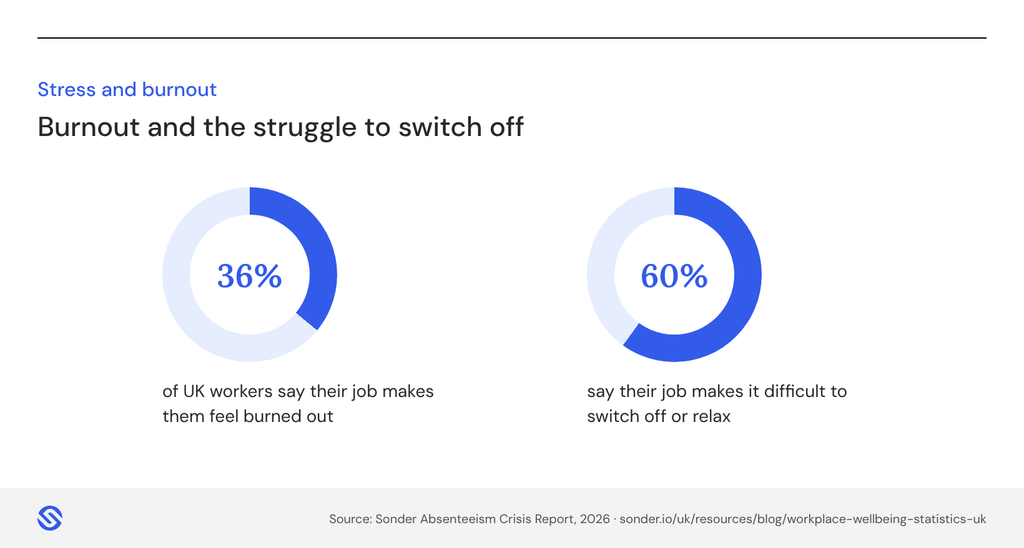
- More than a third (36%) of all workers say their job makes them feel burned out (Sonder Absenteeism Crisis Report, 2026).4
- Shift workers are more likely to feel burned out (40%) compared to non-shift workers (34%) (Sonder Absenteeism Crisis Report, 2026).4
- One in five (20%) of UK workers took time off due to poor mental health caused by stress, rising to two in five (39%) among young adults (Mental Health UK, 2026).5
- Among UK employees who experienced symptoms of poor mental health in the past year, 49% reported stress and 45% reported anxiety, higher than the average across the UK, Australia and New Zealand (47% and 39%) (Sonder State of Employee Health and Wellbeing Report, 2026).14
The causes of work-related stress in the UK
- The top drivers of UK workers’ stress include heavy workloads (52%), financial pressure (44%) and long working hours (43%) (Sonder Absenteeism Crisis Report, 2026).4
- Transport workers are the most likely of any sector to attribute work stress to long working hours (Sonder Absenteeism Crisis Report, 2026).4
The cost and impacts of stress on UK employees
- In 2024/25, 964,000 workers in Great Britain experienced work-related stress, depression or anxiety, leading to 22.1 million working days lost (HSE, 2025).6
- 60% of workers say their job makes it difficult to switch off or relax (Sonder Absenteeism Crisis Report, 2026).4
- Work-related stress and burnout are costing the UK economy £28 billion a year (AXA UK and Cebr, 2023).13
What can employers do to prevent employee burnout?
- Look at the workload first: If the same people are always overloaded, a wellbeing perk won’t help. Review workloads, deadlines and staffing before you add anything on top.
- Be clear about what’s expected after hours: Tell people it’s fine not to reply to emails or messages out of hours. It’s particularly powerful if leaders can role model this behaviour too.
- Make roles and priorities crystal clear: When people aren’t sure what good looks like, they second-guess themselves and overwork. Ask in one-on-ones: “What are your top priorities right now?” and “Is anything getting in the way?”
- Make taking time off normal: Encourage people to use their leave, and don’t reward the person who never switches off. If leaders skip breaks and holidays, everyone else will too.
- Learn the early warning signs: Missed deadlines from a usually reliable person, a change in mood or constant tiredness and headaches are all clues. Raise it early and kindly, before it turns into time off.
Why don’t UK employees ask for help at work?
Many UK workers don’t feel comfortable asking for help because sharing that they’re struggling feels risky. Employees worry about being judged, being seen as less capable or being treated differently by managers. Plus, many are concerned about how this information will be used and whether it will lead to meaningful change in the pressures they face at work.
Health and wellbeing stigma statistics in the UK: key stats at a glance
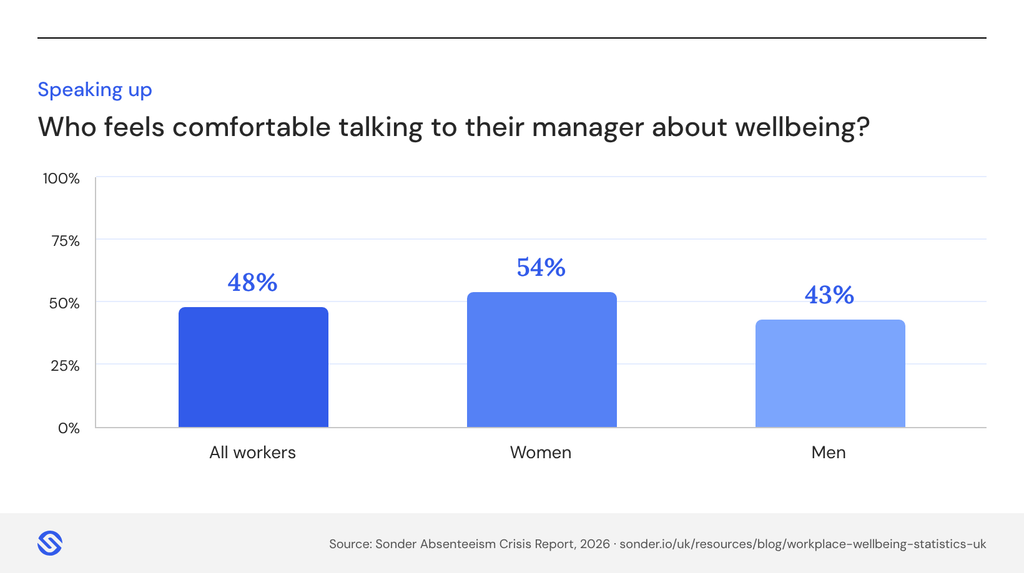
- Fewer than half (48%) of workers say they feel comfortable talking to their manager about their wellbeing (Sonder Absenteeism Crisis Report, 2026).4
- Women (54%) are more likely than men (43%) to feel comfortable having open conversations with their manager about their wellbeing (Sonder Absenteeism Crisis Report, 2026).4
- More than two-thirds (67%) lack confidence in their employer’s ability to support them in a crisis (Sonder Absenteeism Crisis Report, 2026).4
- Over one in three (35%) of UK workers said they did not feel comfortable discussing high or extreme levels of stress with a manager (Mental Health UK, 2026).5
- A third (34%) of respondents would rather avoid discussing their mental health than risk an awkward conversation (Mind, 2025).8
- Almost three-quarters of workers with experience of mental illness (74%) expected to be treated unfairly at work (See Me and Mental Health Foundation, 2025).9
What can employers do to address this stigma?
- Talk about support early and often: Normalise support seeking by regularly referencing where and how to access support in team meetings, one-on-ones and company-wide communications.
- Check in with a simple, open question: Questions that lead with curiosity such as, “You’ve seemed a bit stretched lately. How are you getting on?” are enough to open the door.
- Be open and honest about your own struggles as a manager: Sharing your experiences with stress and the strategies you use to manage it builds trust and shows employees that speaking up is encouraged at all levels.
- Ask what they need, then point them to expert help: “What would be most helpful right now?” gives them some control. Then connect them to confidential support, and follow up a few days later. One conversation is a start, not the finish line.
- Offer support routes that don’t run through a manager: Make 24/7 support available with a real person on the other end and ensure individuals are empowered to reach out on their terms (without having to book a meeting with their manager).
What is driving rising aggression towards frontline workers?
Frontline workers are facing rising incidents of customer aggression due to external pressures and friction in operational systems. Factors like cost-of-living stress are driving up theft, while long queues, faulty self-serve tills and staffing shortages boil over and put hospitality and retail workers in the firing line. Workers are absorbing violence and aggression shift after shift, often with little support afterwards.
Frontline workers have got in touch [with Sonder] after witnessing armed robbery, being subjected to intimidation and shouting, or having had customers throwing things off shelves

Head of Member Support, Sonder
Customer aggression statistics in the UK: key stats at a glance
- More than one in four (28%) of UK workers say they have experienced verbal aggression or abuse in their workplace over the past 12 months. 25% have witnessed verbal aggression directed at a colleague (Sonder Absenteeism Crisis Report, 2026).4
- An average of 1,600 incidents of violence and abuse occur against retail workers every day in the UK (BRC, 2026).10
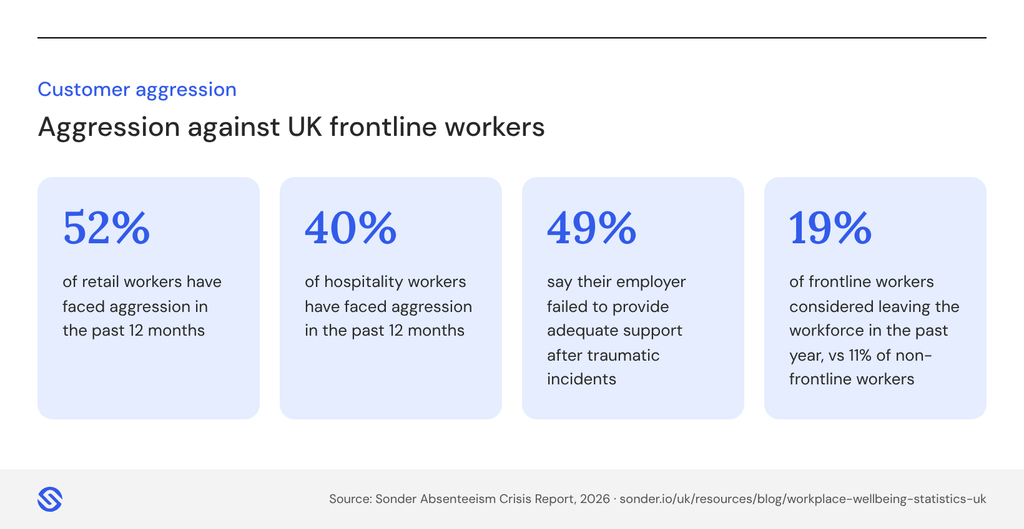
- Two in five UK hospitality workers (40%) and more than half of retail workers (52%) have faced aggression in the past 12 months. Almost half (49%) say their employer failed to provide adequate support after traumatic incidents (Sonder Absenteeism Crisis Report, 2026).4
- 11% of workers reported facing physical aggression in their workplaces, and 10% have seen the same happen to a colleague (Sonder Absenteeism Crisis Report, 2026).4
- One in five workers (20%) say they have felt unsafe at work because of their environment (Sonder Absenteeism Crisis Report, 2026).4
- Frontline workers are almost twice as likely as their non-frontline counterparts to have considered leaving the workforce over the past year (19% vs 11%) (Sonder Absenteeism Crisis Report, 2026).4
We’ve seen this in our own data. 1 in 10 retail workers said they’d been threatened with physical assault, and more than half had thought about leaving the job because of their health and wellbeing.
VP & General Manager UK, Sonder
What can employers do to protect frontline workers?
- Make “abuse is never okay” unmissable: A policy on paper isn’t enough. Tell people clearly what’s unacceptable, what they can do and who has their back.
- Train for the moment, then follow through after it: Pair de-escalation training with clear escalation paths, so workers know when to step back and who to call. Then check in after an incident. Sonder’s 24/7 personal safety support gives frontline and lone workers a way to get help in the moment, not just after the shift ends.
- Ensure reporting is easy and worth it: People stop reporting when they don’t think anyone’s listening or don’t know what happens next. Tell teams you want to hear about incidents at every level of severity. Then track patterns across sites and shifts, not just formal reports, because repeated low-level behaviour is where harm builds up.
- Fix the triggers you control: Customers get frustrated by self-checkouts that fail, understaffing and long waits, and frontline teams are bearing the brunt of it. Review the friction points in your systems and processes. Fixing them is often cheaper than handling the fallout.
- Look out for your youngest and newest workers: They’re the least likely to speak up. Geetika Chhibber, Registered Counsellor at Sonder, suggests structured check-ins instead of “open door” policies, non-managerial peer buddies and visibly acting on what staff raise.
If someone at work is behaving aggressively or asks them to do something that feels unsafe, younger workers may be less confident to challenge it and less likely to know that what they’re being asked to tolerate isn’t normal.

Registered Clinical Psychologist, Sonder
How Southeastern Rail is supporting its frontline teams
Southeastern runs more than 500,000 passenger journeys a day, with around 4,500 staff and a large shift-based and frontline workforce. When someone is absent, the effect is immediate. A single absent driver can mean up to five cancelled trains and more than 5,000 affected travellers. Engagement with its traditional EAP was low, so Southeastern partnered with Sonder to give staff 24/7 access to clinician-led support by app, phone or chat, including personal safety support.
Within two months, 20% of the workforce had engaged. That’s well above the 2–5% typical of traditional EAPs. Half of those who got in touch accessed counselling, and one in three reached a GP. Alex South, Head of HR Shared Services, described it as giving teams “fast, trusted access to care.” Read the Southeastern Rail case study.
How are bereavement and caring duties affecting work?
Bereavement and caring responsibilities are common and often show up as dips in output, patchy attendance and requests to cut hours. It’s not surprising, given that grief piles practical admin on top of intense emotional weight, and caring is a second unpaid job employees do out of hours.
As we heard from Co-Founder of Good Mourning, Sally Douglas in this Sonder masterclass, the biggest challenge is that many caring and grieving employees don’t speak up about what they’re facing in their personal lives, worried about how their employer will respond or how the news will impact their career progression.
Grief and caring statistics in the UK: key stats at a glance
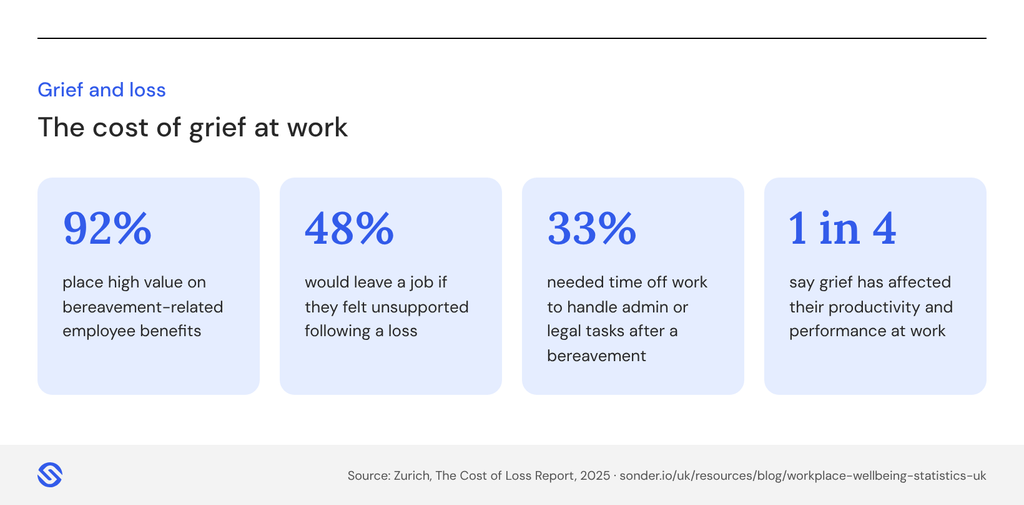
- 92% of respondents say they place high value on bereavement-related employee benefits, and nearly a quarter (23%) say this would influence their decision when considering a potential employer (Zurich, 2025).11
- 48% of respondents say they would leave a job if they felt unsupported following a loss (Zurich, 2025).11
- 33% needed to take time off work to handle administrative or legal tasks after their bereavement (Zurich, 2025).11
- One in four say grief has impacted their productivity and performance at work (Zurich, 2025).11
- Across the UK, nearly 3 million unpaid carers are working in paid employment (Carers UK, 2026).12
- 47% of carers who are employees are considering reducing their working hours or giving up work (Carers UK, 2026).12
- Nearly one in two (48%) carers who had given up work did not feel comfortable speaking to their line manager about the challenges of combining work and care (Carers UK, 2026).12
What can employers do to support grieving and caring employees?
[Grief is] not a problem to be fixed and they’re not someone to be managed. Their grief is something to be held with compassion and care.

Good Mourning
- Don’t mistake grief for disengagement: Grief affects thinking as well as feeling. Someone can look fine while struggling, including a colleague who throws themselves into deadlines. Check in before you performance-manage, and let them lead on what helps. Some people want space to talk, and others want something practical to do.
- Plan the return before they walk back in: Start with a human-to-human conversation before they return, and tell them there’s no pressure to be at full capacity and that you’re available if a day gets hard or heavy. Then build in a flexible first few weeks. For office roles, that could mean reduced hours, phased responsibilities and working from home on harder days. For frontline roles, it could mean an adjusted roster, shorter shifts or back-of-house tasks.
- Keep showing up after the first few weeks: Support tends to drop off around the two-to-six-month mark, which Sally calls the “grief support cliff”. Set reminders to check in at weeks 3, 6 and 10, and keep going past the point where it feels necessary. Small wording changes help too. Asking “how are you today?” instead of “how are you?” signals that you’re opening space for an honest answer.
- Offer flexibility carers can actually use: Statutory carer’s leave is only one week of unpaid leave a year, which won’t go far for someone caring long term. Predictable rotas, flexible start and finish times and shift swaps often make more difference than a policy on paper.
- Point people to expert support: Grief and caring pressures often need more than a manager can offer. Sonder’s counsellors support employees with grief, loss, family and parenting issues, so people have somewhere to turn. For more advice, check out the Sonder masterclass recording with Sally Douglas.
Leaders set the tone. If boards and executives don’t talk about how they pull work and home together, we’re missing the hearts and minds of our people.

CEO, Parents at Work
What is the cost of not investing in employee health and wellbeing?
Doing nothing has a cost, too. Employers pay later and often more, through sickness absence, cover and overtime, recruitment and people cutting their hours or leaving work altogether. And the bill is getting harder to ignore. Statutory sick pay is now payable from day one, and the policy conversation is shifting towards employers doing more to keep people well and in work.
Sonder sits on the DWP’s Keep Britain Working Vanguard Taskforce, and the same conversation is happening there: how do you keep people well and in work, rather than picking up the pieces after they’ve left?
VP & General Manager UK, Sonder
That’s why the smartest employers are moving wellbeing off the perks list and onto the risk register. The question is no longer “can we afford to invest?” but what it’s costing us not to.
Most employee support models only switch on once something has already gone wrong, once someone’s off sick, or has already handed in their notice. For young talent, that’s too late.
VP & General Manager UK, Sonder
Here’s how to shift the conversation from wellbeing perk to risk-reduction investment:
- Track leading indicators, not just days lost: Absence figures tell you what has already gone wrong. Watch the early signals instead, like absence patterns by team, site and shift, how comfortable people are talking to their manager, and how often people reach out for support. The Sonder Portal shows de-identified trends from support interactions, filterable by division and time period, so you can spot pressure points early.
- Build the business case with your own numbers: Averages are a good starting point, but model the return using your headcount, wages, absence and turnover so finance can test it. Sonder’s ROI calculator can help you estimate the value of proactive workforce care.
- Back your managers: They’re the biggest control point, and burnout hits them hardest. Investing in their capability and support delivers the most visible and impactful ROI.
Final thoughts: What to take into your 2027 planning
If you only take away five things from this guide, make them these:
- Absenteeism: Get support in early. Fast access to a clinician can stop a few days off becoming a few weeks, and fixing the work itself prevents a lot of absence.
- Stress and burnout: Fix the work, not just the worker. Workload, pay and hours drive stress, so address them before adding a wellbeing perk.
- Speaking up: Silence is an early warning sign. People, especially young workers, won’t raise concerns unless it feels safe and they see action.
- Customer aggression: Make “abuse is never okay” unmissable, train for the moment and follow through after it.
- Grief and caring: Make space for it. Plan the return to work and keep checking in well past the first few weeks.
The common thread across these workplace health and wellbeing stats? Start acting early, before small issues turn into sick days, resignations or crises.
How Sonder can help
Sonder is a people risk intelligence and prevention platform, built on care that starts before crisis. It gives employees 24/7 access to trained care specialists across mental health, medical and safety support, by app, phone or chat. And it gives leaders de-identified reporting, including workforce health trends surfaced through support interactions, so you can see what’s emerging and act earlier.
Book a demo to see how Sonder can support your people in 2027.
FAQs
Sickness absence is costing UK employers around £85 billion a year, according to the Keep Britain Working review, with absence at a 15-year high. Employers lose an estimated £120 a day for each sick employee, and replacing someone who leaves can cost more than £11,000 in recruitment alone.
In 2024/25, 964,000 workers in Great Britain experienced work-related stress, depression or anxiety, leading to 22.1 million working days lost, according to the Health and Safety Executive. Heavy workloads (52%), financial pressure (44%) and long working hours (43%) are the top drivers, according to Sonder’s Absenteeism Crisis Report.
UK retail workers face an average of 1,600 incidents of violence and abuse every day, according to the British Retail Consortium’s 2026 Crime Report. Sonder’s research found that more than half of retail workers (52%) and two in five hospitality workers (40%) have faced aggression in the past 12 months.
Fewer than half of UK workers (48%) feel comfortable talking to their manager about their wellbeing, according to Sonder’s Absenteeism Crisis Report. Women (54%) are more comfortable than men (43%). Mental Health UK found that over a third (35%) wouldn’t feel comfortable discussing high or extreme stress with a manager.
Young UK workers are leaving because of heavy workloads (53%), pay that doesn’t match demands (52%) and long working hours (43%), according to Sonder’s Young Worker Absenteeism Report. Nearly one million people aged 16 to 24 are not in education, employment or training, and six in 10 of them have never had a job.
Reference list
- Keep Britain Working review – March 2026 update
- Office for National Statistics, Sickness absence in the UK labour market, 2025
- UK Department for Work & Pensions, Young people at work: Interim report, August 2026
- Sonder UK, The Absenteeism Crisis Report, 2026
- Mental Health UK, The Burnout Report, 2026
- Health and Safety Executive, Work-related stress, depression, or anxiety statistics in Great Britain, 2025
- Sonder UK, Young Worker Absenteeism Report, 2026
- Mind UK, Time to Talk Day 2025 Research
- See Me and Mental Health Foundation, Scottish Mental Illness Stigma Study, 2025
- The British Retail Consortium’s Crime Report, 2026
- Zurich, The Cost of Loss: UK’s Bereavement Burden Report 2025
- Carers UK, The Tipping Point Report, 2026
- AXA UK and Centre of Economic Business Research, The true cost of running on empty, 2023
- Sonder State of Employee Health and Wellbeing Report, 2026