At a glance:
- The right now covers all employers: Since 26 August 2025, employers of every size covered by the Fair Work Act must respect employees’ right to disconnect.
- Contact isn’t banned: Employers can still get in touch after hours. Employees can refuse to monitor, read or respond unless refusing is unreasonable.
- The first cases set a high bar: In 2026, the South Australian Employment Tribunal found frequent after-hours messages didn’t breach the right, because employees weren’t prevented from ignoring them.
- Clear expectations protect everyone: Policies, manager training and a shared definition of “urgent” reduce disputes and support wellbeing.
Australian employees now have the right to disconnect and refuse work-related communications outside of hours. In this blog, we unpack what these legal changes mean and how both employers and employees can benefit.
Disclaimer: The information contained in this article and on this website is general information only and does not constitute legal advice. Although all efforts have been made to ensure the accuracy and currency of the information presented, Sonder takes no responsibility for any errors or omissions presented. Please contact a legal representative for individual advice.
From August 26, 2024, employees in Australia gained the right to disconnect from work-related communications outside their working hours. This protection was introduced through the Fair Work Legislation Amendment (Closing Loopholes No. 2) Act 2024 and sits in section 333M of the Fair Work Act 2009. It brings Australia in line with other nations like France, Belgium and Argentina where similar rights have been enacted to support employees’ work-life balance.
The right to disconnect is an increasingly important issue in an age where the lines between work-life and home-life are increasingly blurred. A study from Safe Work Australia found that 33% of workers are experiencing work-related mental health issues due to poor work-life balance. An absence of work-life balance can lead to burnout, a syndrome that results from chronic and unsuccessfully managed stress, among other factors. For organisations, this can mean increased absenteeism and turnover, as well as lower engagement and productivity.
The right to disconnect has applied to employers with 15 or more employees since 26 August 2024, and to small businesses (fewer than 15 employees) since 26 August 2025. That means it now covers all employers under the Fair Work Act, regardless of size. When counting employees, include those of associated entities and casuals who work on a regular and systematic basis.
All modern awards have also included a right to disconnect term since 26 August 2024. These terms explain how the right applies in specific industries and occupations, so check any awards that cover your people.
“Rather than fearing punishment for non-compliance, organisations should see this as an opportunity to improve workforce management, boost productivity, and enhance employee wellbeing.”
Michael Bates, VP Legal at Sonder
Understanding The Right to Disconnect
1. What does it mean for employers?
The right to disconnect provides that an employee may refuse contact, or attempted contact, outside of working hours from their employer or a third party unless the employee’s refusal to do so is unreasonable. The legislation does not prohibit employers from contacting employees, rather, it focuses on protecting employees if they choose not to respond.
Not every attempt to contact an employee outside working hours will contravene the law;an expectation to respond may be deemed reasonable, based on:
- The nature and urgency of the reason for contact
- The method of contact (e.g. a phone call would likely be considered more disruptive than an email)
- Whether the employee is compensated for working outside their ordinary hours
- The level of the employee’s responsibility within the organisation
- The employee’s personal circumstances (e.g. caring responsibilities)
The ‘Right to Disconnect’ legislation represents a significant evolution in Australian employment law. It formalises the balance between professional obligations and personal time, giving employees a robust legal framework to protect their mental health and wellbeing.
Michael Bates, VP Legal & Company Secretary at Sonder
2. What does it mean for employees?
The right to disconnect does not prevent employees from working additional hours, or responding to communications if they choose to. Rather, it acts as a legal buffer, empowering them to maintain clear boundaries and switch-off after their work-day.
Disputes should first be raised and discussed at the workplace. If they can’t be resolved, either party can take the dispute to the Fair Work Commission. The Commission can make a stop order or deal with the dispute in other ways, such as holding a conference. Breaching a stop order can lead to financial penalties. Employees can also contact the Fair Work Ombudsman for information and advice.
The first right to disconnect cases: what employers need to know
In August 2026, the South Australian Employment Tribunal handed down the first reported decisions on Australia’s right to disconnect: Kalleske v Mcguire [2026] SAET 106 and Elliot v Mcguire [2026] SAET 107.
Two apprentices at an Adelaide hair salon claimed their employer breached the right through frequent after-hours contact. This included messages on days off and while on leave, social media videos about non-urgent work, and a request to take the salon phone home over a long weekend.
The Tribunal upheld the apprentices’ other claims, including underpayments and missed breaks, but found no breach of the right to disconnect. It said the test is whether the employer’s conduct prevented employees from exercising their right to ignore contact. How often contact happened, or whether it was unwelcome, wasn’t the test. The owner’s disapproval created some pressure, but there were no consequences for not responding.
Key takeaways for employers:
- Consequences are the line. Penalising or sidelining employees for not responding could turn pressure into a breach.
- These are early decisions. The employer didn’t appear at either hearing, so expect future cases to refine the test.
- Legal isn’t the same as healthy. Frequent after-hours contact can still drive stress and burnout. Job demands are the most common psychosocial hazard in Sonder’s support data, making up 23% of hazards tagged between May 2025 and May 2026.
Putting it into practice
- Establish and communicate clear expectations: Open a dialogue with employees about working hours and the expectations for communication outside of those hours. This should include discussions around what constitutes urgent contact and what procedures will be followed in an emergency.
“We need a job design that enables reflection and rest. Communicating expectations around responsiveness can help, so people know it’s okay not to respond to that Slack message or email. There’s no pressure to respond out of hours. It’s a very simple thing to do , but often we forget the need to set that expectation clearly with others.”
Raechel Gavin, Chief People Officer at Sonder
- Review contracts and policies: Ensure contracts and policies are updated to reflect the new legal requirements. This may include a Right to Disconnect Policy which documents expectations (including when it might be reasonable to expect a response outside of hours), procedures for emergency communications, and dispute resolution pathways.
- Train managers and leaders: Train and empower managers to lead by example. This could include practical tips and tricks such as scheduling emails or Slack messages to be delivered within working hours, or implementing an email signature that states that they do not expect a response outside of working hours.
- Review and adjust compensation strategies: Reassess how employees are compensated for after-hours work. Ensure that any necessary contact outside of normal working hours is fairly compensated and justified.
- Reassess expectations with clients: Set clear expectations with clients regarding after-hours communication. Remember, employees have a right not to respond to communication from third-parties as well.
How Sonder can help
Putting the right support in place is key to implementing the right to disconnect and reaping the rewards of improved work-life balance. As your team adapts to new working norms, it is important to ensure they have access to resources and services that enable them to effectively manage their wellbeing and switch off outside of working hours.
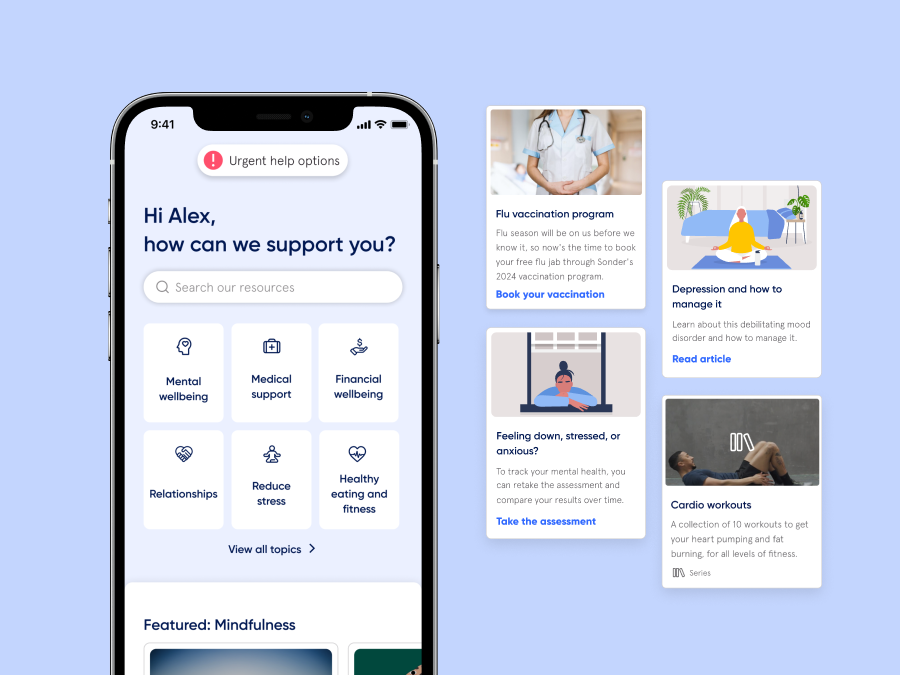
Through Sonder, your employees can access tailored learning and self-help resources, including a content series dedicated to work-life balance (our second most viewed series). These resources are helpful for managers seeking to lead by example, implement the right culture, and support their teams to recharge outside of work hours. Beyond content, the Sonder app also provides 24/7 support pathways for employees to access health, safety, and care services outside of work hours.
Employers can be confident that they’re offering their employees comprehensive and accessible wellbeing support while remaining compliant with the latest legislation and fair work practices.
Sonder’s psychosocial risk management solution also helps leaders identify and act on workplace hazards like high job demands, using real-time insights from employee support.
Ready to improve productivity and employee wellbeing?
Sonder is a workforce health and safety platform that provides the right care at the right time for personal safety, medical, and mental health needs. The Sonder app offers 24/7 immediate connection to expert support via chat or call, personal safety tools like smart check-ins and journey tracking, and access to wellbeing resources such as personal assessments and self-care content.
For more information about how Sonder can help you reduce people related risks and costs, ensure compliance, and build a resilient, productive workforce, we invite you to contact us here.
FAQs
Yes. The right to disconnect doesn’t ban contact. It gives employees the right to refuse to monitor, read or respond to work contact outside working hours, unless refusing is unreasonable.
Yes. It has applied to small businesses (fewer than 15 employees) since 26 August 2025, and to larger employers since 26 August 2024.
It depends on the circumstances. Factors include the reason for the contact, how it’s made and how disruptive it is, whether the employee is paid to be available, their role and level of responsibility, and their personal circumstances, such as caring responsibilities.
Not in the first reported cases. In 2026, the South Australian Employment Tribunal found no breach because the employer’s after-hours contact didn’t prevent employees from disconnecting. Future cases may take a different view, particularly where employees face consequences for not responding.
Disputes should first be raised at work. If unresolved, the Fair Work Commission can make a stop order, and breaching that order can lead to financial penalties.