At a glance:
- A slow-building hazard: Inadequate reward and recognition is a psychosocial hazard, characterised by a sustained imbalance between what employees give and what they get back.
- AI risks widening the gap. As AI increases output and expectations, acknowledgement and meaning often don’t keep pace, making this hazard harder to manage.
- High performers are most exposed: They’re often “rewarded” with more work, not genuine recognition, putting your best people at greatest risk of burnout and attrition.
- Systems beat memory: Leaders address this by building recognition into rhythms and systems, not by leaving it to individual manager style.
Leading a project and exceeding every KPI, but never hearing about it. Being passed over for a promotion with no explanation. Watching your office-based colleagues get shoutouts in team meetings, while your work as a remote employee goes unmentioned.
These are everyday examples of inadequate reward and recognition, a psychosocial hazard characterised by an imbalance between the effort employees put in and the value they receive in return. As a legally recognised workplace hazard, leaving it unaddressed can lead to increased harm, reduced productivity, and a heightened risk of employee turnover.
It’s also widespread. Nearly half (49%) of Australian and New Zealand employees are experiencing feelings of burnout or exhaustion, and 52% report their mental health is suffering, according to a survey by Sonder. And while burnout tends to result from multiple factors, a lack of reward and recognition at work is certainly one of them.
In this article, we unpack what inadequate reward and recognition means as a psychosocial hazard, the factors that contribute to it, the impacts on people and organisations, and share practical ways to reduce the risk while keeping your teams motivated, supported and engaged.
This is part of a series on understanding psychosocial hazards. Other features in the series include:
- Understanding the risk and impact of poor role clarity
- Understanding the risk and impact of imbalanced job demands
- Harmful behaviour in the workplace and how to navigate it
- Navigating traumatic events or material in the workplace
- The risk and impact of isolated or remote work
- How to overcome poor organisational change management
- Organisational justice explained
- The risks and impacts of a poor physical work environment
- Understanding the risk and impact of low job control
- Poor support in the workplace and how to navigate it
Disclaimer: The information contained in this article and on this website is general information only and does not constitute legal advice. Although all efforts have been made to ensure the accuracy and currency of the information presented, Sonder takes no responsibility for any errors or omissions presented. Please contact a legal representative for individual advice.
What is inadequate reward and recognition?
Inadequate reward and recognition is a psychosocial hazard that occurs when there’s a severe, sustained and frequent imbalance between what an employee contributes and what they receive in return, according to Safe Work Australia.
| Reward | Recognition | |
| What it is | Tangible or financial return an employee receives (such as bonuses, benefits, promotions or additional paid leave) | Acknowledgement of an employee’s effort (such as verbal praise, public celebration, and inclusion in decisions) |
| Who delivers it | Set at an organisational level by HR and leadership teams | Comes from managers, peers, and senior leaders |
| How often it happens | Usually tied to performance cycles or project milestones | Should be ongoing, timely, and specific to the contribution |
| What happens without it | Employees feel undervalued, question their worth, and may look for better compensation elsewhere | Employees feel invisible, lose motivation, and disengage (even if pay is competitive) |
It’s more than a manager forgetting to share feedback occasionally, or missing a chance to say thanks after a busy quarter. Your people want to know that their efforts and contributions are fairly valued. In the workplace, reward and recognition covers everything from financial compensation to non-financial acknowledgement, such as praise, visibility and career progression.
When both are missing, employees can experience low motivation, low productivity, and heightened stress, burnout and disengagement. Over time, this can lead to increased presenteeism and absenteeism, and reduced employee retention.
What contributes to inadequate reward and recognition?
Inadequate reward and recognition usually results from systemic gaps in how employees are celebrated, as well as leaders failing to foster a culture of praise and recognition.
There are a range of contributing factors that may be present in your organisation, including:
- Output-only performance cultures: Employees are measured on deliverables and output, not effort, professional growth or adaptability.
- One-size-fits-all approaches: When reward and recognition are standardised or generic, such as company-branded swag, they rarely hit the mark for the individuals being recognised.
- Inconsistent or informal recognition: Praise that depends on a manager’s personal style rather than organisational design, heightening the risk of bias, favouritism and inequality.
- Pay inequity or lack of transparency: Employees who don’t understand how compensation decisions are made experience lower trust and higher frustration.
- Unclear or inaccessible promotion pathways: When people can’t see a way forward, the present feels like a ceiling, leading employees to feel undervalued and unmotivated.
The rapid adoption of AI also presents new challenges. Dominic Price, Work Futurist at Be Luminous, argues most leaders are still asking ‘How do we use AI to do more?’ Through a psychosocial lens, he says that question often drives inadequate reward and recognition: effort and expectations rise, but acknowledgement doesn’t keep pace.
We’ve got an old human operating system that is built for 2006, and we’re running the risk of doing the wrong thing faster with AI. We’re producing more, faster, but not necessarily better.

Work Futurist, Be Luminous
As AI accelerates the speed of work, companies need to ensure reward and recognition initiatives keep pace to avoid team disengagement.
Inadequate reward and recognition is also closely tied to organisational justice. Reward and recognition only feel meaningful and motivating when employees know a company operates from a place of fairness. Otherwise, these gestures can feel performative or hollow.
What are the risks of inadequate reward and recognition?
When a lack of reward and recognition becomes a persistent, frequent issue, there are wide-reaching risks for both individuals and organisations.
- Disengagement and “quiet quitting”: Going ‘above and beyond’ no longer feels worth it for team members who aren’t recognised or rewarded for their discretionary effort. Over time, your best people will stop putting their hand up for extra projects and only do the bare minimum required to get by.
- Burnout: If high performers are assigned more work after exceeding expectations, rather than being rewarded with recognition, they risk becoming disengaged, visibly fatigued and drained by an increasingly heavy workload.
- Attrition: Top talent will leave for workplaces where their contribution is seen. Sonder’s Safety Gap Report 2025 reveals the scale of workforce disengagement more broadly with half the workforce (50%) is disengaged.
- Erosion of psychological safety: Employees who feel unseen are less likely to raise issues, share ideas or flag risks.
We tolerate a low standard, and that low standard becomes the benchmark. You get mediocrity at best and underperformance at worst — and that’s when your high performers leave.

Founder & Leadership Coach, Boldside
How do you identify inadequate reward and recognition in your team?
To address inadequate reward and recognition in your workplace, you first need to identify what challenges your people are facing. There are several ways you can build a picture of what’s happening in your team.
| Signal | What to look for |
| A drop in quality or initiative from high performers | An employee who previously took ownership, delivered consistently, and showed initiative begins producing work that feels flat or requires more direction than usual. Consider whether their contribution has been acknowledged recently; disengagement driven by poor recognition often surfaces here first. |
| Increased cynicism or detachment from team conversations | A team member who once engaged actively in discussions becomes harder to read: quieter in meetings, less invested in outcomes, or more likely to make dismissive comments about the organisation or its direction. Cynicism is often what disengagement sounds like when it starts to find a voice. |
| Employees not putting their hand up for new opportunities | When recognition is missing, the implicit message employees receive is that extra effort leads to nothing. Over time, they stop volunteering for projects, stretch assignments, or visible work; not because they lack capability or ambition, but because experience has taught them it won’t be seen or rewarded. |
| Voluntary turnover among top talent | High performers are typically the first to leave when recognition falls short, because they have the most options. If strong employees are exiting and exit interviews indicate they feel undervalued or overlooked, the recognition gap is likely already well established. |
How can leaders address inadequate reward and recognition?
Consider the following strategies to close the recognition gap and boost engagement, productivity and retention:
- Make recognition specific and timely: Generic praise lands less well than specific acknowledgement of a particular contribution. Encourage managers and teams to celebrate wins and effort regularly with tailored, timely praise.
- Build recognition into the rhythm, not just reaction: Create a culture of frequent reward and recognition by establishing team rituals, structured shoutouts, and regular feedback loops that don’t rely on a manager remembering to act.
- Audit the recognition gap: Ask employees directly, “Do you feel your work is seen?” or “Do you understand how compensation decisions are made?” Use this feedback to shape your reward and recognition program going forward.
- Explicitly recognise AI adaptability: As AI changes workflows, employees doing the hard work of upskilling and adjusting need to be acknowledged for that effort, not just the output.
- Clarify progression pathways: Reward isn’t only pay or bonuses. Involve your team in their own career development, and make sure they can clearly see the pathways available to them.
Wellbeing isn’t a perk, it’s a performance system. The companies that understand this are the ones consistently outpacing their peers.

Chief People Officer, Culture Amp
FAQs
Yes. Safe Work Australia recognises it as a psychosocial hazard when there’s a severe, sustained and frequent imbalance between what an employee contributes and what they receive in return.
A manager forgetting to say thanks once isn’t the hazard. It becomes one when the imbalance is persistent and systemic, not a one-off.
As AI increases output and expectations, acknowledgement often doesn’t keep pace, widening the gap between effort and reward.
How Sonder supports employees and organisations
To get reward and recognition right, your organisation needs to consider how work is designed, measured and led, and have the data to know when something is shifting before it becomes a hazard.
Sonder supports that work at every level.
1. Aggregated data and insights help organisations detect early signals of a recognition gap. Including rising disengagement, increased support-seeking, and significant behavioural shifts that precede formal complaints or voluntary turnover.
2. Self-guided wellbeing resources give employees a confidential space to process feelings of undervaluation and access support on their own terms.
3. Dedicated manager support equips leaders with the guidance they need to recognise this hazard for what it is, and respond before the gap widens.
Learn more
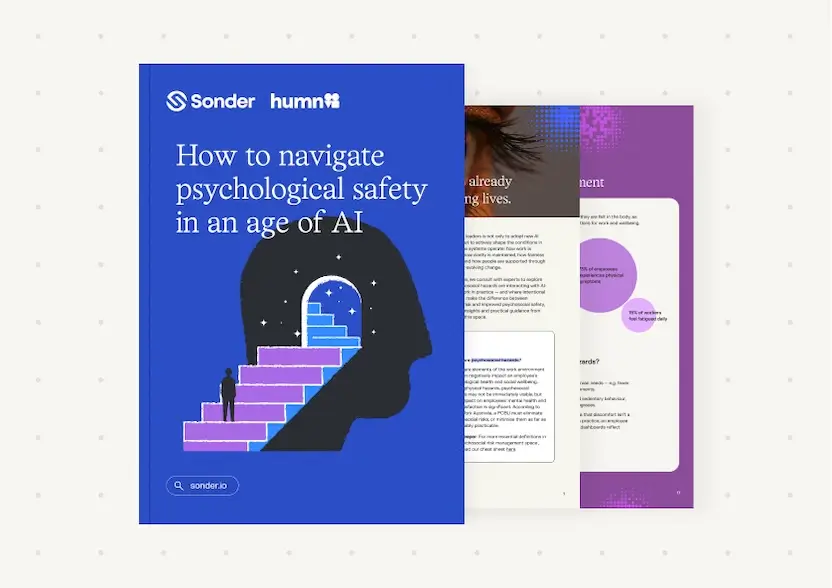
Sonder’s How to Navigate Psychological Safety in an Age of AI guide explores how rising expectations and shifting work design are making reward and recognition harder to get right, and what leaders can do about it.
Download the report, or speak with our team about how Sonder can support your organisation. Request a demo.