At a glance:
- Poor support is one of the most common psychosocial hazards: It appears in the top three of the 9,183 psychosocial hazards Sonder tagged in support cases between May 2025 and May 2026, third only to job demands and workplace conflict.
- It’s defined by absence: The check-in that didn’t happen, the guidance that wasn’t there, the resource that wasn’t available.
- AI adoption risks widening the gap: Many organisations are rolling out new tools without giving people the training or context to use them with confidence.
- Leaders can close it with a few deliberate changes: Proactive check-ins, clear written guidance on AI, defined escalation pathways and after-hours access to care.
Even highly skilled employees need guidance, direction and training to deliver their best work. Without the right tools and resources, people can lack the support needed to do their job safely and effectively.
Poor support covers a range of scenarios. It can include not having the right tools to work safely, receiving unclear or delayed instructions. It can even look like supervisors being unavailable to help, taking a long time to make decisions, or being unempathetic to employees’ requests for help.
When poor support is severe, prolonged, and frequent, it is recognised by Safe Work Australia as a psychosocial hazard. As a leader, identifying this psychosocial hazard is just the first step. In fact, you are legally obliged to eliminate the risks of hazards (such as poor support) by introducing effective control measures in your workplace.
In this article, we unpack what poor support means as a psychosocial hazard, explore the factors that contribute to it, highlight the impacts on both people and the organisation, and share practical ways to reduce the risk while keeping your teams safe, supported, and connected.
This is part of a series on understanding psychosocial hazards. Other features in the series include:
- Understanding the risk and impact of poor role clarity
- Understanding the risk and impact of imbalanced job demands
- Harmful behaviour in the workplace and how to navigate it
- Navigating traumatic events or material in the workplace
- The risk and impact of isolated or remote work
- How to overcome poor organisational change management
- Organisational justice explained
- The risks and impacts of a poor physical work environment
- Understanding the risk and impact of low job control
Disclaimer: The information contained in this article and on this website is general information only and does not constitute legal advice. Although all efforts have been made to ensure the accuracy and currency of the information presented, Sonder takes no responsibility for any errors or omissions presented. Please contact a legal representative for individual advice.
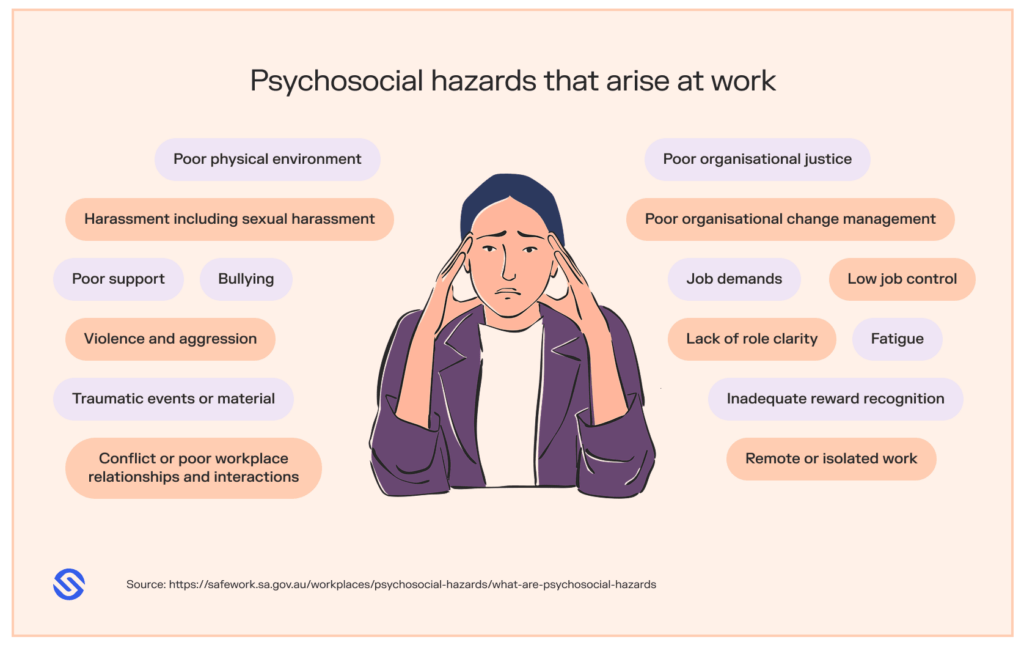
What is poor support as a psychosocial hazard?
Poor support means employees aren’t receiving the help they need from others to do their job well. It includes both managers and coworkers failing to provide adequate emotional or practical assistance, as well as a lack of training, information, tools, and resources to safely and effectively perform their job.
There are several types of poor support people can encounter at work, including:
- Supervisor and leadership support: Managers being unable to offer guidance, not providing timely constructive feedback, or taking too long to make clear decisions.
- Coworker and peer support: Team members being uncollaborative, highly competitive, or overly critical of each other’s work, as well as being too busy or unwilling to help others.
- Organisational support: Companies providing faulty or outdated systems, broken equipment, and confusing or conflicting instructions for how to perform a job.
Poor support can be felt by a range of individuals, regardless of their level of experience or seniority. Here are a few common workplace scenarios where poor support could play out.
| Who | The situation | What poor support feels like |
| A new starter | Joins during an AI rollout and is handed new tools with no guidance on how or when to use them; onboarding assumes prior knowledge they don’t have. | Spends their first weeks second-guessing every decision, reluctant to ask questions for fear of looking incompetent, and slowly disengages before they’ve had a chance to settle in. |
| A remote employee | Works across a different time zone to their manager, with no after-hours support and no clear escalation pathway for when things go wrong. | Hits a problem outside business hours, pushes through alone, and gradually stops raising issues altogether, not because things improve, but because asking stops feeling worth it. |
| A frontline worker | Low digital confidence means they struggle with newly introduced AI tools, but the rollout moves at a pace that assumes everyone is starting from the same place. | Falls behind peers without anyone noticing, assumes the gap reflects their own limitations, and becomes increasingly reluctant to flag that they need help. |
| A manager | Expected to support their team through a significant AI transition with no training, no updated guidance, and no one checking in on how they’re coping. | Defaults to reassurance they can’t back up, models confidence they don’t feel, and absorbs the pressure of supporting others while going unsupported themselves. |
Is poor support a common psychosocial hazard?
Poor support appears in the top three of the 9,183 psychosocial hazards Sonder tagged in support cases between May 2025 and May 2026, third only to job demands and workplace conflict.
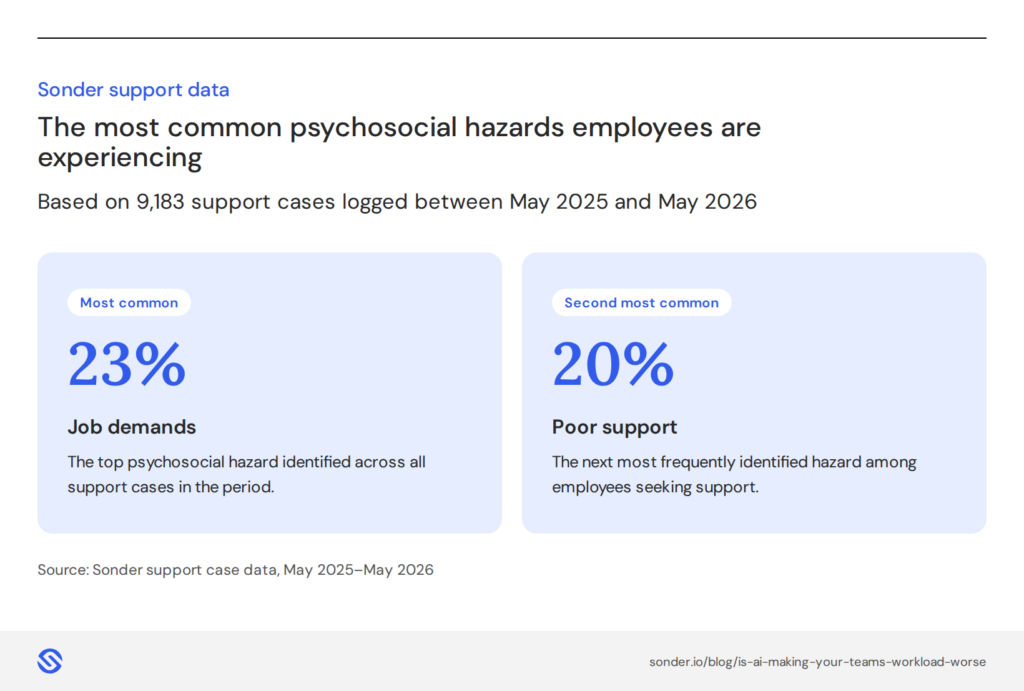
Nearly two-thirds of psychosocial hazard tags in Sonder support cases over the past year fell into just three categories: job demands, poor support, and workplace conflict.

Chief People Officer, Sonder
What is a leader’s obligation to minimise the harm of poor support?
Under Work Health and Safety (WHS) legislation, businesses are now required to identify and manage 17 psychosocial hazards in Australia, including poor support. From 1 July 2026, section 26A of the Work Health and Safety Act 2011 (NSW) means businesses must follow an approved Code of Practice or prove they’re managing the risk to an equal or higher standard of safety. This means effective psychosocial risk management means the standard has shifted from “did you have a policy?” to “did you take reasonably practicable steps to control the risk?”
You can read more about the latest code of practice update in our blog: Psychosocial hazards: What NSW’s 1 July 2026 code of practice change means for employers.
What contributes to poor support in the workplace?
Inadequate resources, poor leadership, and an uncollaborative workplace culture are some of the key drivers of poor support.
But there are a range of contributing factors that may be present in your organisation, including:
- Managers stretched thin: Stressed leaders who are overcapacity may be unable to proactively check in or provide meaningful guidance to their direct reports.
- Support systems designed for an old way of working: If policies and processes haven’t been updated to reflect AI-enabled workflows, an organisation’s systems may no longer be fit for the current shape and pace of work.
- A culture of internal competition: If workplace cultures are designed for competition rather than collaboration, coworkers may be discouraged from asking questions, raising concerns, or helping each other.
- Concerns around job security: In uncertain job markets, employees may not feel confident to ask for help or raise concerns (particularly when a company culture actively discourages it). Recent data reveals only 48% of workers feel secure in their jobs, and employees who feel uncertain about their future are far less likely to raise concerns or ask for help.
- Uneven accessibility: Factors like language barriers, digital confidence gaps (particularly in relation to AI), and even an employee’s location can mean support is available but not evenly accessible to all.
We give people AI tools and assume they'll adapt. But we don't always give them the training, context, or space to build confidence in how to use them well. So people are left to figure it out on the fly, often under pressure, and when they struggle it's labelled as resistance rather than what it really is; a lack of support and enablement.

Work Futurist, Be Luminous
What are the risks of poor support in the workplace?
Most employees can easily brush off a slight delay in receiving feedback or a one-off instance of confusing instructions. But when a lack of support becomes a persistent, frequent issue, there are wide-reaching risks and potential implications for both individuals and organisations.
- Psychological harm: Without the right level of support, stress and mental fatigue can accumulate unchecked, and employees are left feeling alone and isolated with problems that could be resolved sooner.
- Errors and lower quality output: Unsupported employees may be forced to make decisions without sufficient guidance, often under pressure, in order to perform their role. This can lead to both a decline in productivity, a drop in quality, and a potential rise in mistakes (that can have costly impacts on a company’s bottom line and even increase exposure to safety risks).
- Disengagement and attrition: When an employee feels unsupported at work, trust is eroded towards the organisation. The longer the issue persists, the more disengaged a person is likely to become at work, increasing the risk of absenteeism, presenteeism, and employee turnover.
- Compounding hazards: Poor support amplifies every other recognised psychosocial hazard. For example, a person facing high job demands and poor support is at significantly higher risk than if they were experiencing either hazard on its own.
Taken together, these risks point to the same underlying problem: when support is treated as an afterthought rather than a design principle, the consequences compound.
Support without redesigning work is still just support. EAP is a downstream support, not a control.

Co-Founder, Humn
How do you identify poor support in your team?
To address poor support within your workplace, you first need to identify what challenges your people are facing. There are several ways you can build a picture of what’s happening in your team:
| Signal | What to look for |
| Employees going to peers instead of leaders | Team members regularly turn to colleagues for direction, approval, or guidance that should be coming from their manager. This is a signal that formal support channels aren’t working well, or that employees don’t feel comfortable using them. |
| Errors that trace back to unclear direction | A rise in mistakes or quality issues that stem from ambiguous instructions or missing guidance rather than a lack of capability. Before attributing errors to performance, ask whether the employee had what they needed to do the work correctly. |
| People going quiet | Employees who stop raising concerns, asking questions, or flagging problems. Silence in a workplace context is more often a sign that people have stopped expecting their concerns to be listened to or acted on. |
| Hesitation, over checking, or avoidance of AI tools | Employees who seem reluctant to use new tools, or avoid AI-enabled workflows altogether. These behaviours frequently signal an underlying support gap, where employees haven’t been given enough guidance, context, or confidence to use new tools well. |
| A high performer suddenly disengaging | High performers are often assumed to be coping precisely because their output masks the strain. A sudden shift in engagement is usually a signal that support structures have broken down, and that no one has noticed yet. |
How can leaders close the support gap?
Closing the support gap starts with small, deliberate changes in how your leaders show up, how information flows, and how employees access help. The following strategies are a practical place to start:
- Proactive check-ins: Empower managers to run structured 1:1s that go beyond task status and specifically ask about what’s working and what’s unclear.
- Establish role clarity early: Support and role clarity are deeply connected. Employees who don’t know what’s expected of them can’t easily identify where and when they need help. Learn more in our guide to understanding the risk and impact of poor role clarity.
- Written guidance on AI: Create and share clear, accessible answers to common questions. Empower your team with step-by-step guidance on where AI fits and where it doesn’t fit into your company’s workflows.
- Clear escalation pathways: Ensure employees know exactly who to go to and how to remove ambiguity about what warrants asking for help.
- After-hours access: Ensure support doesn’t only exist within business hours. Set up 24/7 support that ensures employees in pressure situations have somewhere to turn when managers aren’t available.
- Manager capability-building: Train leaders to recognise poor support as a hazard, rather than a performance issue. This equips managers to spot early warning signs and step in before issues escalate.
Psychosocial safety isn't created by wellness initiatives. It's not yoga classes or a fruit bowl. It's how work is designed, how decisions are made, and how leaders behave under pressure.
Co-Founder, Humn
How Sonder helps organisations close the support gap
Closing the support gap means proactively rethinking how work is structured, how leaders are equipped, and how employees access help.
Sonder makes that possible.
With round-the-clock access to trained care specialists, dedicated manager support, digital self-guided tools for early intervention, and data and insights that track where gaps are emerging before they become harm, Sonder connects the signals, the support, and the outcomes that organisations need to protect their people and manage psychosocial risk proactively.
Sonder’s How to Navigate Psychological Safety in an Age of AI explores how AI adoption is reshaping support gaps across organisations, and what leaders can do about it.
Download the report, or speak with our team about how Sonder can help close the support gap in your organisation. Request a demo.
FAQs
Yes. It’s one of 17 psychosocial hazards recognised under work health and safety law, and Safe Work Australia requires employers to eliminate or minimise the risk as far as reasonably practicable.
It covers a lack of guidance or feedback from managers, uncollaborative or overly critical coworkers, and organisational failures like outdated systems or unclear instructions.
Many organisations roll out AI tools without giving employees the training or context to use them confidently, leaving people to figure it out under pressure — often without anyone checking in.
Practical starting points include structured 1:1 check-ins, written guidance on where AI does and doesn’t fit into workflows, clear escalation pathways, and after-hours access to support.