At a glance:
- Average EAP utilisation sits around 5%: In Australia, around 5% of covered employees use their EAP. In the UK, it’s 3.34%.
- Low uptake has clear causes: Many workers don’t think they need support, don’t feel comfortable asking or worry about privacy.
- Earlier, simpler support lifts engagement: Around 40% of Sonder members typically activate, compared with around 5% utilisation for traditional EAPs.
- Utilisation is only half the picture: Tracking outcomes like absence, turnover and return to work shows whether support is making a difference.
The average employee assistance program (EAP) utilisation rate is around 5% of covered employees in Australia and 3.34% in the UK, meaning that most people with access to an employee assistance program (EAP) don’t use it in a given year. However it’s important to remember that utilisation only tells you who is using support, not whether it’s working.
In this blog, we compare average EAP utilisation rates for traditional EAPs and EAP alternatives, look at why utilisation is only half the story and set out what to track alongside it, so you can see whether your EAP is driving real outcomes.
What is the average EAP utilisation rate?
The average EAP utilisation rate is around 5% of covered employees in Australia, according to SIRA’s EAP literature review, and 3.34% in the UK, according to EAPA UK’s 2025 report. Utilisation rates capture the percentage of employees who have accessed support services provided by their employer over a certain period, usually one year.
But these figures are averages and rates vary by industry. Only around 1% of people in safety and law enforcement use EAP support, compared to around 9% in financial and insurance services, according to SIRA.
For what a good rate looks like and how to compare providers’ figures, see our blog on what a good EAP utilisation rate is.
Unpacking the causes of low EAP utilisation rates
Awareness of support doesn’t automatically translate to high uptake or engagement. Across Australia, New Zealand and the UK, three in four workers (75%) are aware of health, safety or wellbeing support services. But only 17% actually used them in the last 12 months, according to Sonder’s State of Employee Health and Wellbeing Report 2026.
Sonder’s survey data reveals multiple drivers behind low utilisation rates, including:
- Not feeling they needed support: Many employees simply didn’t feel they needed support (63%)
- Discomfort or distrust in support: Others didn’t feel comfortable asking (15%) or didn’t trust it would help (13%)
- Confidentiality fears: Privacy concerns remain significant. Nearly 10% worried managers would know, and others feared embarrassment or colleague awareness (6%)
In the past 12 months, around 1 in 3 workers (33%) delayed seeking medical support. The most common reason? Feeling their symptoms weren’t serious enough (42%). Source: Sonder’s State of Employee Health and Wellbeing Report 2026.
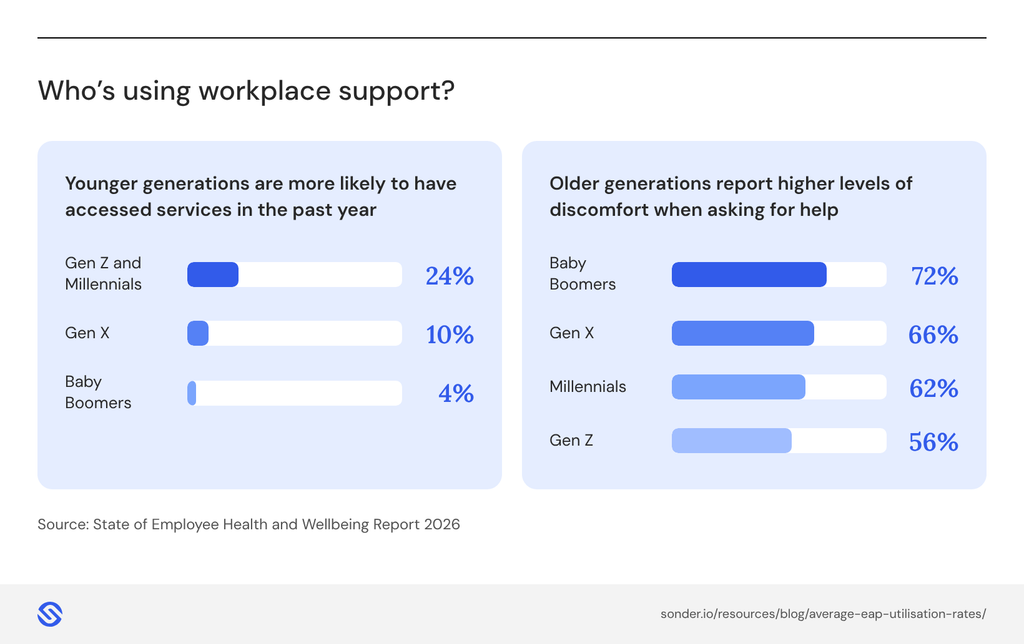
Plus, there are important generational differences in how likely employees are to engage with workplace support. Younger workers are more likely to have accessed services in the past year, while older generations report higher levels of discomfort when asking for help. For a closer look at why uptake is low and how to lift it, see our blog on what a good EAP uptake rate looks like.
How do EAP utilisation rates compare between traditional EAPs and EAP alternatives?
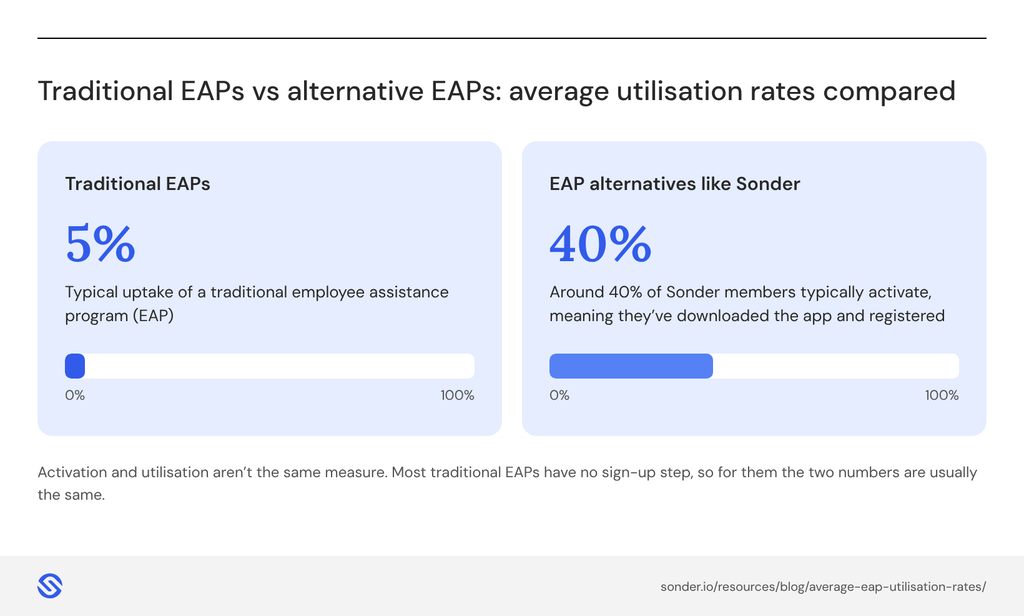
EAP alternatives typically see much higher engagement than traditional EAPs. Around 40% of Sonder members activate, meaning they’ve downloaded the app and registered, compared with around 5% utilisation for traditional EAPs. Activation and utilisation aren’t the same measure, but most traditional EAPs have no sign-up step, so for them the two numbers are usually the same. A user that has downloaded and registered with a service is ready to use it when they need it.
Sonder is a people risk intelligence and prevention platform that delivers care that starts before crisis. Here’s how its early intervention model compares with a traditional EAP.
| Traditional EAPs | Sonder | |
| Scope of care | Mainly mental health counselling | All-in-one: mental health, medical and safety in one platform |
| Confidentiality | Often a source of hesitancy for employees | 100% confidential and accredited by the Australian Council on Healthcare Standards (ACHS) |
| Family coverage | Not always available to family members | Family access available, depending on plan |
| Referral pathways | Limited, or complex to navigate | Care Specialists triage every request, with registered nurses stepping in for clinical assessment and referral to GPs or ongoing care |
| Availability | After-hours support varies and is often crisis-only | 24/7 in-app chat or call |
| Response time | Long wait times common | A Care Specialist responds in 30 seconds or less, 24/7 |
| Approach | Reactive; support activates after a problem surfaces | Early intervention; self-help resources and proactive tools aim to keep people well before crisis |
| Personalisation | One-size-fits-all | Tailored care pathway based on holistic triage of the whole person |
We don’t have a traditional EAP in place. Our engagement levels with Sonder have far surpassed anything we had previously. Over 55% of our employees have used Sonder, whereas previously we had less than 5% of our employees using our previous EAP provider.

Head of Diversity, Inclusion & Wellbeing, Hays
Why does high utilisation matter, and where does it fall short?
High EAP utilisation matters because it shows employees know support exists and feel able to use it, but it doesn’t show whether that support is working. Typically, a high utilisation rate indicates workplaces have created a culture where seeking support is encouraged, barriers to access are lowered, and stigma and fear of judgement have been reduced or removed altogether.
Three in five (59%) workers across Australia, New Zealand and the UK reported that their organisation’s wellbeing programs and EAPs positively impacted their overall wellbeing and productivity.
Sonder’s State of Employee Health and Wellbeing Report 2026.
High utilisation is also an indicator that employees are receiving timely interventions and care that starts before crisis. But measuring utilisation alone only gives you half the picture. While uptake tracks how many people are using the service, it doesn’t confirm whether support services are reducing harm, lowering claims or improving retention.
Although utilisation rates are cited as evidence of EAP relevance, Australian EAPs tend to rely on utilisation metrics and satisfaction surveys to demonstrate their effectiveness, rather than outcome measures that measure and track change from pre- to post-intervention.”
What to track beyond EAP utilisation
Leading organisations are becoming increasingly sophisticated with how they measure the impact of workplace wellbeing initiatives. Showing uptake alone isn’t enough; stakeholders and regulators are now focused on the link between early intervention and the outcomes that matter: absence, claims, turnover, productivity, return-to-work rates and risk reduction.
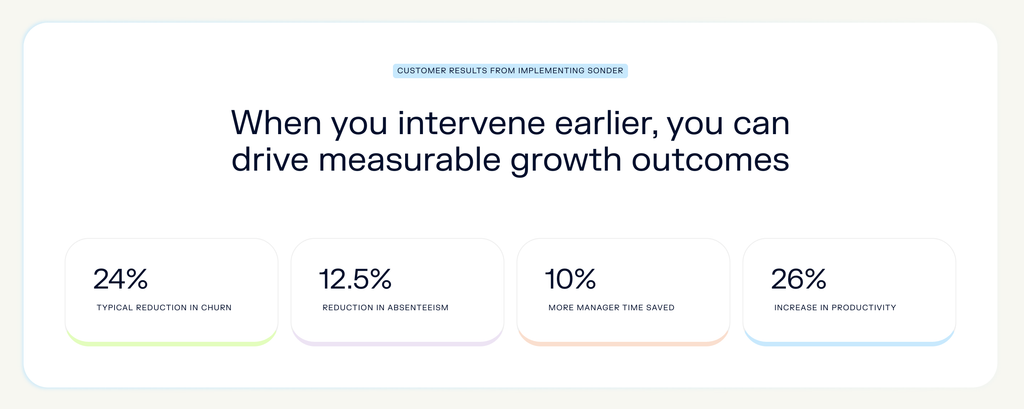
When programs are comprehensive, trusted and accessible, they deliver measurable benefits. With a focus on early intervention, EAP alternatives like Sonder see higher engagement and back this up with tangible outcomes. Sonder customer data shows a 24% reduction in turnover and 12.5% lower absenteeism.
For Australian employers, there’s a compliance angle too. Comcare notes that an EAP can be a work health and safety control for managing psychosocial hazards, and Safe Work Australia’s model Code of Practice says a control that isn’t working effectively must be reviewed and modified or replaced.
Sonder’s own member survey points the same way: 76% of members surveyed between June 2025 and July 2026 said Sonder helped them avoid taking time off work or study, and 73% said it helped their productivity.
In our data, 63% of mental health cases were resolved with early support alone. That’s the clinical case for proactive care. Traditional EAPs were largely built around counselling sessions booked once someone is already in distress, so they often meet people at their lowest point, rather than when we as clinicians can help most. Getting in early, across mental health, medical and safety needs, is better for people and far less costly for organisations.

VP of Clinical Services, Sonder
Curious about how your EAP, wellbeing and employee support investments stack up? Estimate the annual value of proactive workforce care with our free ROI calculator. Calculate your ROI.
What should you measure alongside EAP utilisation?
To see whether your EAP is working, measure three things: activation, utilisation and outcomes. Providers report uptake in different ways, so ask each one which measure their figures are based on and how they define it.
- Activation: people who have registered and can get support the moment they need it
- Utilisation: people who have used a service, such as a counselling session or a call with a nurse
- Outcomes: whether the support made a difference, such as changes in absence, turnover, claims and return-to-work rates
If you already have an EAP, ask for the last 12 months of utilisation data well before your renewal date. It’s the clearest way to judge whether your provider has earned another term.
How can employers boost EAP utilisation?
Employers can boost EAP utilisation by making sure people know what support exists, how to reach it and that it’s confidential, fast and not just for crises. That helps people address concerns early, before issues escalate.
In practical terms, that means taking steps to:
- Increase awareness: Implement regular communications about EAP benefits, ensuring your team knows what services are available and how to access them.
- Reduce stigma: Create a workplace culture that supports mental health and wellbeing openly, with leaders setting the tone for transparency by sharing their own stories to create a psychologically safe environment for staff to access support.
- Feedback and improvement: Continue to check in with your team and gather anonymous feedback from employees about their experience with the EAP and adjust the program accordingly.
- Look beyond uptake: A rising utilisation number is a good sign, but it isn’t the finish line. Pair usage tracking with a view of what happens next: are people returning to work sooner, staying longer, engaging with early intervention before things escalate? That’s what tells you the number is translating into real impact, not just activity.
Looking for more practical tips on how to get your team to engage with your EAP offering? Dive into our top tips for increasing EAP uptake, or watch this clip where Leanne Naber, Sonder’s Senior Account Executive, and Julia Bageski, Sonder’s Head of Customer Success, share the questions you should be asking your potential provider when it comes to usage rates.
What’s the cost of low EAP utilisation, and low-impact usage?
Low EAP utilisation costs organisations twice: the investment isn’t reaching people, and issues that could be resolved early escalate into absence, turnover and claims. If left unchecked, low utilisation rates can cause employees to ‘suffer in silence’, failing to seek timely support for personal or work-related issues that can impact their performance, health and wellbeing.
Over time, this leads to high absenteeism, lower productivity levels and poor morale across your business.
Plus, there are other costs employers need to consider beyond tracking utilisation rates. Taking a reactive approach to employee wellbeing typically yields only modest returns (an ROI of approximately $2.30 for every $1 spent, according to PwC). In contrast, a proactive approach that prioritises preventative care delivers a tangible Value on Investment (VOI), with returns of up to $11.97 for every $1 spent.
Wellbeing isn’t a perk; it’s a performance system. The companies that understand this are the ones consistently outpacing their peers.

Chief People Officer, Culture Amp
From utilisation to outcomes: Build your business case for early intervention
Companies that turn employee health, safety and wellbeing into a strategic growth driver are making the shift from reactive to preventative support. Utilisation is still worth tracking: it’s the clearest sign employees know support exists and feel able to use it. But it’s the starting point, not the destination.
The organisations getting the most value from their EAP or EAP alternative are the ones asking the next question: Is this support actually changing outcomes?
Ready to compare your options? Our insider’s guide to comparing EAPs includes a 10-step comparison checklist and a plan for switching providers without gaps in support. Download the guide.
Or if you’d like to see how an early intervention model works in practice, book a demo and we’ll walk you through it.
FAQs
The average EAP utilisation rate is around 5% of covered employees in Australia, according to SIRA’s EAP literature review, and 3.34% in the UK, according to EAPA UK’s 2025 report. Rates vary by industry, from around 1% in safety and law enforcement to around 9% in financial and insurance services.
Traditional EAP utilisation is low for a mix of reasons. Many employees don’t feel they need support, don’t feel comfortable asking or don’t trust it will help, and some worry about their privacy at work. Limited hours, unclear referral pathways and a “crisis only” reputation also make it harder to engage, even when people know support exists.
High EAP utilisation is a positive sign, but it doesn’t prove the support is working. It shows employees know about the service and feel able to use it. To understand impact, pair usage data with outcome measures such as absence, turnover, claims and return-to-work rates.
High EAP utilisation is a positive sign, but it doesn’t prove the support is working. It shows employees know about the service and feel able to use it. To understand impact, pair usage data with outcome measures such as absence, turnover, claims and return-to-work rates.
EAP usage measures how many employees accessed support over a period, while EAP outcomes measure what changed as a result. Usage answers “are people using it?” while outcomes answer “is it working?” A program can have strong usage and still fall short if care isn’t timely or connected to measurable results like reduced absence or turnover.
Yes, and more. Sonder provides everything you’d expect from a traditional EAP, including confidential counselling, critical incident support and manager advice, and adds 24/7 nurse-led medical triage and personal safety support, so employees have one place to go for any health, safety or wellbeing need. It’s 100% confidential and accredited by the Australian Council on Healthcare Standards (ACHS), held to the same standards as hospitals.