At a glance:
- Progress hasn’t stopped the rise: Stigma is falling and more people are seeking help, yet about 50% of Australians report signs of depression or anxiety, and severity has climbed from about 6% to 8% in two years.
- Money is the roadblock: Financial stress is the number one driver of distress, and the cost of services is the number one barrier to getting help.
- Managers are stretched thin: The “frozen middle” is being asked to lead psychosocial safety without the training or support to do it.
- Prevention pays: PwC research for Beyond Blue found a $2.30 return for every dollar spent, and Sonder customers see 24% lower turnover and 12.5% lower absenteeism. Fixing job design matters more than adding wellness perks.
The conversation around mental health has come a long way in Australia. But nearly half of Australians now report signs of anxiety or depression (and symptoms are getting more severe).
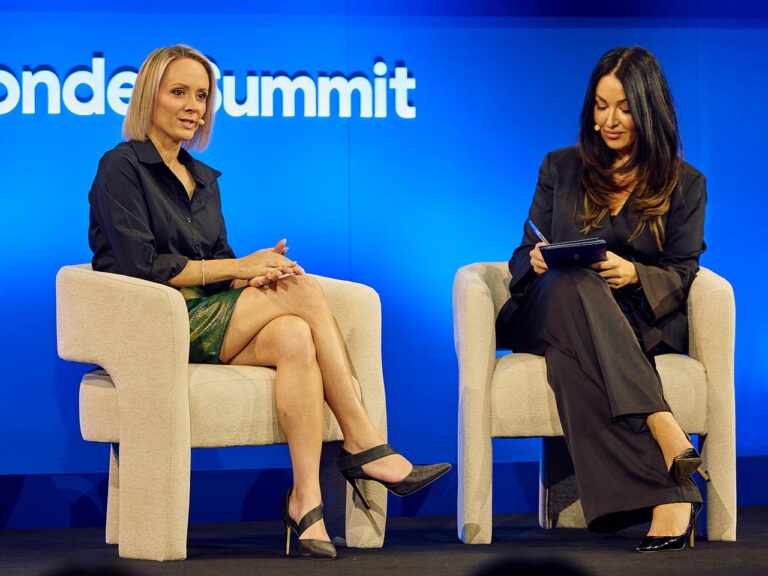
So what’s holding people back, and what can workplaces do? At Sonder Summit 2026, Sonder’s Craig Cowdrey sat down with Georgie Harman AO, CEO of Beyond Blue, to unpack what’s driving distress, why managers are stretched thin, and why prevention is the next frontier.
Watch the full recording here, or catch up on the highlights below.
Disclaimer: This article touches on suicide and mental health challenges. If this brings anything up for you, Lifeline is available 24/7 on 13 11 14 and Beyond Blue on 1300 22 4636
Meet the expert: Georgie Harman AO
Georgie Harman AO is one of Australia’s most respected mental health leaders, with over 30 years’ experience across government, community, and the not-for-profit sector. Since being appointed CEO of Beyond Blue in 2014, Georgie has steered the organisation through significant growth and transformation.
Previously, she was Deputy CEO of the National Mental Health Commission and, for six years before that, served as a senior executive at the Commonwealth Department of Health, where she had national responsibility for mental health, suicide prevention, substance misuse, cancer, and chronic disease.
What is the current state of mental health in Australia?
While real progress has been made, 1 in 2 Australians are still struggling with mental health challenges like anxiety and depression. During Sonder Summit 2026, Georgie shared new, previously unreleased data from Beyond Blue showing that while stigma is easing, symptoms are getting more severe and too many people are waiting until a crisis point to seek help.
- Half of Australians are showing signs of struggle: About 50% of Australians report signs and symptoms of depression or anxiety, and that figure is continuing to rise year-on-year.
- Symptoms are getting more severe: Severity has risen from about 6% to about 8% in two years. Demand for Beyond Blue’s services is up 12% year on year, and teams are spending roughly 30% more time with each person because symptoms are becoming more complex.
- Money is the biggest driver of distress: Financial worries are the number one driver of psychological distress, with housing stress now ranking at number two (up about 10% since 2022). Cost is also the number one barrier to seeking help, and stigma still exists around money problems.
- Stigma has shifted, and people are starting to seek help earlier: University of Melbourne researchers analysed 25 years of national survey data and found significant reductions in stigma towards depression, a change they didn’t see in other countries. They also found steady increases in professional help-seeking. Georgie also shared early signs in Beyond Blue’s new data that people are coming forward sooner, when symptoms are less acute. But she was quick to add that far too many still wait until crisis.
We’ve just got to keep banging on about the importance of not waiting till you’re in crisis, because far too many people are still doing that.

CEO, Beyond Blue
Why does early intervention matter for workplaces?
Early intervention means supporting employees who are showing the first signs of distress and acting before they reach a crisis point. For organisations, that looks like good job design, building trusting relationships with managers, and offering accessible support channels that remove barriers like out-of-pocket costs, wait times, and the stigma associated with talking about financial, wellbeing, and mental health challenges.
Georgie points to the benefits of early intervention for both organisations and individuals: employees who feel safe disclosing their mental health challenges to their manager are more likely to feel supported, stay at work, or return sooner.
Plus, employers are well placed to tackle one of the biggest barriers to proactive help-seeking: cost. When support is free, confidential, and available around the clock, employees are more likely to reach out sooner.
This echoes Australia’s primary healthcare access crisis: 60% of Australians have delayed a GP visit due to cost or unavailability. But businesses that provide telehealth solutions reported a 22% reduction in absenteeism costs.
Why are managers struggling to support their teams?
Managers are on the front line of psychosocial safety for their teams, even though they aren’t qualified or trained to provide this level of care.
According to Georgie, managers are stuck in the “frozen middle”, caught between rising expectations and insufficient support. Plus, many leaders are juggling pressures outside of work, such as caring for ageing parents and raising children.
We’ve created an unrealistic expectation of managers who are not superheroes. They are not industrial relations experts, they are not mental health experts, yet they are being asked to be the front line of psychosocial safety.
CEO, Beyond Blue
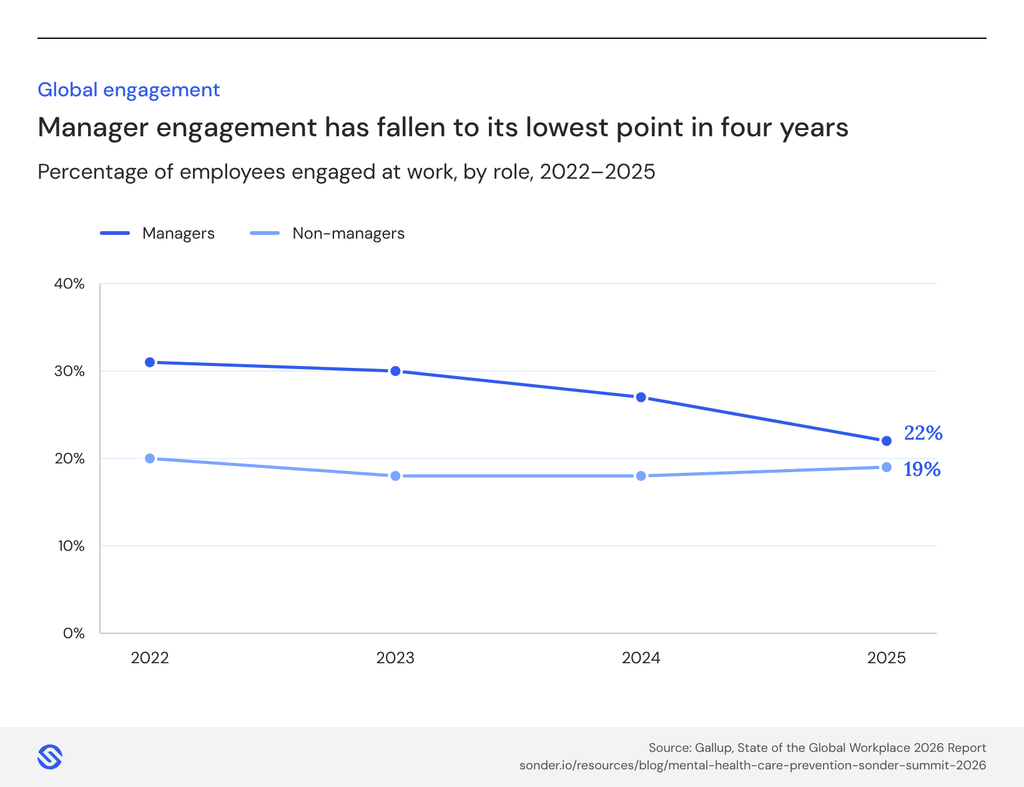
It’s not surprising that Gallup’s 2026 State of the Global Workplace Report found that manager engagement has dropped 9% since 2022.
The fix is to build a shared understanding of what’s reasonable, support managers to have honest conversations with teams, and ensure professional support is available to everyone in the business. The goal isn’t for managers to carry the load alone; instead, they should have the training and resources handy to empower their people to seek support.
How can leaders make the business case for prevention?
The most compelling business case for preventative care starts with evidence, and follows up by measuring what matters. The research already exists: PwC analysis for Beyond Blue found an average return of $2.30 for every dollar spent on workplace mental health. The challenge is convincing a CEO, CFO, or even a board that investment delivers measurable impact.
Claims, absenteeism, and turnover are the numbers most boards track. But Georgie warns they’re rearview-mirror metrics, and the damage is already done by the time they show up on a dashboard. Instead, focus on asking questions that track early indicators before they show up as lost productivity or low retention. And if the numbers still don’t land, make it personal.
Sonder’s early intervention model prioritises care that starts before crisis, with an average utilisation rate of 40% (markedly higher than the 3-5% seen in traditional EAP models). Learn more in Sonder’s State of Employee Health and Wellbeing Report 2026.
Lead with the research, then make it personal
Plenty of reliable data shows that prevention works. Using Sonder’s ROI estimator, you can run your own numbers and model turnover, absence, and manager time using your headcount and wages. It’s based on customer results showing that proactive workforce care leads to 24% lower turnover and 12.5% lower absenteeism.
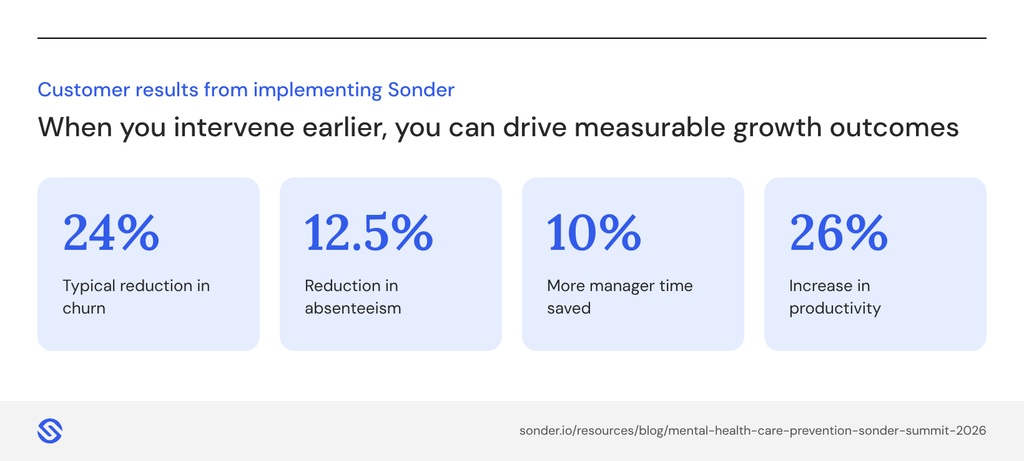
But numbers alone only tell part of the story. Make things personal by turning ROI figures into real-world examples, anchored in lived experience. Get leaders to imagine their own son or daughter in this scenario to give weight to these metrics.
Track early signals, not just claims
Alongside rearview-mirror metrics like absenteeism and claims, Georgie recommends leaders track the early warning signs, too. A drop in engagement, silence in 1:1s, or team members showing fatigue or low mood can all indicate someone is starting to struggle.
Trust and connection are key here. Employees need to feel psychologically safe to disclose that they need help or ask for support. Georgie encourages leaders to consider whether connection and belonging are values lived out within the business, and whether managers have created the conditions for people to speak up early.
Fix job design before adding wellness perks
Job design covers everything from role clarity to job demands, and has one of the biggest impacts on employees’ health and wellbeing. While breathwork classes and one-off workshops are easy to run, Georgie shares that good job design is the number one driver of a good mental health experience at work.
Her advice for leaders? Have honest conversations with stretched employees and managers, and be open to redesigning their roles so they can keep showing up.
The number one driver of a good mental health experience in a workplace is good job design. It’s not about yoga and asking, ‘Are you okay?’ It’s actually about job design.
CEO, Beyond Blue
Treat compliance as the starting point, not the goal
Complying with Work Health and Safety (WHS) legislation isn’t optional, and new enforceable standards keep rolling out (such as NSW’s 1 July 2026 code of practice change). But Georgie has seen too many organisations stop at the risk agenda and dashboards.
Her challenge to leaders is to shift from “have we ticked the boxes?” to “how do we want people to feel and show up at work?”
Regulation is what all of us should be doing as good employers. It’s not negotiable. What matters is taking it to the next step, which is about humanity and connection.
CEO, Beyond Blue
Final thoughts: Why prevention is the future of workplace mental health
While stigma is easing and help-seeking is rising, many Australians are struggling with increasingly complex mental health challenges. Preventative care allows employers to intervene early and deliver proactive support that doesn’t wait for a crisis point.
Be curious, be kind, be clear. Don’t think about this as a compliance task.
CEO, Beyond Blue
Sonder helps organisations to detect risk earlier, intervene faster, and reduce harm before it escalates. With 24/7 access to counsellors, psychologists, and social workers, plus face-to-face support in major cities across Australia and New Zealand, employees can reach an expert in an average of 10 seconds.
Book a demo to see how Sonder supports prevention and early intervention, or watch every Sonder Summit 2026 session on demand.
FAQs
Mental health prevention at work means acting early, before someone reaches crisis. That starts with the conditions people work in, such as job design, workload, and trust with their manager, and includes making support easy to reach as soon as someone starts to struggle. As Georgie Harman puts it, it’s less about free yoga classes and more about how the work itself is designed.
Earlier support tends to be less acute, and Beyond Blue’s new data suggests more people are reaching out sooner. It also gives employers a better chance of keeping someone at work, or getting them back sooner, because there’s time to adjust the role or workload. Waiting is costly: Sonder’s 2026 report found 1 in 3 workers delayed seeking medical support, often because they felt their symptoms “weren’t serious enough”.
Cost is the biggest one. Georgie says financial stress drives distress, and the cost of services is the top barrier to getting help. There’s also still stigma around money problems, which she says hasn’t had the same national conversation as mental health.
Start with honest conversations. Ask what’s going on for someone, what’s realistic, and whether the role needs adjusting so they can stay. Keep expectations realistic, too, because managers aren’t mental health or IR experts, and back them with expert guidance so they’re not carrying it alone. That includes looking after the manager’s own wellbeing.