
At a glance:
- A psychologically safe review isn’t a soft one: It means preparing well and leading with empathy so people understand what needs to improve, without giving up on accountability or honesty.
- Most reviews escalate because of surprises, not feedback: When expectations have been unclear or systemic issues go unaddressed, employees are far more likely to experience feedback as an attack.
- Curiosity beats assumptions: Open-ended questions surface context a fixed narrative would miss, and often reveal operational or leadership problems rather than individual failings.
- The stakes are real for leaders too: Poorly handled performance management is now a recognised psychosocial risk, and managers need clear frameworks and support, not to act as counsellors.
The way we talk about workplace experiences is changing. Employees are increasingly using the language of emotional harm and psychological safety to describe what happens at work.
“I’m burnt out.”
“That conversation made me anxious.”
“I didn’t feel safe raising that.”
At the same time, organisations face growing obligations around psychosocial risk and wellbeing.
Performance reviews sit right at the intersection of this shift. Once treated as a standard management process, they now carry real weight and when handled poorly, they can cause genuine harm to wellbeing and performance.
A psychologically safe performance review means approaching it with enough preparation, clarity, empathy and structure that employees leave understanding what needs to improve without feeling blindsided, humiliated, or shut out. But it doesn’t mean avoiding accountability. Businesses still need honest conversations when things aren’t working. The challenge is learning to have those conversations in a way that’s clear, fair, and supportive.
This guide is for leaders who want to do exactly that.
Discomfort is a necessary part of growth. It is not the same as being unsafe.

Co-Founder, Chief Health Officer, Humn
Why do performance reviews escalate so quickly?
The context surrounding a performance review is often just as important as the review itself.
For example, an employee who has had very little feedback or support for months is unlikely to respond well to a formal meeting where several concerns are suddenly raised all at once. Likewise, someone who already feels unsupported or uncertain at work is far more likely to experience feedback as an attack, even if the manager has good intentions.
Most psychosocial harm at work isn't caused by bad people or toxic individuals. It's caused by well-meaning managers operating inside unclear, pressured systems.
Co-Founder, Chief Health Officer, Humn
This is often where performance processes begin to unravel. A manager believes they are simply addressing a legitimate issue, while the employee experiences the conversation as deeply unfair or threatening.
Sometimes that reaction stems from how the feedback was delivered. Other times, it reflects broader organisational issues that have gone unaddressed for too long, such as:
- Inconsistent leadership
- Unclear expectations
- Unrealistic workloads
- Poor communication
- Inadequate training or onboarding
- Unresolved team conflict
- Cultures where feedback only appears once something has already gone wrong
According to Sonder’s data, these organisational issues are all too common. Sonder tagged 9,183 psychosocial hazards across support cases (11 May 2025 to 11 May 2026). The top three were job demands (23%), conflict or poor workplace relationships (21%) and poor support (20%), together representing nearly two-thirds of all tags.
When these factors are present, performance conversations can easily become emotionally charged because employees feel held individually responsible for wider systemic problems.
When does performance management become a psychosocial hazard?
The personal and legal implications can be serious in the UK too. Work-related stress, depression and anxiety already account for around half of all work-related ill health: HSE recorded 964,000 workers affected in 2024/25, with 22.1 million working days lost as a result. Under Section 2 of the Health and Safety at Work etc. Act 1974, employers have a duty to protect employees’ health, safety and welfare so far as reasonably practicable, and the Management of Health and Safety at Work Regulations 1999 require a suitable risk assessment of foreseeable stress risks, covering the six areas set out in HSE’s Management Standards: demands, control, support, relationships, role and change.
Enforcement is tightening. In December 2025, HSE issued a Notice of Contravention against the University of Birmingham over inadequate stress risk assessments, following a similar notice against East of England Ambulance Service NHS Trust in April 2025. A performance management process that creates foreseeable, unmanaged stress can fall within this duty just as easily as any other workplace hazard.
How should leaders prepare for a performance review?
The strongest performance conversations are usually the ones that contain very few surprises.
Don't wait for the six-month performance review. Have timely conversations – and that matters just as much for positive feedback as for constructive.

Founder & Leadership Coach, Boldside
Employees generally cope far better with difficult feedback when expectations have already been discussed earlier, examples are specific and recent, and the conversation feels grounded in fairness rather than a manager’s frustration.
Before going into a review, leaders could reflect on the following questions:
- Have expectations genuinely been clear?
- Am I focusing on observable behaviours and outcomes rather than assumptions?
- Do I have timely and specific examples?
- Is there anything systemic contributing to this issue?
- Has this employee had the tools, support, and training needed to succeed?
- What outcome am I actually hoping for from this conversation?
That final question is important because it shapes the tone of the whole conversation and helps you slow down and check whether you’re relying on emotional reactions or assumptions that could be distorting fair judgement.
Too many performance conversations become focused on documenting failure instead of improving outcomes. This is partly why traditional performance improvement plans often struggle to achieve meaningful change.
In theory, they are designed to support development and create structure. In practice, many employees experience them as a final warning or even the beginning of being managed out of the organisation.
Once a performance management process feels like it’s focused on punishment, people tend to shift into self-protection rather than improvement.

Counsellor, Sonder
When in doubt, lead a performance review with curiosity before assumptions
One of the most common mistakes leaders make during difficult conversations is entering them with a fixed narrative already formed.
Once that happens, managers can stop asking questions and start building a case instead. The conversation becomes something happening to the employee rather than with them. This is why it’s so important to check your assumptions and come in with an open mind.
Curiosity is the antidote to defensiveness.
Founder & Leadership Coach, Boldside
Open-ended questions can significantly shift both the tone and outcome of a review because they create space for context that may not otherwise surface.
| Instead of asking: | Try asking: |
| “Are you having problems?” “Can you see your mistakes?” “Do you understand expectations?” “Are you committed to improving?” | “Can you walk me through what’s been challenging recently?” “What obstacles made this situation harder for you?” “What support do you feel is currently missing?” “How are you feeling about the workload and expectations?” “What do you think is working well currently?” |
Sometimes these conversations reveal operational or leadership problems rather than individual failings. Other times, employees may disclose personal circumstances temporarily affecting their capacity — grief, financial stress, relationship breakdowns, burnout, or caring responsibilities.
A lack of onboarding, conflicting priorities, poor systems, unclear communication, or unrealistic workloads can all appear on the surface as performance issues.
None of those situations automatically removes accountability, but they often change what appropriate support should look like moving forward.
Keep the conversation balanced and future-focused
Performance reviews that focus exclusively on someone’s shortcomings are highly unlikely to motivate that person to improve.
Employees will generally be more receptive to feedback when they feel the organisation is invested in helping them succeed, rather than simply documenting what has gone wrong.
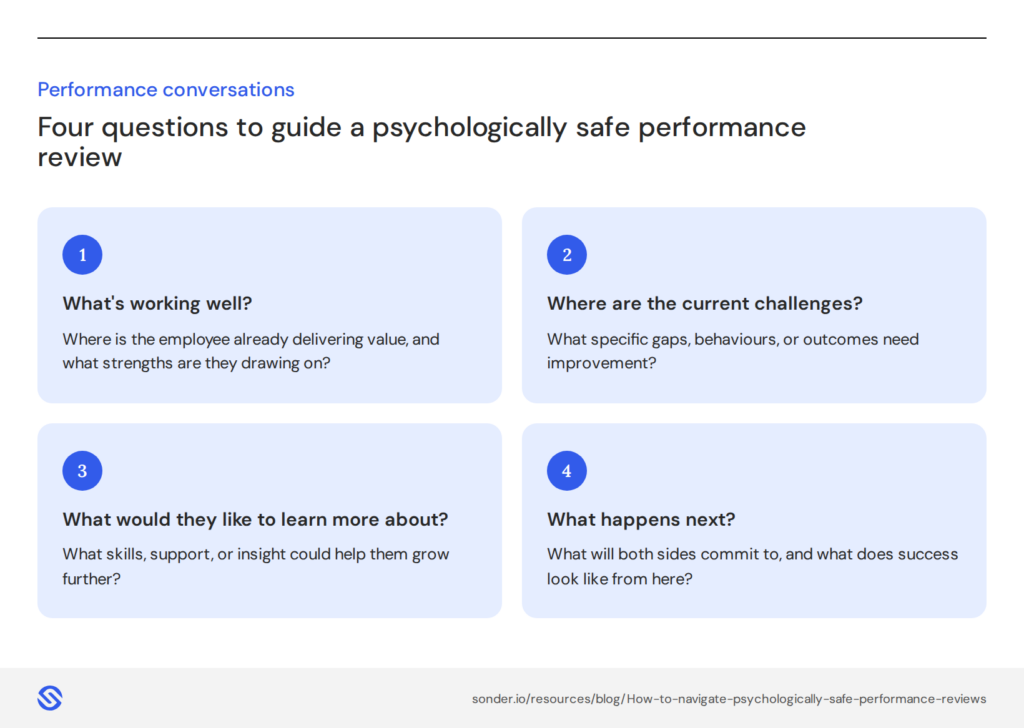
One practical structure leaders can use is:
| 1. What’s working well? People are quick to second-guess themselves or be blind to the value they bring, so it’s important to acknowledge the positives. Where is the employee already delivering value? Which strengths are they naturally drawing on? What positive impact are they having on the team? | 2. Where are the current challenges? While you might have an idea of the challenges, the reality can look different for the employee. Getting into specifics helps surface that gap and leads to more practical, effective solutions. What specific gaps, behaviours, or outcomes need improvement? Keep feedback timely, observable, and connected to expectations rather than personality or assumptions. |
| 3. What would they like to learn more about? Learning can be a positive driver for both the employee and the organisation. What patterns are emerging? What skills, support, or insight could help them improve or grow further? This helps keep the conversation focused on development, not just critique, and creates space for the employee to have a say in where they want to go next. | 4. What happens next? What actions will both sides commit to moving forward? What support will be provided? What does success realistically look like from here? This approach helps create a more collaborative discussion rather than one that feels entirely one-sided. It also ensures clarity on both sides. |
Reminder: language also shapes how feedback lands emotionally.
- Compare: “You’re failing to meet expectations.”
- With: “There are some areas where we need to work together on consistency and support so you can succeed in this role.”
Both communicate concern clearly, but one is far more likely to keep the employee engaged in the conversation rather than emotionally shutting down.
Managers are under pressure too
What often gets overlooked in discussions around psychologically safe leadership is the pressure sitting on managers themselves.
Many leaders are trying to support team wellbeing while simultaneously managing operational demands, workforce shortages, restructures, conflict, budget pressure, and their own stress levels. People leaders should absolutely help foster psychological safety within their teams, but they should not be expected to function as counsellors, psychologists, or crisis responders. Authentic leadership involves recognising the boundary between management and the necessity for specialist medical intervention.
Counsellor, Sonder
Organisations that navigate performance management well tend to recognise that psychologically safe workplaces require support systems around both employees and leaders.
That includes:
- Practical frameworks for difficult conversations
- Guidance around psychosocial hazards
- Escalation pathways for complex situations
- Manager training and support
- Access to expert advice when leaders are unsure how to proceed
- Wellbeing support employees can access privately and after hours
According to Sonder data, only 50% of managers agree their employer has provided sufficient support and training to support their team’s wellbeing; 40% of employees cited poor support from managers as affecting their performance.
Keep learning:
- Read: It’s never been harder to be a manager than right now. Our guide has insights and practical tips to empower people leaders, helping them to cultivate more productive, engaged workforces in 2025. Download it here: A manager’s guide to building more resilient teams
- Read: Want to learn how to navigate psychological safety in an age of AI? Download Sonder’s guide, packed with advice from a psychosocial expert and work futurist, designed to give leaders a head start in this high-stakes area of people management. Download now.
- Watch: In this masterclass, Sam Young — Clinical Psychologist, Co-Founder and Chief Health Officer of Humn — shares a practical, evidence-based toolkit to help managers understand their role as the primary on-the-ground control for psychosocial risk, and build the capabilities to lead safely and effectively. Watch it below.
Empower and protect your leaders with Sonder
Being a manager has never been harder. Particularly in workplaces where leaders are expected to balance performance, wellbeing, psychosocial risk, and people management simultaneously.
“Line managers are not mental health experts.”
Dr Jamie Phillips, Medical Director
Sonder helps managers in three ways:
- Redirecting struggling employees to trusted care: Managers aren’t trained therapists, and they shouldn’t have to act like one. With Sonder, they can refer a struggling employee to expert care with confidence, knowing the right support pathway will take it from there. This protects their time, their team, and ensures they’re fulfilling their duty of care.
- Prevents manager burnout: With all of the pressures placed on managers, they are particularly vulnerable to burnout and exhaustion. Sonder helps them stay well by offering 24/7 medical, mental health and safety support for them and their families. Because when managers struggle, it impacts the entire team.
- Resources to lead and support teams with confidence: Sonder’s in-app resources and learning programs help them lead teams with greater confidence and clarity. They can also request a 1:1 coaching session prior to a difficult conversation with a colleague, to help them prepare.
Want to see how proactive, data-driven safeguarding works in real-time? Book a demo with Sonder today to discover how our 24/7 evidence-based support model drives early intervention and protects the wellbeing of your evolving workforce.
FAQs
A performance review approached with enough preparation, clarity, empathy and structure that an employee leaves understanding what needs to improve without feeling blindsided, humiliated or shut out. It doesn’t mean avoiding accountability. Honest conversations still happen, just in a way that’s clear, fair and supportive.
Yes. Psychological safety isn’t about avoiding hard feedback. Businesses still need honest conversations when things aren’t working. The aim is to deliver that feedback clearly and kindly so people stay engaged rather than shutting down.
Reflect first: have expectations genuinely been clear, do you have timely and specific examples, is anything systemic contributing, has the person had the tools and training to succeed, and what outcome are you actually hoping for?
Open-ended ones that surface context, such as “Can you walk me through what’s been challenging recently?”, “What obstacles made this harder?”, “What support feels like it’s currently missing?” and “What’s working well?”