At a glance:
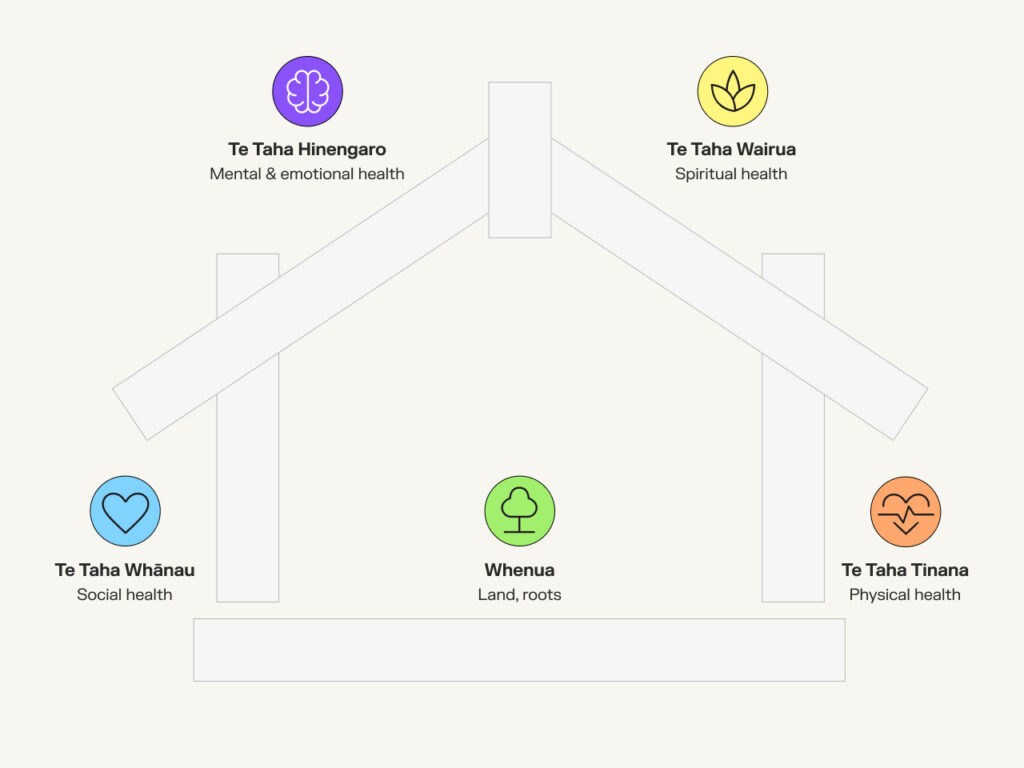
- Te Whare Tapa Whā sees wellbeing as four walls. Developed by Sir Mason Durie, this Māori model frames health across four dimensions: mental and emotional, spiritual, social and physical, all resting on a foundation of connection.
- A clear model of care helps leaders address causes, not just symptoms. Without a framework, wellbeing efforts tend to default to surface-level fixes that miss what’s really shaping someone’s experience.
- The strain is widespread. Sonder’s research found 77% of employees had symptoms of poor mental health in the past year, and 94% reported fatigue, yet most don’t name it or seek support.
- Sonder treats the whole person. Our model assesses each member’s needs and connects them to the right safety, medical or mental health support, because the four walls are connected.
Many leaders want to improve team wellbeing, but the harder question is how to make that support genuinely effective, for the person and the business.
This is where a lot of wellbeing efforts fall short. Without a clear framework, it’s easy to default to surface-level fixes. Addressing symptoms, rather than understanding what’s really shaping someone’s experience.
Models of care offer that framework. They help leaders step back and see the full picture, such as the conditions inside an organisation, and the key elements that shape how a person shows up every day.
One widely recognised framework that brings this thinking to life, and is used here at Sonder, is Te Whare Tapa Whā, a model of health and wellbeing from Aotearoa (New Zealand), developed by Sir Mason Durie.
What are the four pillars of Te Whare Tapa Whā?
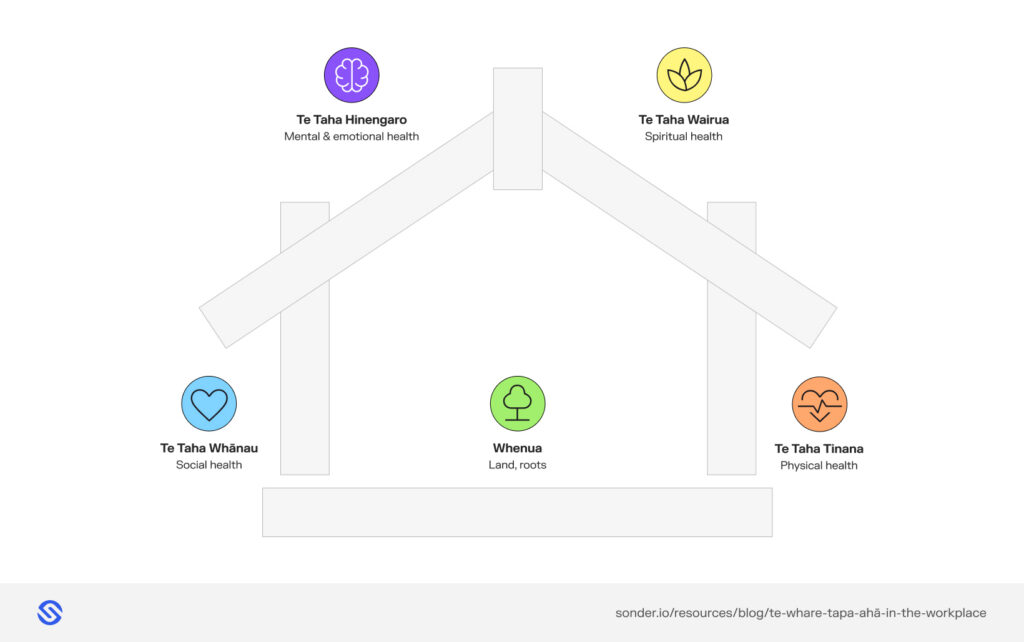
Te Whare Tapa Whā represents a meeting house — a wharenui — with four walls. Each wall or pillar (pou) is a dimension of wellbeing:
- Taha hinengaro (mental and emotional wellbeing)
- Taha wairua (spiritual wellbeing)
- Taha whānau (social wellbeing)
- Taha tinana (physical wellbeing)
And at the base, beneath it all is whenua: the land or foundation which grounds and supports the structure.
As NZ’s Ministry of Health describes, “If one of the 4 dimensions is missing or damaged in some way, a person or collective may become ‘unbalanced’ and subsequently unwell.”
This model gives leaders a more complete way to understand wellbeing at work. It moves us beyond siloed initiatives and toward something more integrated. It is a way of thinking about care that reflects how people actually experience their lives.
At Sonder, this thinking has been brought into practice through the work of Kimi Powell. It’s helped shape a philosophy of care that doesn’t try to separate people into neat categories, but recognises that everything is connected, and the importance of meeting people in that complexity.
The importance of Te Whare Tapa Whā in the workplace
Let’s take a closer look at what each pillar, or pou, looks like in the workplace.
1. Taha hinengaro — mental and emotional health
This pillar, or pou, speaks to how people think, feel, and make sense of their experiences internally and in how they connect with others.
At work, mental and emotional wellbeing is never shaped by a single factor. It’s layered. Organisational dynamics like workload, leadership, and clarity intersect with everything people are carrying outside of work from life pressures to relationships, and all sorts of uncertainty.
When this pillar is under strain, sometimes it’s easier to spot: burnout, anxiety, withdrawal, increased sick days. But just as often, it’s less obvious: low energy, presenteeism, a gradual drop in engagement that’s easy to miss.
Recent data reflects this tension: 77% of employees report symptoms of poor mental health, yet 78% don’t identify as having a mental health condition. Many people are still showing up, still performing, just not feeling okay, and not necessarily naming it that way.
That strain can build over time. Ongoing low-level stress. Unclear expectations. The sense of always being “on.” In some roles, it’s also inherent through repeated exposure to trauma in frontline work, or rising and unpredictable aggression in customer-facing environments.
For those in leadership, building in pathways for communication and mental health support can make a big difference, for example:
- Ensure clear, visible pathways to support are embedded (EAPs, mental health services)
- Train managers in empathetic leadership to notice subtle changes in behaviour
- Create regular, low-pressure check-ins that go beyond task updates
- Reduce avoidable stressors like unclear roles and shifting expectations
- Normalise conversations around mental health so people don’t have to carry it alone
There is no magical fence that keeps everything in your home life out this side of the fence and everything in your work life in this side of the fence.
Group Director, Safety, Health and Wellbeing, Woolworths Group
2. Taha wairua — spiritual health
This pou (pillar) speaks to a person’s sense of meaning, purpose and values, and the things that ground them. It’s also where motivation lives. What drives this person? What connects them to their work? And what kind of environment brings that to life?
When this pillar is supported, it becomes a source of stability. Something people can draw on through change, uncertainty, and growth, whether that’s happening inside or outside of work.
There’s a physical dimension here, too. Access to natural light, fresh air, and time outside can play a meaningful role in how grounded and connected people feel, with mounting evidence linking the natural environment to improved wellbeing.
For leaders, supporting this pillar means creating conditions where people can connect to what matters alongside delivering on what’s required. That might look like:
- Be clear and consistent in how organisational values are communicated and lived
- Create space for reflection, meditation, prayer, or reset where appropriate
- Support progression pathways that connect to what motivates someone
- Look for ways to align work with what already gives people a sense of purpose
- Consider how physical space (light, air, nature) can be integrated into work
3. Taha whānau — social health
This pou (pillar) speaks to our relationships, from the people around us at work and beyond. And the role these connections play in how we feel and function.
And as Sonder’s State of Health and Wellbeing Report reminds us: over a decade of scientific research confirms that belonging is a fundamental psychological resource. One that shapes how people engage with their work. And while many people feel supported in their broader communities, that sense of connection doesn’t always carry through into the workplace.
But it’s just as important, as a connected workforce performs better together.
83% of Australian workers perform better when they feel they belong and 62% would leave a job if they didn’t. 87% of NZ workers perform better with a sense of community.
Belonging isn’t built through surface-level gestures. Do co-workers feel safe around each other? Is there a sense of camaraderie? Have tensions been acknowledged or are they left to sit beneath the surface?
Left unaddressed, those dynamics can compound into cultural issues, reputational risk, and in some cases, legal outcomes.
For leaders, the focus shifts from one-off initiatives to the quality of connection across the organisation. That might look like:
- Build psychological safety through consistent, everyday behaviour
- Address harmful behaviour, tension, or exclusion early
- Invest in team dynamics and how people work together
- Recognise people in ways that feel personal and specific
Recognition is one of the simplest, most effective ways to improve someone’s experience: acknowledging not just what they do, but what matters to them.
4. Taha tinana — physical health
Physical health can feel like the most straightforward part of workplace wellbeing, and yet, it’s consistently under strain.
Fatigue is a clear signal. Across AUNZ, Sonder’s data shows that over the past 12 months, 94% of employees reported fatigue, 73% experienced physical symptoms impacting their work, and 15% felt fatigued daily.
This fatigue can show up in different ways. Sometimes it’s visible: heavy physical labour, long hours, poor equipment, unsafe lifting. Other times, it’s less obvious: a poorly designed workspace leading to chronic pain, or sustained stress taking a physical toll over time.
Because the body keeps score. When someone’s nervous system is constantly on alert — scanning, bracing, anticipating — that overload shows up physically, building a level of strain most workplaces underestimate.
Our response to psychological stress is pretty much the same response we had as cave people facing a lion.

NeuRA / Understand Your Brain
You see this in high-risk environments, but it’s not limited to them. From frontline roles exposed to aggression, to managers carrying unsustainable pressure without support that accumulates.
And beyond work, there’s more people are carrying. Private caregiving responsibilities, physical demands at home, the kind of load that doesn’t switch off at the end of the day.
Fatigue dramatically affects how people function. As it builds, so does the risk of mistakes, incidents, and harm, with very real implications for workplace safety.
For leaders, this means looking beyond the obvious and addressing the conditions that drive physical strain. That might look like:
- Design work and rosters to allow for proper rest and recovery between shifts
- Ensure equipment, environments, and safety practices are up to standard
- Encourage movement and breaks throughout the day where possible
- Support boundaries around switching off, and model this clearly
- Stay aware of the full load people may be carrying, not just what’s visible at work
A holistic approach to workplace wellbeing
Sonder’s holistic approach aims to treat the whole person. We assess each member’s needs to identify the most suitable pathway, whether that’s safety, medical, or mental health support. Our evidence-based model is not a booking service but rather a comprehensive first step with Care Specialists qualified in psychological first aid and emergency response.
Need to strengthen your team’s wellbeing? Chat with a member of the Sonder team today.
FAQ
A model of health and wellbeing from Aotearoa (New Zealand), developed by Sir Mason Durie. It pictures wellbeing as a wharenui, or meeting house, with four walls, each a dimension of health.
Taha hinengaro (mental and emotional wellbeing), taha wairua (spiritual wellbeing), taha whānau (social wellbeing) and taha tinana (physical wellbeing), all resting on a foundation of whenua, the land.
As New Zealand’s Ministry of Health explains, if one of the four dimensions is missing or damaged, a person or collective may become unbalanced and unwell.
It gives leaders a complete view of wellbeing, moving beyond siloed initiatives toward whole-person support, with each pillar mapping to practical actions from clear mental health pathways to rest and recovery in job design.