At a glance:
- Sonder’s Absenteeism Crisis Report reveals 39% of UK workers say their job negatively impacts their wellbeing, and 1 in 10 are at risk of leaving the workforce entirely because of it.
- 25% have taken a week or more off sick in the past year, and it doesn’t stop with them; colleagues absorb the strain, too.
- Frontline workers (healthcare, hospitality, and retail) are hit hardest, facing more stress and far higher rates of workplace aggression.
- Only 25% of workers have any employer wellbeing support, despite most saying real, human, fast access is exactly what they need.
Workplace stress and pressure are a part of normal working life. Long hours to hit a hard deadline and back-to-back meetings during busy periods can all be managed, as long as there is the right support and an end date in sight.
But Sonder’s latest report points to a crisis that’s beyond an occasional late night or stressful client call. 2 in 5 UK workers say their job is actively damaging their wellbeing, and for 1 in 10, it’s severe enough that they’re considering leaving the workforce altogether.
Catch up on part one of this series, where we cover the scale, cost, and factors driving the UK’s workplace wellbeing crisis. In part two, we dive into the report’s four headline findings.
Download Sonder’s Absenteeism Crisis Report to explore the complete findings, including industry-by-industry data on which sectors are most at risk.
Or dive into the highlights below.
Finding 1: 1 in 10 UK employees are at risk of leaving the workforce entirely in the next 12 months
The wellbeing crisis flagged in Sonder’s research isn’t coming, it’s already here, and having significant impacts on individuals and organisations across the UK.
More than three million UK workers are at risk of dropping out of the workforce entirely due to poor health and wellbeing.
An even larger group (22%) say they are likely to reduce their working hours over the next 12 months to protect their health and wellbeing. This means hours of lost output, lower productivity, and more pressure on coworkers left behind.
People are leaving work, or struggling to return to it, because their health or wellbeing has been allowed to deteriorate to the point where staying in a job is no longer possible.

Co-founder and CEO, Sonder
Finding 2: 23% of employees say colleague sickness frequently disrupts their work
One of the clearest impacts of this crisis is a rise in absenteeism. Sonder’s data reveal that a quarter of UK workers took more than a week off sick in the past year. Concerningly, the vast majority (87%) say their job has caused or worsened their ill health.
Even a single staff member’s absence has meaningful flow-on effects for entire teams, leading to:
- Increasingly unmanageable workloads: 43% of workers say they’ve ended up working longer hours to cover for an unwell colleague.
- Missed deadlines and a decline in output: 36% have seen deadlines and deliveries slip when a team member has been off.
- Operational impacts across industries: 38% of transport workers say colleague sickness leads to increased customer delays, while 36% of construction workers say it causes disruption to ongoing projects.
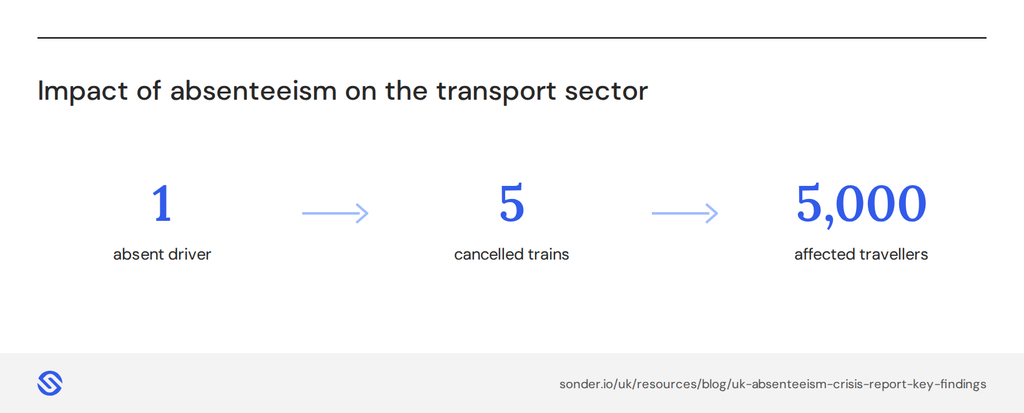
See how this played out for one of the UK’s busiest rail operators in our Southeastern Rail case study.
Finding 3: Frontline workers are 2x as likely to consider leaving the workforce
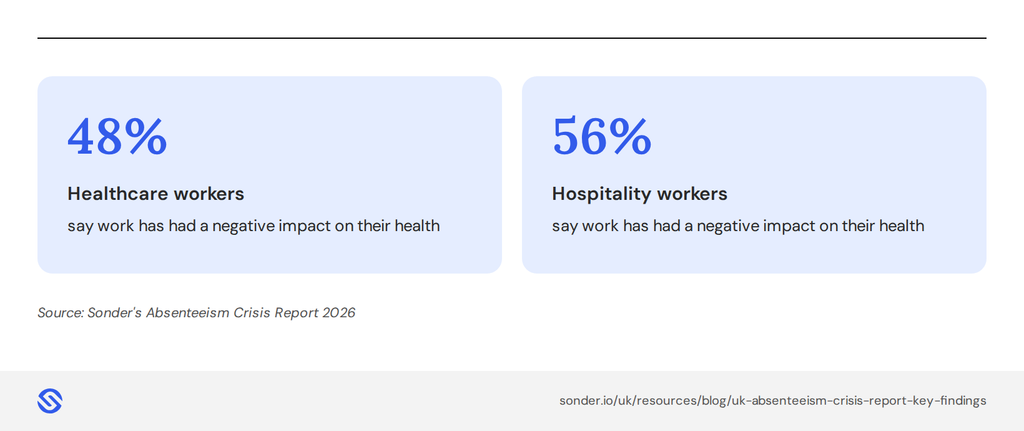
Not all industries are facing the same scale or severity of workplace wellbeing challenges. Frontline workers are shown to be hit the hardest, with 39% of healthcare workers and 44% of hospitality workers reporting poor overall health and wellbeing.
Significant portions of healthcare workers (48%) and hospitality workers (56%) say work has had a negative impact on their health.
Concerningly, frontline workers are nearly 2x more likely to consider leaving the workforce than their non-frontline counterparts.
The nature of frontline work means these employees face unique pressures, including:
- Heavy workloads, long hours, and poor staffing levels
- Higher exposure to customer aggression and traumatic incidents
- Disrupted sleep and safety concerns (particularly for shift workers)
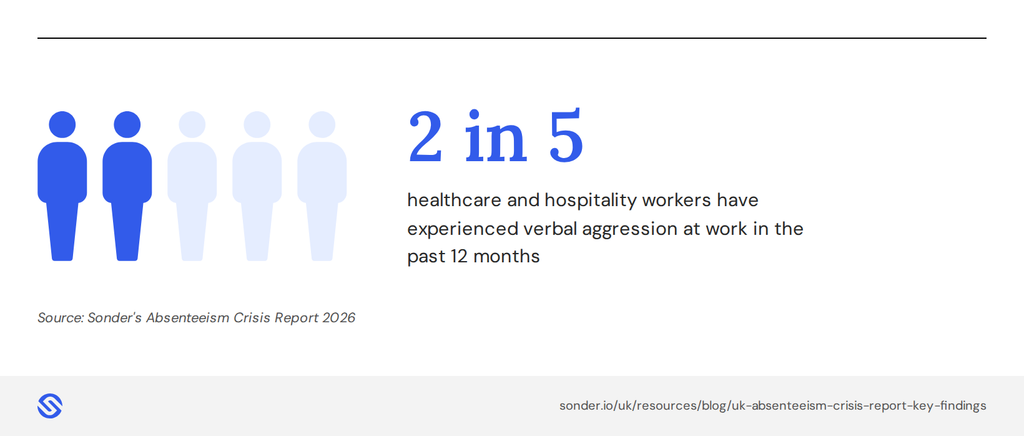
- 2 in 5 healthcare and hospitality workers have also experienced verbal aggression at work in the past 12 months.
Keep reading: Discover how Sonder UK supports frontline medical workers.
Finding 4: 58% of employees say a sick day could have been avoided with faster, more accessible support
The good news is that greater wellbeing support can play a key role in retaining workers.
Sonder’s research reveals that 6 in 10 workers could have avoided taking at least one sick day in the past 12 months if they had received faster or better support.
Unfortunately, 3 in 4 workers either had no employer health or wellbeing support or didn’t know what support their employer offers.
And employees are already telling companies what kind of support they want: real people, not automated systems (81%), immediate access (77%), and confidentiality (76%).
Closing this support gap is the most effective way for organisations to reduce sick leave, retain skilled staff, and prevent the cycle of burnout that drives people out of the workforce altogether.
Wellbeing isn’t a perk, it’s a performance system. The companies that understand this are the ones consistently outpacing their peers.”

Chief People Officer, Culture Amp
How Sonder supports organisations tackling absenteeism
The four key findings from Sonder’s Absenteeism Crisis Report reveal that absenteeism is rarely a standalone problem. By the time someone’s off sick, the most effective moment to intervene has already passed.
Sonder gives employees 24/7 access to real medical, mental health and safety support, so a stressed or unwell team member can speak to a qualified clinician the same day, rather than waiting weeks for a GP appointment or pushing through until it becomes a longer-term absence.
For frontline and shift workers who are most at risk, that immediacy is what turns a one-off sick day into early intervention rather than the start of something longer.
See how Sonder can help reduce absenteeism in your organisation. Book a demo.
Four findings, one clear opportunity for UK employers
These four findings are just a preview of what Sonder’s Absenteeism Crisis Report uncovers. The full report breaks down all eight sectors surveyed, giving UK employers a clearer picture of where the risk sits in their own workforce, and what closing the support gap could mean for retention and productivity.
Download Sonder’s Absenteeism Crisis Report to explore the complete findings, including industry-by-industry data on which sectors are most at risk.
FAQs
39% of UK workers, around 2 in 5, say their job is negatively impacting their wellbeing, according to Sonder’s Absenteeism Crisis Report.
More than three million UK workers, around 1 in 10, are at risk of leaving the workforce entirely because of poor health and wellbeing.
Frontline industries, including healthcare, hospitality and retail, report the highest rates of poor wellbeing and workplace aggression. Frontline workers are nearly twice as likely to consider leaving the workforce as their non-frontline counterparts.
Real people over automated systems (81%), immediate access (77%) and confidentiality (76%).