At a glance:
- Psychosocial risk is now a business cost: Mental health claims cost more than four times the typical claim ($67,000 vs $16,300) and keep people off work almost five times longer (35.7 vs 7.4 weeks), according to Safe Work Australia.
- Silence is the warning sign: Seven in 10 Australians wouldn’t tell their employer about a mental health condition, and only 7% say their workplace always provides a safe environment to ask for help, according to WayAhead research.
- Frontline teams and managers are stretched: 65% of ANZ workers have experienced customer aggression, according to Sonder’s Safety Gap Report, and nearly seven in 10 leaders (68.8%) report burnout.
- Acting early costs less than a claim: Employers who support workers before a claim is lodged see higher return-to-work rates (74.3% vs 62.2%), while people with psychological injuries are less likely to return to work than those with physical injuries (76.5% vs 90.2%), according to Safe Work Australia.
These Australian workplace wellbeing statistics for 2027 suggest that psychosocial risk now carries a real cost, many employees are struggling in silence and frontline workers and managers are under the most pressure.
If you’re planning your 2027 workplace wellbeing strategy, this guide brings together 60+ Australian statistics every leader needs to know, plus insights from Sonder’s experts and Sonder Summit 2026 speakers, to help you decide where to focus.
How we chose these statistics: This guide focuses on Australian data published between 2023 and 2026 by government bodies, peak bodies, researchers and Sonder. Each statistic names its source, with the full reference list at the end of the guide.
Top 10 Australian workplace wellbeing statistics for 2027
The most impactful statistics at a glance.
| Statistic | Source | Year |
| Mental health claims make up 12% of all serious workers’ compensation claims | Safe Work Australia | 2025 |
| Median compensation for a mental health claim is $67,000, more than four times the $16,300 median across all claims | Safe Work Australia | 2025 |
| Median time lost for mental health claims is 35.7 weeks, compared with 7.4 weeks across all claims | Safe Work Australia | 2025 |
| 38% of employers say psychosocial claims rose in the past year | Australian HR Institute | 2025 |
| Nine in 10 Australian workers report some level of work-related distress | Suicide Prevention Australia | 2026 |
| Seven in 10 Australians wouldn’t tell their employer about a mental health condition | WayAhead and Mental Health Association of NSW | 2023 |
| 65% of ANZ workers have experienced customer aggression at work | Sonder Safety Gap Report | 2025 |
| 68.8% of leaders report burnout, compared with 58.4% of team members | The Wellbeing Lab and AHRI | 2023 |
| Job demands are the most common psychosocial hazard in Sonder support cases (23%) | Sonder | 2026 |
| Cost is the top barrier to medical care for Australian employees (49%) | Sonder State of Employee Health and Wellbeing Report | 2026 |
How much are psychosocial hazards costing Australian employers?
Psychosocial hazards are costing Australian employers far more than typical workers’ compensation claims. A mental health claim costs more than four times as much as the typical claim. Plus, the median time lost is almost five times the median across all claims, according to Safe Work Australia.1
Just a few years ago, psychosocial risk was mostly a wellbeing conversation. Today, the conversation has shifted from “nice to have” to a legal liability and compliance obligation. Psychosocial hazards are showing up in workers’ compensation data, in courtrooms and in boardroom conversations.
Cost cannot be the only consideration when assessing risk. The question is no longer ‘can we afford it?’ it’s ‘can we afford not to?’

Co-Founder, Humn
Psychosocial hazard statistics in Australia: key stats at a glance
- Mental health claims now make up 12% of all serious workers’ compensation claims (Safe Work Australia, 2025).1
- Median time lost for mental health claims is 35.7 weeks (almost five times the 7.4-week median across all claims) (Safe Work Australia, 2025).1
- Median compensation for mental health claims is $67,000 (more than four times the $16,300 median across all claims) (Safe Work Australia, 2025).1
- Just one in five organisations (20%) report no psychosocial claims or complaints at all in the past two years (AHRI, 2025).2
- 38% of employers report psychosocial claims rose in the past year, with only 13% noting a decrease (AHRI, 2025).2
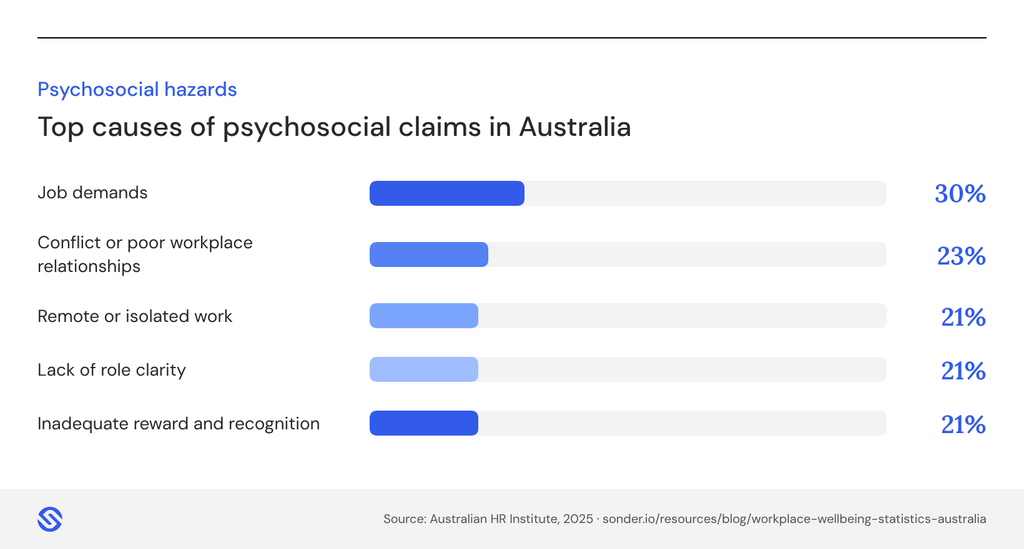
- The top causes of these claims include:
- Job demands (30%)
- Conflict or poor workplace relationships (23%)
- Remote or isolated work (21%)
- Lack of role clarity (21%)
- Inadequate reward and recognition (21%) (AHRI, 2025)2
- Employees impacted by psychological injuries have a much lower return-to-work rate (76.5%) than workers impacted by physical injuries (90.2%) (Safe Work Australia, 2025).3
- Job demands are also the most common hazard in Sonder’s own support data (23%), followed by conflict or poor workplace relationships (21%) and poor support (20%), based on 9,183 psychosocial hazards tagged in Sonder support cases between May 2025 and May 2026.18
Psychosocial safety has moved from a wellbeing conversation to core business risk. Mental health now sits alongside slips, trips, and falls.
Co-Founder, Humn
What can employers do to address psychosocial hazards?
- Get specific in your risk assessments: Regulators expect assessments tied to named hazards, not a generic line like “staff experience stress”. As Cilla Robinson of King & Wood Mallesons put it at Sonder Summit 2026, “Not all risk assessments are created equal.”
- Fix the work, not just the worker: While important in their own right, training and employee assistance programs (EAPs) sit at the bottom of the hierarchy of controls. Look at structural factors like job demands, role clarity and workload first, because they’re the top causes of claims. Sonder helps organisations mitigate potential harms caused by common workplace psychosocial hazards, discover more here.
- Look at the everyday processes: Restructures, performance reviews and meeting loads can all create risk. Cilla’s advice is simple: “If you want to look for psychosocial harm, look at people’s calendars.”
- Step in early: Employers who helped their workers manage an injury before a claim was lodged had a higher return-to-work rate (74.3%) than those who didn’t (62.2%), according to Safe Work Australia’s National Return to Work Survey.3 Early intervention, whether from a manager or an outside service, is cheaper and more effective than responding to a claim.
The conversation [around psychosocial safety] has shifted now to the way we work… how do we continue to design, with intent, and embed psychological and physical safety into the way we run our organisation?
Executive Manager, Safety and Wellbeing, IAG
Why don’t Australian employees feel safe to speak up?
Many Australian employees don’t feel safe to speak up because they fear judgement or unfair treatment from employers. WayAhead research shows nearly two in three (64%)5 would hide a mental health challenge for fear of discrimination, while Suicide Prevention Australia found only a few workplaces normalise support-seeking behaviour (with just 20% of workers saying it’s strongly encouraged)4. When concerns don’t lead to action, people stop speaking up.
Nine in 10 Australian workers report some level of work-related distress, according to Suicide Prevention Australia4, yet seven in 10 wouldn’t tell their employer about a mental health condition (WayAhead, 2023).5
Silence is one of the most reliable early warning signs of psychosocial risk.

Co-Founder and Chief Health Officer, Humn
Psychological safety statistics in Australia: key stats at a glance
- Nine in 10 Australian workers (90%) are experiencing some level of work-related distress; one in five (22%) report extreme levels of distress (Suicide Prevention Australia, 2026).4
- While many workplaces have mental health and/or wellbeing policies, only 20% of workers say support is strongly encouraged and normalised (Suicide Prevention Australia, 2026).4
- Seven in 10 Australians wouldn’t tell their employer about a mental health condition (WayAhead, 2023).5
- Only 7% say their workplace always provides a safe environment to ask for help (WayAhead, 2023).5
- 64% say they would hide a mental health challenge for fear of discrimination (WayAhead, 2023).5
- 38% reported having been treated unfairly at work after disclosing a mental health condition (WayAhead, 2023).5
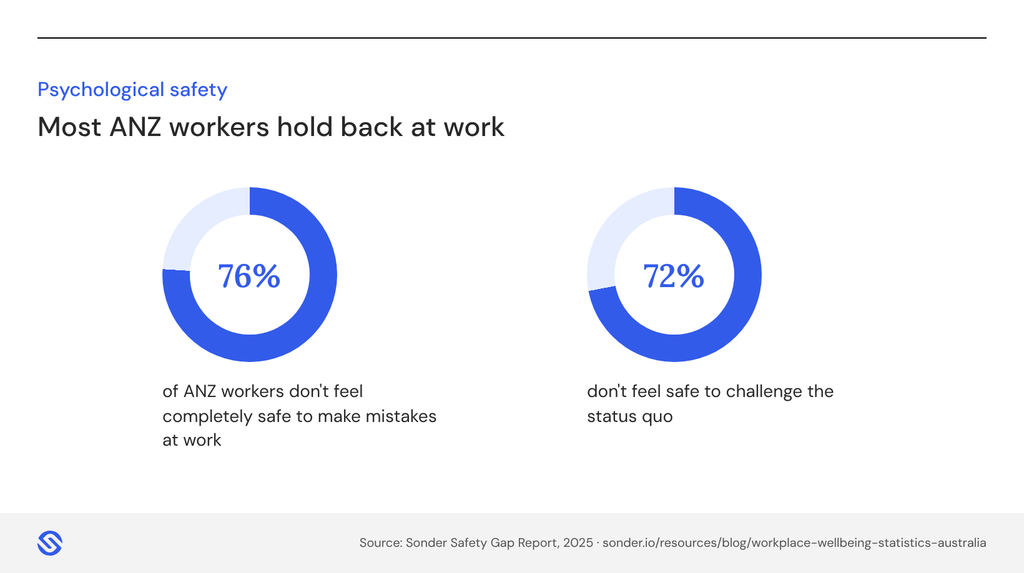
- 76% of ANZ workers don’t feel completely safe to make mistakes at work, while 72% say they don’t feel safe to challenge the status quo (Sonder Safety Gap Report, 2025).6
What can employers do to create psychologically safe workplaces?
If you’re not having difficult or slightly uncomfortable conversations, the odds are you don’t work in an environment where there’s psychological safety.

Director, The ZALT Group
- Ask, then show what you did with the answer: Consultation only builds trust if people can see it leads to meaningful change. At IAG, a work design project started by asking the people doing the job what wasn’t working. Managers gave employees the autonomy to suggest and make changes. The result was greater satisfaction, a better customer experience and higher productivity. As shared at Sonder Summit.
- Make uncomfortable conversations normal: Discomfort and danger aren’t the same thing. If your team never has a slightly awkward conversation, it’s probably because people are holding back. Empower leaders and teams to have difficult conversations with compassion, clarity and confidence.
- Give managers simple habits: Sam Young points to five manager behaviours that protect or erode safety: role clarity, procedural justice, psychological safety, support and availability, and emotional regulation. A good place to start is two questions in your one-on-ones: What are our top three priorities right now? and Do you know what success looks like in your role?
- Offer support that doesn’t run through a manager: If 64% of employees would hide a challenge for fear of discrimination, asking for help shouldn’t only happen through a manager. Confidential, expert support that employees can reach anytime helps them get help early, before a small issue becomes a claim.
What tends to erode psychological safety is that sense that nothing ever happens with the feedback provided to organisations.
If employees have been through the consultation period multiple times but feel like no one listens to what they say, it is going to be hard to build trust.

Chief Executive and Workplace Psychologist, APS
What is driving customer aggression against frontline workers?
In Australia, frontline workers face customer aggression and violence driven by everyday frustrations that are often out of their control, like self-checkouts that fail, understaffing and long waits.
Many workplaces also haven’t made their policies and support clear, so only about half of retail workers know their store has a customer aggression policy, according to Service and Creative Skills Australia.7
Customer aggression statistics in Australia: key stats at a glance
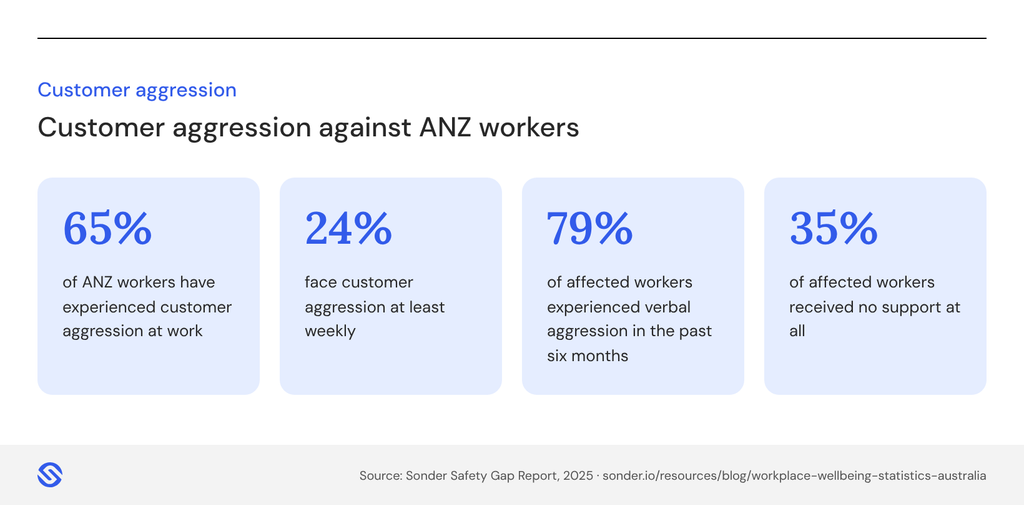
- 65% of ANZ workers have experienced customer aggression at work; 24% at least weekly (Sonder Safety Gap Report, 2025).6
- Verbal aggression is the most common form, experienced by 79% of affected workers in the past six months (Sonder Safety Gap Report, 2025).6
- 76% of Gen Z workers reported experiencing customer aggression, and 18% had taken time off in the past year because they felt unsafe at work (Sonder Safety Gap Report, 2025).⁶
- 35% of workers who experienced customer aggression received no support at all (Sonder Safety Gap Report, 2025).6
- 61% of employers say customer aggression makes it harder to attract new workers, while 74% say it contributes to retention challenges (SaCSA, 2026).7
- Only 47% of workers who received training feel sufficiently prepared, and just 22% rate post-incident employer support as adequate (SaCSA, 2026).7
- Harassment and bullying, work pressure and occupational violence together account for 73% of serious mental health claims in sales and service roles (Safe Work Australia, 2025).¹⁴
- One in four (25%) sales and service workers took at least one day off in the past month due to psychological distress (Safe Work Australia, 2025).¹⁴
What can employers do to protect frontline workers?
Most of what we’re seeing is lower-level behaviour: verbal aggression, hostility, intimidation. But because it’s repeated, the potential for harm is really high.

Partner & Principal Psychologist, APS
- Make “abuse is never okay” unmissable: A policy on paper isn’t enough. Tell people clearly what’s unacceptable, what they’re allowed to do and who has their back.
- Train for the moment, then follow through after it: Pair de-escalation training with clear escalation paths, so workers know when to step back and who to call. Then check in after an incident. For serious incidents, Sonder’s critical incident response is delivered by employed, trained Sonder Responders, and personal safety tools like Check on Me and Help Alerts give workers a way to get help in the moment.
- Ensure reporting is easy and worth it: People stop reporting when they don’t think anyone’s listening or don’t know what happens next. Tell teams you want to hear about incidents at every level of severity. Then track patterns across sites and shifts, not just formal reports, because repeated low-level behaviour is where harm builds up.
- Fix the triggers you control: Customers get frustrated by self-checkouts that fail, understaffing and long waits, and frontline teams cop it. Review the friction points in your systems and processes. Fixing them is often cheaper than handling the fallout.
- Look out for your youngest and newest workers: They’re the least likely to speak up. Geetika Chhibber, Registered Counsellor at Sonder, suggests structured check-ins instead of “open door” policies, non-managerial peer buddies and visibly acting on what staff raise.
At HOYTS, where many of the more than 3,100 team members across Australia and New Zealand are in their first job, 24/7 Sonder support paired with an employee value proposition built on belonging, purpose and growth helped deliver a 15% decrease in frontline staff turnover over three years and a 28% drop in first-year turnover. Read the HOYTS case study.
If someone at work is behaving aggressively or asks them to do something that feels unsafe, younger workers may be less confident to challenge it and less likely to know that what they’re being asked to tolerate isn’t normal.

Registered Clinical Psychologist, Sonder
How Woolworths is tackling frontline violence and aggression
When the pandemic ended, Woolworths Group expected customer aggression to ease. It didn’t. Sarah Faorlin, Head of Acts of Violence and Aggression, said the team also realised that their reporting culture wasn’t where it needed to be. Teams weren’t sure their reports were being heard, or what to do next.
Since then, Woolworths has built a multi-layered response. It includes tighter controls in higher-risk stores, safer store design, realistic training and support for workplace protection order legislation. The common thread is asking teams to report everything, at every level of severity. Learn more from this Sonder Summit 2026 session.
What pressures are making managers particularly vulnerable to burnout?
Managers are caught between rising leadership expectations and not enough training or support to meet them. Managers are expected to be coaches, compliance officers and mental health first responders all at once.
As a result, nearly seven in 10 leaders (68.8%) report burnout, compared with 58.4% of team members, according to The Wellbeing Lab and AHRI.8
We’ve created an unrealistic expectation of managers who are not superheroes. They are not industrial relations experts, they are not mental health experts, yet they are being asked to be the front line of psychosocial safety.

CEO, Beyond Blue
Manager burnout statistics in Australia: key stats at a glance
- Nearly seven in 10 leaders (68.8%) report burnout, compared to 58.4% of team members (The Wellbeing Lab and AHRI, 2023).8
- Half of all Australian managers experience high stress daily (Gallup, 2026).9
- One in two Australians have experienced burnout in the past year; one in three won’t tell their manager (Beyond Blue, 2025).10
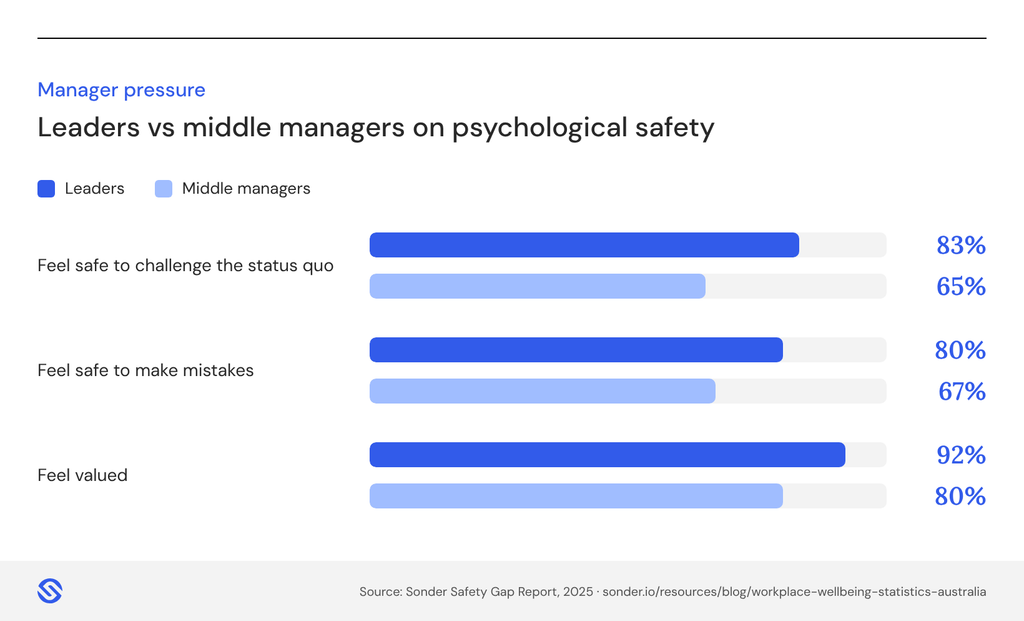
- Leaders vs middle managers on psychological safety (Sonder Safety Gap Report, 2025)6:
- Feel safe to challenge the status quo: 83% vs 65%
- Feel safe to make mistakes: 80% vs 67%
- Feel valued: 92% vs 80%
- 70% of team engagement can be attributed to the manager, meaning that when this layer of the workforce is properly engaged, it has a domino effect on the rest of the business (Gallup, 2026).9
- However, manager engagement has dropped 9% since 2022 (Gallup, 2026).9
What can employers do to prevent manager and employee burnout?
- Clearly define a manager’s role: Managers in lean teams can easily overextend themselves beyond their expertise, causing stress, tension and undue pressure. Lift literacy for both employees and managers to build a shared view on what’s reasonable.
- Give managers a clear handoff for when it’s beyond them: Managers shouldn’t be expected to act as counsellors or crisis responders. Set up escalation pathways and a trusted place to refer someone who needs expert care, so the manager isn’t carrying the load alone.
- Look after the manager, too: Leaders report higher rates of burnout than their teams, so they need their own support. That includes access to expert help for them and their families, and coaching before a difficult conversation. Discover how Sonder empowers leaders with clinical care and manager support solutions here.
How are grief, loss and the caring load showing up at work?
Grief and caring responsibilities are common experiences and can often look like performance problems at work: absenteeism, low motivation or even a sudden dip in productivity. Many employees struggle with loss and the caring load in silence, worried that sharing these pressures will affect their career progression and development opportunities.
Plus, as we heard in our masterclass with Good Mourning Co-Founder Sally Douglas, grief isn’t linear, and support often tapers off just when employees need it the most.

What looks like absenteeism, low motivation or a sudden drop in performance might actually be grief.

Co-Founder, Good Mourning
Grief and caring statistics in Australia: key stats at a glance
- Over 1.6 million Australians experience grief annually (Griefline, 2025).13
- Around one in 10 experience grief-related mental health challenges (Griefline, 2025).13
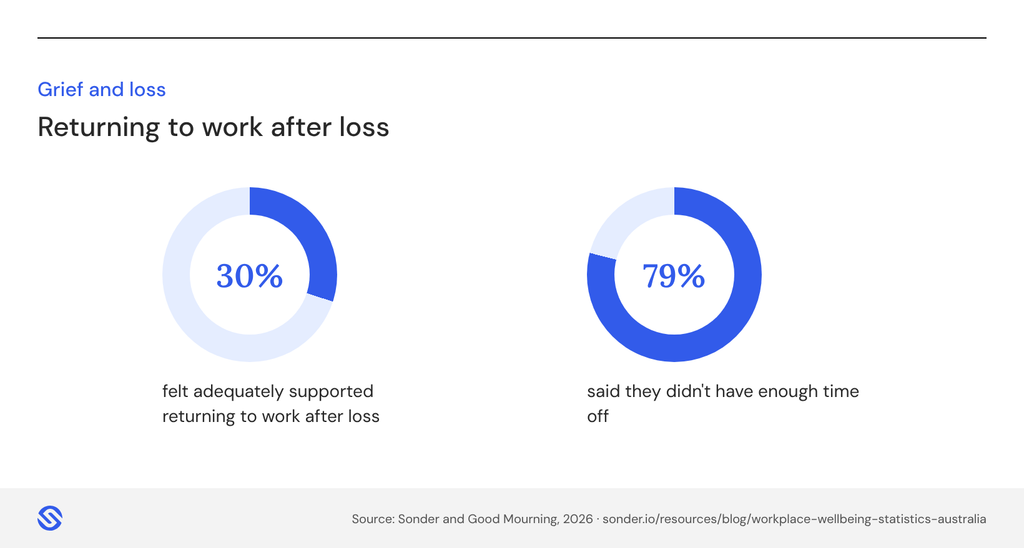
- Only 30% felt adequately supported returning to work after loss, and 79% said they didn’t have enough time off (Sonder and Good Mourning, 2026).12
- Caring responsibilities are the largest barrier to employment for 75% of women with children under 15 who want a job or more hours (ABS, 2023).11
- Caring for children is the top reason women are unavailable for work (44%), compared with 4% of men (ABS, 2023).¹¹
- 73% of sandwich-generation families work full-time while caring for children and ageing parents (The Violet Initiative, 2025).¹⁵
- By 2030, 2.2 million Australians will be providing eldercare, with $11.5 billion in lost productivity annually (The Violet Initiative, 2025).¹⁵
- 89% of carers fear for their mental wellbeing, and up to 50% experience significant psychological distress (The Violet Initiative, 2025).¹⁵
- Australia’s caregiving readiness score is just 23.1 out of 100 (The Violet Initiative, 2025).¹⁵
- People in family-friendly workplaces report being around 7% more likely to be satisfied with their work-life balance (Family Friendly Workplaces, 2025).16
What can employers do to support grieving and caring employees?
[Grief is] not a problem to be fixed and they’re not someone to be managed. Their grief is something to be held with compassion and care.
Co-Founder, Good Mourning
- Don’t mistake grief for disengagement: Grief affects thinking as well as feeling. Someone can look fine while struggling, including a colleague who throws themselves into deadlines. Check in before you performance-manage, and let them lead on what helps. Some people want space to talk, and others want something practical to do.
- Plan the return before they walk back in: Start with a human-to-human conversation before they return, and tell them there’s no pressure to be at full capacity and that you’re available if a day gets hard or heavy. Then build in a flexible first few weeks. For office roles, that could mean reduced hours, phased responsibilities and working from home on harder days. For frontline roles, it could mean an adjusted roster, shorter shifts or back-of-house tasks.
- Keep showing up after the first few weeks: Support tends to drop off around the two-to-six-month mark, which Sally calls the “grief support cliff”. Set reminders to check in at weeks 3, 6 and 10, and keep going past the point where it feels necessary. Small wording changes help too. Asking “how are you today?” instead of “how are you?” signals that you’re opening space for an honest answer.
- Point people to expert support: Grief and caring pressures often need more than a manager can offer. Sonder’s counsellors support employees with grief, loss, family and parenting issues, so people have somewhere to turn. For more advice, check out our masterclass recording with Sally Douglas.
Leaders set the tone. If boards and executives don’t talk about how they pull work and home together, we’re missing the hearts and minds of our people.

CEO, Parents at Work
What is the cost of not investing in employee health and wellbeing?
Inaction comes with a price tag, and not investing in your people’s health and wellbeing means paying for problems after they happen. Mental health claims are more complex, more expensive and more likely to lead to extended time off work.
That’s why more employers are moving wellbeing off the perks list and onto the risk register. The question is no longer “can we afford to invest?” but what it’s costing us not to.
The cost of inaction in Australia: key stats at a glance
- Cost is the top barrier to medical care for Australian employees (49%), compared with 29% across Australia, New Zealand and the UK (Sonder State of Employee Health and Wellbeing Report, 2026).17
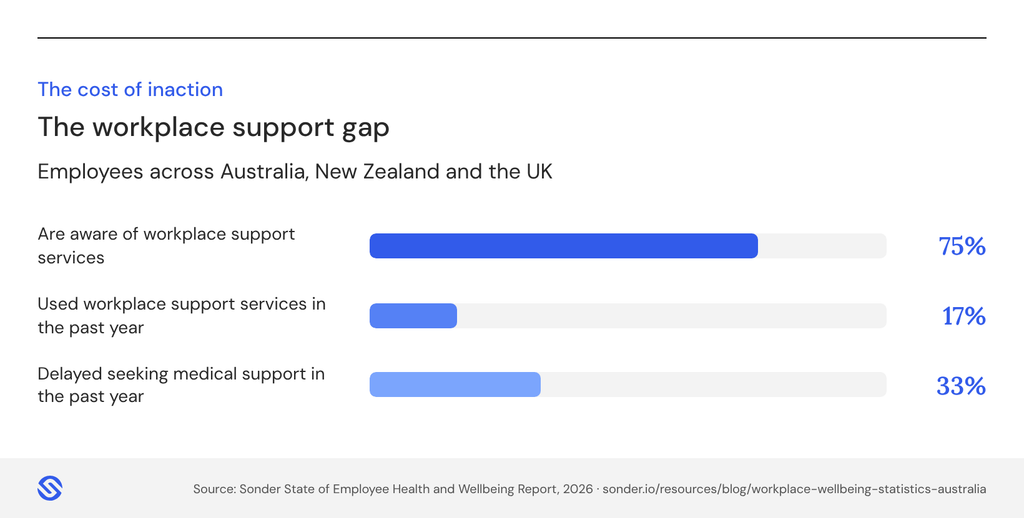
- 75% of employees across Australia, New Zealand and the UK are aware of workplace support services, but only 17% used them in the past year (Sonder State of Employee Health and Wellbeing Report, 2026).17
- One in three (33%) employees across Australia, New Zealand and the UK delayed seeking medical support in the past year (Sonder State of Employee Health and Wellbeing Report, 2026).17
- Typical EAP usage sits at just 3–5%, while Sonder averages 40% upake (Sonder State of Employee Health and Wellbeing Report, 2026).17
Mental ill health and suicide cost the economy $70 billion a year in presenteeism, absenteeism and lost productivity… If we invest in the mental health and wellbeing of our workforce, that to me is the obvious starting place.
CEO, Beyond Blue
Here’s how to shift the conversation from wellbeing perk to risk-reduction investment:
- Move wellbeing onto the risk register: Psychosocial hazards are now a legal duty, so treat them like any other business risk.
- Step in before a claim: Early support leads to better outcomes and return-to-work rate. Make early help easy by removing the barriers that keep people away, like cost, accessibility and the fear of telling a manager. Cost is the top barrier to medical care in Australia, cited by 49% of employees in Sonder’s State of Employee Health and Wellbeing Report, so support like Sonder’s GP access and medical triage helps people get care sooner.
- Track leading indicators, not just claims: Claims and absence tell you what has already gone wrong. Watch the early signals instead, like hazard themes, how comfortable people are disclosing to managers and how often people reach out for help. The Sonder Portal surfaces psychosocial hazard themes and trend data from support interactions, filterable by division and time period.
- Build the business case with your own numbers: Averages are a good starting point, but model the return using your headcount, wages, absence and turnover so finance can test it. Sonder’s ROI calculator can help you estimate the value of proactive workforce care.
- Back your managers: They’re the biggest control point, and burnout hits them hardest. Investing in their capability and support delivers the most visible and impactful ROI.
How TFE Hotels uses Sonder as a risk control
TFE Hotels wanted to give its directors, board and leadership group confidence that the business was doing all it practically could to keep its team safe and well. Sonder is now part of how it manages and reports on people risk.
Sonder is mapped in TFE Hotel’s enterprise risk management framework as a control measure against various risks in our risk profile and embedded into our serious incident response process too.
We also include Sonder’s anonymous utilisation data in our quarterly reporting for our audit risk committee and board, which enables us to have an ongoing conversation across the business around the various risks and identifying opportunities to do more.

Director of Safety and Wellbeing, TFE Hotels
Final thoughts: What to take into your 2027 planning
If you only take away five things from this guide, make them these:
- Psychosocial hazards: Fix the work, not just the worker. Risk assessments need to name specific hazards, and early support beats a claim.
- Speaking up: Silence is an early warning sign. People won’t raise concerns unless they see action.
- Customer aggression: Make “abuse is never okay” unmissable, train for the moment and follow through after it.
- Manager support: Leaders are stretched thin. Give them clear boundaries, practical skills and support of their own.
- Grief and caring: Make space for it. Plan the return to work and keep checking in well past the first few weeks.
The common thread across these workplace health and wellbeing stats? Start acting early, before small issues become claims, resignations or crises.
How Sonder can help
Sonder is a people risk intelligence and prevention platform, built on care that starts before crisis. It gives employees 24/7 access to trained care specialists across mental health, medical and safety support. It gives managers the guidance and tools to respond with confidence. And it gives leaders de-identified reporting, including psychosocial hazard themes surfaced through support interactions, so you can see what’s emerging and act earlier.
Book a demo to see how Sonder can support your people in 2027.
FAQs
Mental health claims cost Australian employers far more than other workers’ compensation claims. According to Safe Work Australia, the median compensation for a serious mental health claim is $67,000. That’s more than four times the $16,300 median across all claims. Median time lost is 35.7 weeks, compared with 7.4 weeks.
The most common causes of psychosocial claims in Australia are job demands (30%), conflict or poor workplace relationships (23%), remote or isolated work (21%), lack of role clarity (21%) and inadequate reward and recognition (21%), according to the Australian HR Institute. Sonder’s own support data also shows job demands as the most common hazard (23%).
Around two in three Australian and New Zealand workers (65%) have experienced customer aggression at work, according to Sonder’s Safety Gap Report 2025. Almost a quarter (24%) face it at least weekly. Verbal aggression is the most common form, and 35% of affected workers received no support at all.
Yes. Nearly seven in 10 Australian leaders (68.8%) report burnout, compared with 58.4% of team members, according to The Wellbeing Lab and AHRI’s 2023 Australian Workplace Report. Managers are often expected to act as coaches, compliance officers and mental health first responders without the training or support to do it.
Supporting workers before a claim leads to better outcomes. Safe Work Australia’s 2025 National Return to Work Survey found return-to-work rates were higher when employers helped workers manage an injury before a claim (74.3%) than when they didn’t (62.2%). Psychological injuries also have lower return-to-work rates than physical injuries.
Reference List
- SafeWork Australia, Key Work Health and Safety Statistics Australia, 2025
- Australian HR Institute’s Managing and Minimising Psychosocial Risks in Australian Workplaces Report, 2025
- SafeWork Australia’s National Return to Work Survey, 2025
- Suicide Prevention Australia Spotlight Report, 2026
- Wayahead and Mental Health Association of NSW Report, 2023
- Sonder Safety Gap Report, 2025
- Service and Creative Skills Australia (SaCSA) Customer Aggression in Retail Report, 2026
- The Wellbeing Lab x AHRI Australia Workplace Report, 2023
- Gallup’s State of the Global Workplace Report, Australia Data, 2026
- Beyond Blue’s Australians Facing Workplace Burnout Factsheet, 2025
- ABS Barriers and Incentives to Labour Force Participation, Australia, 2023
- Grief and loss at work, Sonder x Good Mourning Webinar, 2026
- Griefline, National Grief Survey, 2025
- SafeWork Australia, WHS Profile: Sales and service workers, 2025
- The Violet Initiative, CARE Index 2025 Caregiving and Ageing Readiness Evaluation
- Family Friendly Workplaces 2025 Impact Report
- Sonder State of Employee Health and Wellbeing Report, 2026
- Sonder, How to navigate psychological safety in an age of AI, 2026